
Introduction
Types of diodes ~ In the world of electronics, diodes are fundamental components that control the direction of current flow. Acting as a one-way gate, they allow electric current to pass in one direction while blocking it in the opposite direction. However, not all diodes are created equal—different types are designed for specific purposes, each with unique characteristics, voltage ratings, and applications.
In this article, we will explore the different types of diodes, their working principles, features, and common use cases.
1. Types of Diodes: Rectifier Diode
Purpose: Converting AC (alternating current) to DC (direct current).
Description:
The rectifier diode is one of the most common diode types. It is typically used in power supplies to convert AC voltage from the mains into a stable DC output. It works by conducting current during the positive half-cycle of the AC waveform and blocking it during the negative half-cycle.
Examples: 1N4001, 1N5408.
Applications:
- AC to DC conversion in power supplies
- Battery charging circuits
- Voltage protection circuits
Read this article for a more detailed explanation: Rectifier Diode: Working Principle, Types, and Applications
2. Types of Diodes: Zener Diode
Purpose: Voltage regulation.
Description:
Unlike standard diodes, Zener diodes are designed to allow current to flow in the reverse direction when the voltage exceeds a certain threshold—called the Zener voltage. This property makes them perfect for maintaining a constant voltage in a circuit.
Examples: BZX55 series.
Applications:
- Voltage regulation in power supplies
- Surge protection
- Reference voltage sources
Read this article for a more detailed explanation: Zener Diode: Principles, Applications, and Characteristics in Electronics
3. Types of Diodes: Light Emitting Diode (LED)
Purpose: Light generation.
Description:
An LED emits light when current passes through it in the forward direction. LEDs are available in various colors, brightness levels, and sizes, and they are far more energy-efficient compared to traditional incandescent bulbs.
Applications:
- Display indicators
- Automotive lighting
- Screen backlighting
- Decorative lighting
Read this article for a more detailed explanation: Light Emitting Diode (LED): Working Principle, Types, Applications, and Advantages
4. Types of Diodes: Photodiode
Purpose: Light detection.
Description:
A photodiode works in the opposite way to an LED—it generates a current when exposed to light. It is highly sensitive to different wavelengths, making it useful in optical systems.
Applications:
- Solar cells
- Light sensors
- Optical communication systems
Read this article for a more detailed explanation: Photodiode: Working Principle, Types, Applications, and Advantages in Electronics
5. Types of Diodes: Schottky Diode
Purpose: High-speed switching and low forward voltage drop.
Description:
Schottky diodes use a metal-semiconductor junction instead of a p-n junction, resulting in a lower forward voltage drop (typically 0.2–0.3V). They are known for their fast switching speeds and efficiency.
Examples: 1N5819.
Applications:
- High-frequency circuits
- Power rectifiers in low-voltage applications
- RF communication devices
Read this article for a more detailed explanation: Schottky Diode: Principles, Characteristics, and Applications in Modern Electronics
6. Types of Diodes: Tunnel Diode
Purpose: High-speed switching and microwave frequency applications.
Description:
Tunnel diodes exhibit a unique property called negative resistance, which allows them to operate at extremely high speeds. They are suitable for microwave applications and high-frequency oscillators.
Applications:
- High-frequency oscillators
- Microwave circuits
- Fast switching systems
Read this article for a more detailed explanation: Tunnel Diode: Working Principle, Applications, and Advantages in Electronics
7. Types of Diodes: Varactor Diode (Varicap)
Purpose: Voltage-controlled capacitance.
Description:
A varactor diode acts as a variable capacitor when reverse-biased. Its capacitance changes according to the applied voltage, making it ideal for tuning circuits.
Applications:
- RF tuning circuits
- Frequency modulation systems
- Voltage-controlled oscillators
Read this article for a more detailed explanation: Understanding Varactor Diodes: Working Principle, Characteristics, and Applications
8. Types of Diodes: Laser Diode
Purpose: Coherent light emission for data transmission and optical storage.
Description:
Laser diodes produce highly focused and coherent light beams. They are widely used in communication and data storage due to their precision and high energy concentration.
Applications:
- Optical fiber communication
- Laser pointers
- CD/DVD/Blu-ray players
Read this article for a more detailed explanation: Laser Diode: Working Principle, Applications, and Advantages
9. Types of Diode: PIN Diode
Purpose: RF switching and photodetection.
Description:
The PIN diode has a wide intrinsic layer between the p-type and n-type regions, which allows it to handle high-frequency signals efficiently.
Applications:
- RF switches
- Microwave attenuators
- Photodetectors
Read this article for a more detailed explanation: Understanding PIN Diode: Structure, Working Principle, and Applications
10. Types of Diodes: Avalanche Diode
Purpose: Overvoltage protection.
Description:
Avalanche diodes are designed to conduct heavily during reverse breakdown without damage, making them ideal for absorbing high-voltage transients.
Applications:
- Surge protection
- High-voltage switching
Read this article for a more detailed explanation: Avalanche Diode: Working Principle, Applications, and Benefits in Modern Electronics
11. Types of Diode: Gunn Diode
Purpose: Microwave generation.
Description:
Although not a true p-n junction diode, Gunn diodes generate microwaves through the Gunn effect. They are used in radar and high-frequency oscillators.
Applications:
- Police radar speed guns
- Microwave transmitters
Read this article for a more detailed explanation: Gunn Diode: Working Principle, Applications, and Advantages in Modern Electronics
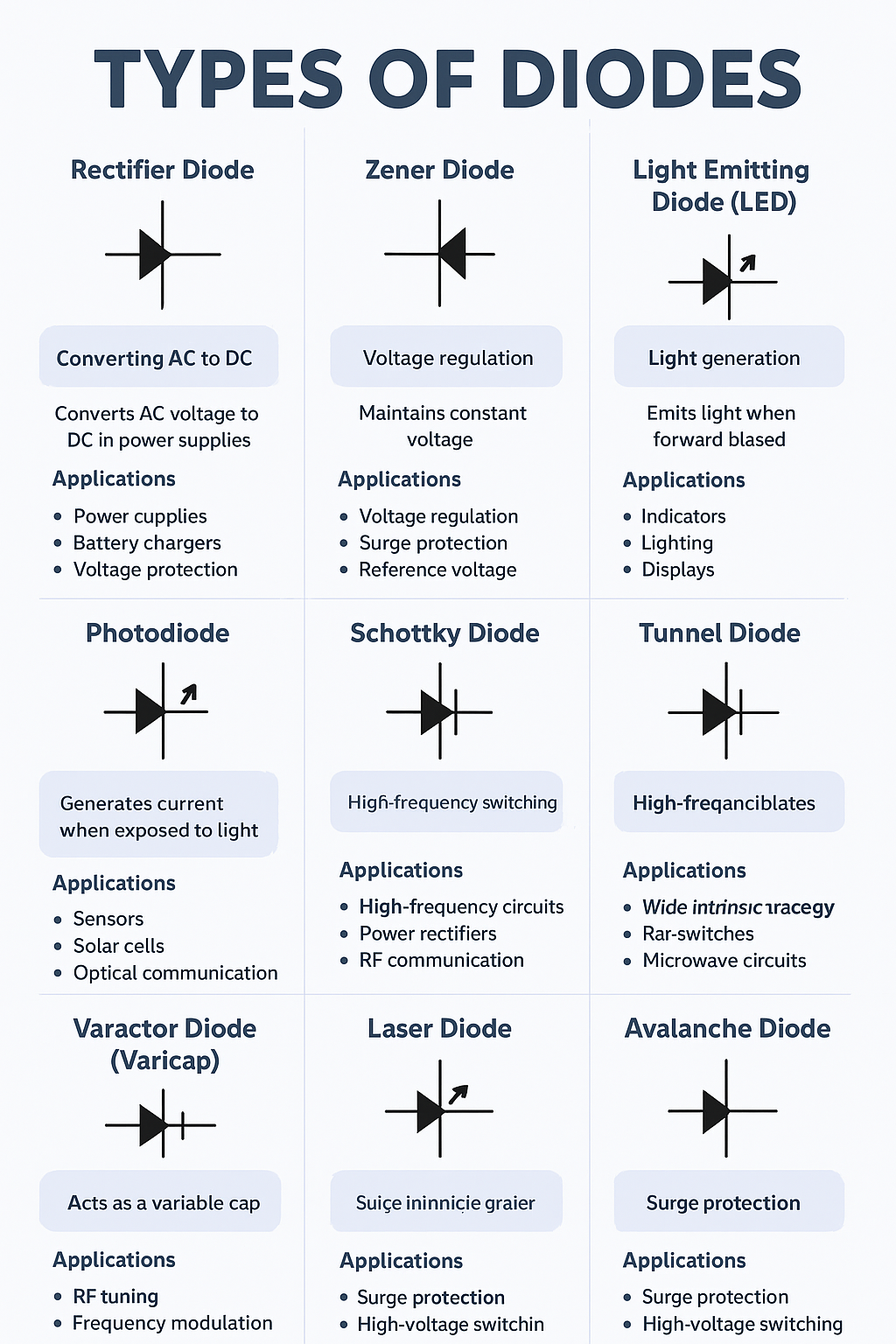
Comparison Table Types of Diode
| Diode Type | Main Function | Common Applications | Special Features |
|---|---|---|---|
| Rectifier Diode | AC to DC conversion | Power supplies, chargers | High current capacity |
| Zener Diode | Voltage regulation | Power regulation, surge protection | Fixed reverse breakdown voltage |
| LED | Light emission | Indicators, displays, lighting | Energy-efficient, multiple colors |
| Photodiode | Light detection | Sensors, solar cells | High sensitivity |
| Schottky Diode | High-speed switching | RF circuits, low-voltage rectifiers | Low forward voltage drop |
| Tunnel Diode | High-frequency switching | Microwave oscillators | Negative resistance property |
| Varactor Diode | Variable capacitance | RF tuning, oscillators | Voltage-dependent capacitance |
| Laser Diode | Coherent light source | Communication, optical storage | High precision beam |
| PIN Diode | RF switching | Microwave circuits, photodetectors | Wide intrinsic region |
| Avalanche Diode | Overvoltage protection | Surge absorbers | Designed for reverse breakdown |
| Gunn Diode | Microwave generation | Radar, transmitters | Uses Gunn effect |
Conclusion of Types of Diode
Diodes may seem like simple components, but their different types serve specialized functions in modern electronics. From regulating voltage and converting current to emitting light and detecting signals, diodes are essential in almost every electronic device we use today.
Understanding the types of diodes and their applications will help you choose the right one for your circuit design, ensuring efficiency, reliability, and performance.