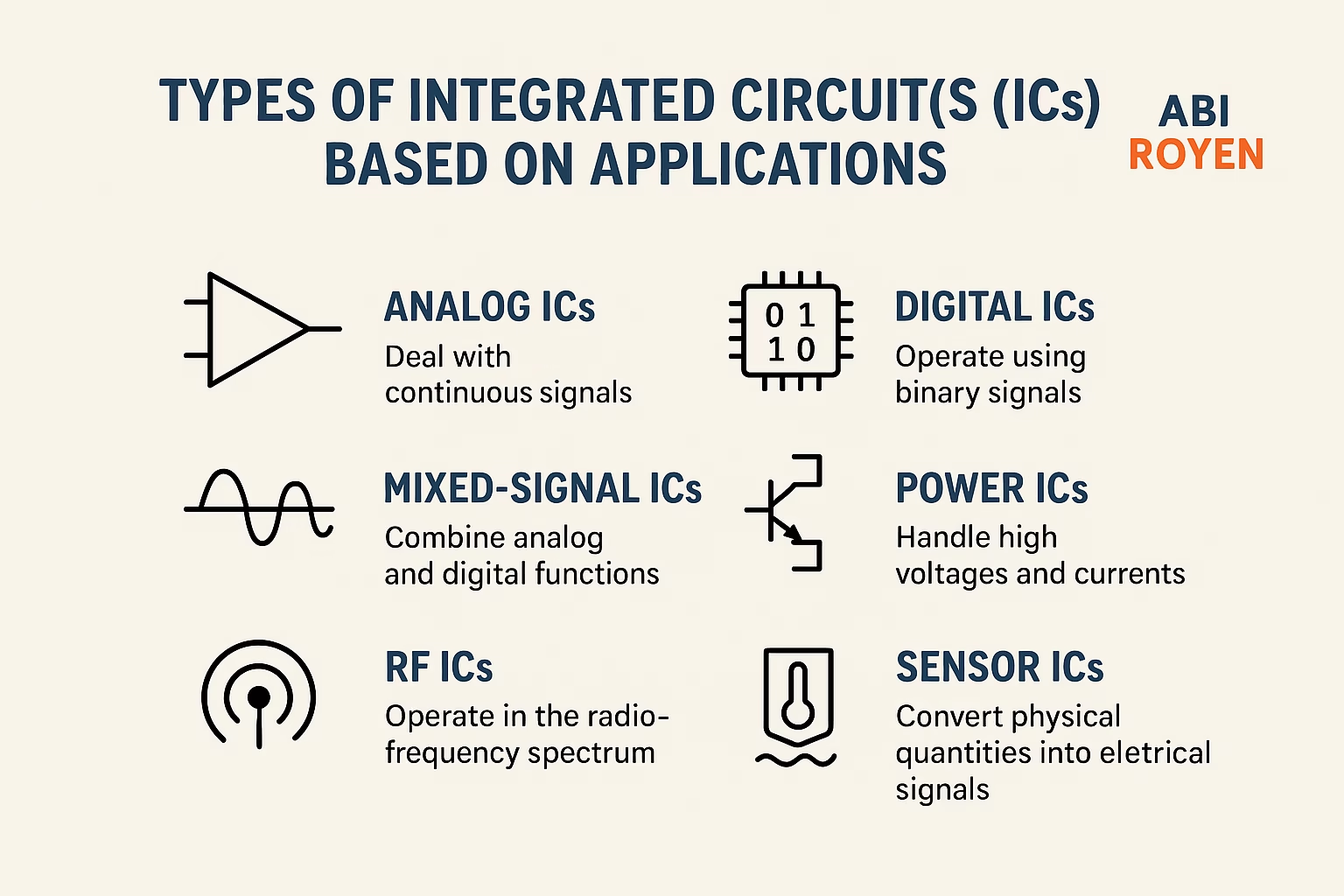
Types of analog ICs ~ In the world of electronics, integrated circuits (ICs) have revolutionized how we design and build systems. While digital ICs get much of the spotlight due to their presence in computing and communication, analog ICs are equally essential. They handle continuous signals and perform crucial functions like amplification, filtering, and regulation.
This article will explore the types of analog ICs, their functions, and how they are used in real-world applications.
What Are Analog ICs?
Analog integrated circuits process continuous signals. Unlike digital ICs that work with binary data (0s and 1s), analog ICs handle real-world signals such as sound, temperature, and light intensity.
Analog ICs can be standalone components or integrated with digital circuits to form mixed-signal ICs. They are commonly found in audio systems, power supplies, sensors, and communication devices.
Main Types of Analog ICs
Let’s look at the primary types of analog ICs and their specific functions.
1. Operational Amplifiers (Op-Amps)
Function: Amplification of weak signals
Overview:
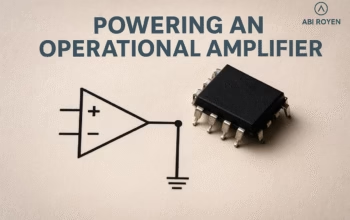
Operational amplifiers are the backbone of analog signal processing. These versatile ICs amplify voltage differences and are used in a wide variety of analog applications.
Applications:
- Signal amplification
- Active filters
- Oscillators
- Voltage followers (buffers)
- Analog computation
Popular Models:
- LM741
- TL081
- LM358
2. Types of analog ICs: Voltage Regulators
Function: Maintain constant output voltage
Overview:
Voltage regulators provide a stable voltage output regardless of changes in input voltage or load conditions. They are crucial in power management circuits.
Types:
- Linear regulators (e.g., 7805, 7812)
- Switching regulators (e.g., buck, boost, buck-boost converters)
Applications:
- Power supplies
- Battery chargers
- Embedded systems
3. Types of analog ICs: Comparators
Function: Compare two voltage levels
Overview:
Comparators compare two input voltages and output a signal indicating which is higher. Though similar in design to op-amps, comparators are optimized for high-speed switching.
Applications:
- Zero-crossing detectors
- Pulse-width modulation
- Level shifters
- Over-voltage protection
Example ICs:
- LM339
- LM393
4. Analog Multipliers
Function: Multiply two analog input signals
Overview:
Analog multipliers output the product of two input voltages. They are used in signal processing where analog computations are required.
Applications:
- Modulation/demodulation (AM, FM)
- Audio mixing
- Power measurement
- RMS-to-DC conversion
Example ICs:
- AD633
- MC1495
5. Phase-Locked Loops (PLLs)
Function: Synchronize output signal with a reference signal
Overview:
PLLs are control systems that generate a signal whose phase is aligned with the phase of an input signal. Analog PLLs use voltage-controlled oscillators (VCOs) and phase detectors.
Applications:
- Frequency synthesis
- Demodulation
- Clock recovery in digital systems
Example ICs:
- CD4046
- LM565
6. Sample and Hold Circuits
Function: Capture and maintain an analog voltage level
Overview:
Sample and hold ICs temporarily “freeze” an analog voltage for processing, particularly useful in analog-to-digital conversion.
Applications:
- Data acquisition systems
- ADC interfacing
- Oscilloscopes
Example ICs:
- LF398
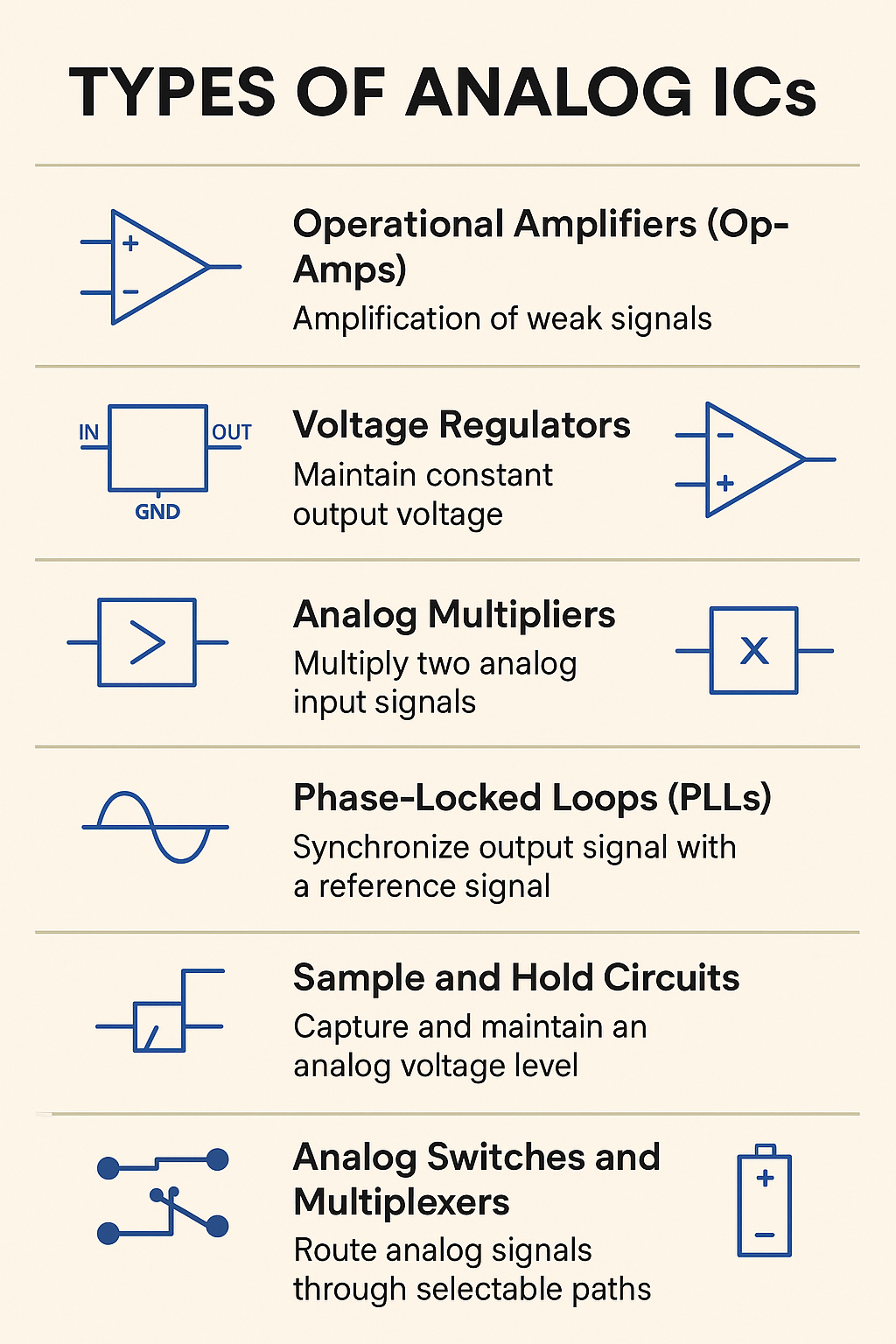
7. Analog Switches and Multiplexers
Function: Route analog signals through selectable paths
Overview:
Analog switches and multiplexers allow multiple analog inputs to share a single path, minimizing wiring and complexity.
Applications:
- Signal routing
- Audio source selection
- Data acquisition
Example ICs:
- CD4051 (8:1 MUX)
- CD4066 (bilateral switch)
8. Types of analog ICs: Voltage References
Function: Provide a precise reference voltage
Overview:
Voltage reference ICs deliver a constant voltage under varying conditions and are crucial in precision applications like ADCs and DACs.
Applications:
- Calibration systems
- Precision voltage monitoring
- Sensor interfaces
Example ICs:
- LM4040
- TL431
Why Analog ICs Still Matter
Even in today’s digital-first world, analog ICs remain critical. Every real-world input—temperature, sound, light—is inherently analog. Analog ICs handle these inputs before they are digitized.
From smartphones to industrial machines, analog ICs help ensure stable operation, accurate measurements, and efficient power usage.
Conclusion of Types of analog ICs
Analog ICs form the foundation of modern electronic systems. By understanding the types of analog ICs, designers and engineers can select the right component for every function—from amplifying a tiny microphone signal to regulating voltage in a sensitive microcontroller.
When designing electronics, always consider the performance, power consumption, and noise characteristics of analog ICs. As technology advances, analog ICs continue to evolve, playing a critical role in analog-digital integration and IoT devices.
Posted by: Abi Royen
Category: Electronics > Analog Circuits
Keywords: Types of Analog ICs, Analog IC Applications, Op-Amps, Voltage Regulators, Analog Electronics