Types ICs Based Applications ~ Integrated Circuits (ICs) are the backbone of modern electronics, powering everything from smartphones and computers to industrial automation systems and medical devices. Since their invention, ICs have revolutionized the electronics industry by combining multiple electronic components into a single, compact semiconductor chip.
One of the most effective ways to understand ICs is by categorizing them based on their applications. This classification provides a clear insight into how these tiny but powerful devices serve specific functions in different domains. In this article, we will explore the types of ICs based on applications, their working principles, advantages, and real-world examples.
1. Types ICs Based Applications: Analog Integrated Circuits
Definition and Function
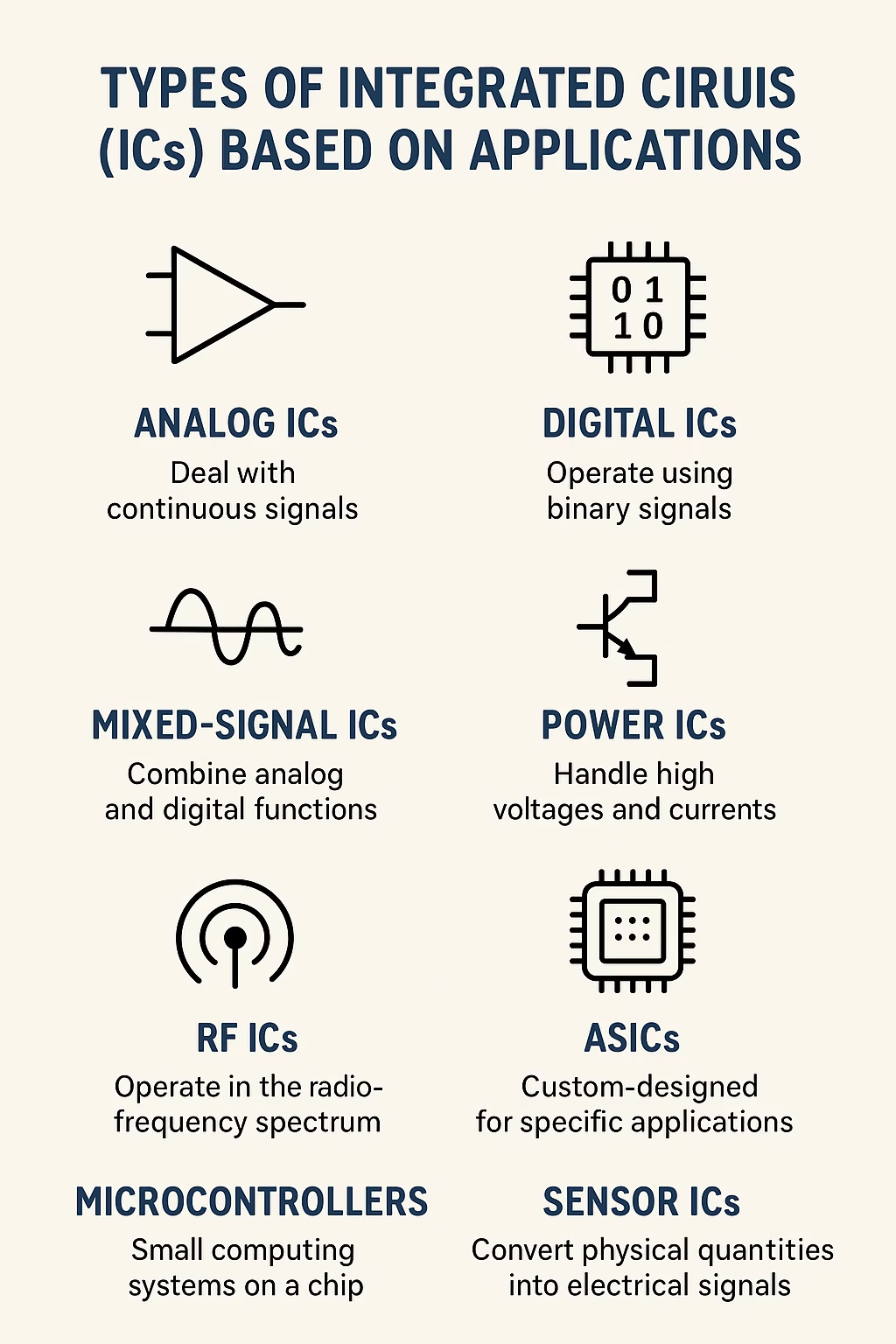
Analog ICs deal with continuous signals rather than discrete ones. They are designed to amplify, filter, or manipulate analog signals, which are typically real-world signals such as sound, temperature, or light.
Common Types of Analog ICs
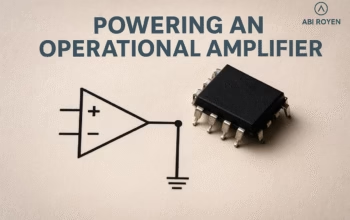
- Operational Amplifiers (Op-Amps): Used for signal amplification, filtering, and mathematical operations.
- Voltage Regulators: Maintain a constant output voltage regardless of input variations.
- Analog Comparators: Compare two analog voltages and output a digital signal based on the comparison.
Applications of Analog ICs
- Audio amplifiers in sound systems
- Sensor signal conditioning in IoT devices
- Power supply circuits in computers and electronics
- Medical devices for signal monitoring (e.g., ECG machines)
2. Types ICs Based Applications: Digital Integrated Circuits
Definition and Function
Digital ICs operate using binary signals (0s and 1s). They form the basis of computing and logic-based applications.
Common Types of Digital ICs
- Logic Gates (AND, OR, NOT, XOR): The building blocks of digital circuits.
- Microprocessors: Central Processing Units (CPUs) that perform calculations and control tasks.
- Memory ICs: Store data in volatile (RAM) or non-volatile (ROM, Flash) formats.
- Timers and Counters: Essential for timing and counting applications.
Applications of Digital ICs
- Computers and smartphones
- Digital watches and calculators
- Industrial automation and robotics
- Communication systems and networking hardware
3. Types ICs Based Applications: Mixed-Signal Integrated Circuits
Definition and Function
Mixed-signal ICs combine both analog and digital functions on a single chip. They bridge the gap between real-world analog signals and digital processing systems.
Examples of Mixed-Signal ICs
- Analog-to-Digital Converters (ADCs): Convert real-world analog signals into digital data.
- Digital-to-Analog Converters (DACs): Convert digital signals into analog outputs.
- Phase-Locked Loops (PLLs): Used in communication systems for synchronization.
Applications of Mixed-Signal ICs
- Smartphones (camera modules, audio processing)
- Automotive electronics (engine control, infotainment systems)
- Wireless communication devices
- Consumer electronics (smart TVs, gaming consoles)
4. Types ICs Based Applications: Power Integrated Circuits
Definition and Function
Power ICs are designed to handle high voltages and currents. They play a crucial role in managing power efficiently in modern electronic systems.
Examples of Power ICs
- Power Management ICs (PMICs): Regulate and distribute power in mobile devices.
- Motor Driver ICs: Control motors in robotics and industrial machines.
- Switching Regulators: Improve efficiency in power conversion.
Applications of Power ICs
- Battery management in smartphones and laptops
- Power supplies for industrial equipment
- Electric vehicles and renewable energy systems
- LED lighting and display systems
5. Types ICs Based Applications: Radio-Frequency (RF) Integrated Circuits
Definition and Function
RF ICs are used in circuits that operate in the radio-frequency spectrum. They handle wireless communication and signal transmission.
Examples of RF ICs
- RF Amplifiers
- RF Mixers
- Oscillators
Applications of RF ICs
- Smartphones (Wi-Fi, Bluetooth, 5G modules)
- Satellite communication systems
- GPS navigation devices
- Wireless IoT devices
6. Application-Specific Integrated Circuits (ASICs)
Definition and Function
ASICs are custom-designed ICs created for a specific application rather than general-purpose use. They offer optimized performance for targeted tasks.
Applications of ASICs
- Cryptocurrency mining (Bitcoin ASIC miners)
- High-performance networking hardware
- Artificial Intelligence (AI) accelerators
- Automotive safety systems (airbag deployment ICs)
7. Microcontrollers (MCUs)
Definition and Function
Microcontrollers are small computing systems on a chip that integrate a processor, memory, and input/output peripherals. They are widely used for embedded applications.
Applications of Microcontrollers
- Home automation systems (smart thermostats, security systems)
- Industrial control systems
- Automotive control (engine management, ABS)
- Consumer electronics (microwaves, washing machines)
8. Sensor Integrated Circuits
Definition and Function
Sensor ICs convert physical quantities (like temperature, pressure, or light) into electrical signals for measurement and processing.
Applications of Sensor ICs
- Smartphones (accelerometers, gyroscopes)
- Medical monitoring devices
- Environmental sensing systems (air quality monitors)
- Automotive applications (tire pressure monitoring)
Advantages of Using Types ICs Based Applications
- Miniaturization: Multiple components integrated into one chip save space.
- Cost-Effectiveness: Mass production reduces manufacturing costs.
- High Performance: Optimized for specific applications.
- Reliability: Fewer connections mean lower chances of circuit failure.
- Energy Efficiency: Lower power consumption in modern ICs.
Future Trends in IC Applications
- Artificial Intelligence and Machine Learning ICs for real-time data processing.
- 5G and Beyond RF ICs for faster communication.
- Green Power ICs for renewable energy integration.
- Medical ICs for advanced diagnostics and wearable health monitoring.
Conclusion of Types ICs Based Applications
Integrated Circuits are the cornerstone of modern electronics, and understanding their classification based on applications helps in grasping their importance across industries. From analog signal processing to digital computing, from power management to AI-driven applications, ICs continue to evolve with technology.
By learning the types of ICs based on applications, engineers, students, and electronics enthusiasts can better design, implement, and innovate in the fast-growing world of electronics.