Transformers Losses and Efficiency ~ Transformers are one of the most crucial devices in electrical power systems. They are widely used to step up or step down voltage levels, ensuring efficient transmission and distribution of electricity. Despite their high reliability, transformers are not perfect. They experience energy losses during operation, which directly impact their overall efficiency.
Understanding transformer losses and efficiency is essential for engineers, technicians, and anyone working with electrical systems. This guide provides a detailed explanation of the types of transformer losses, how they are calculated, and the strategies used to improve efficiency.
1. Introduction to Transformer Losses
Transformers are designed to operate with minimal energy waste, yet no transformer is 100% efficient. Losses occur mainly due to resistance in windings, magnetic effects in the core, and leakage flux. These losses not only reduce efficiency but also generate unwanted heat, affecting the lifespan and performance of the transformer.
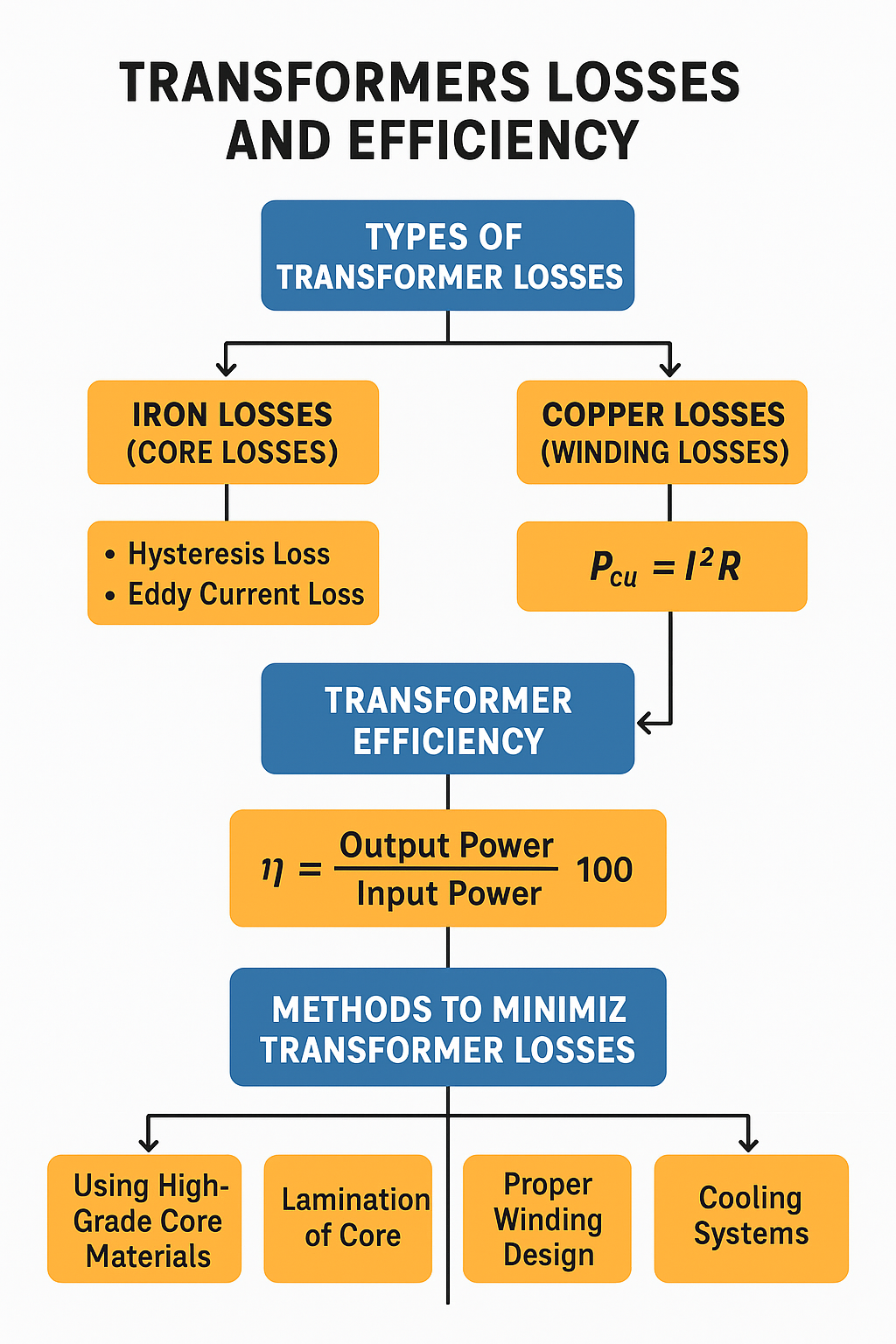
Broadly, transformer losses are categorized into two main types:
- Iron Losses (Core Losses)
- Copper Losses (Winding Losses)
In addition to these, minor losses such as stray losses and dielectric losses may also occur but are usually negligible compared to the two main types.
2. Types of Transformer Losses
2.1 Iron Losses (Core Losses)
Iron losses occur in the transformer core due to alternating magnetic flux. These losses are constant and independent of the load. They include:
- Hysteresis Loss:
Caused by repeated magnetization and demagnetization of the core. The amount of hysteresis loss depends on the material used in the core and the frequency of operation. Transformers use silicon steel laminations to minimize this loss. - Eddy Current Loss:
Alternating magnetic flux induces circulating currents in the core, which generate heat. To reduce eddy current loss, the transformer core is made of laminated sheets insulated from each other, thus reducing current paths.
Formula for Iron Losses:
Piron=Physteresis+Peddy
2.2 Copper Losses (Winding Losses)
Copper losses occur in the primary and secondary windings of the transformer due to electrical resistance. They are proportional to the square of the load current and are variable losses.
Pcu=12R
Where:
- I = current through the windings
- R = resistance of the winding
At no load, copper loss is nearly zero, but at full load, it can be significant.
2.3 Stray Losses
Stray losses result from leakage fluxes that induce eddy currents in transformer structural parts, such as the tank and clamping plates. Though small, they contribute to heating.
2.4 Dielectric Losses
Dielectric losses occur in transformer insulation material when it is subjected to alternating electric stress. These are usually negligible but can increase in aged or damaged insulation.
3. Transformer Efficiency
The efficiency of a transformer is defined as the ratio of output power to input power.
η=(Output Power/Input Power)×100
Since input power is equal to output power plus losses:
η=(Output Power/(Output Power + Losses))×100
Where losses = iron losses + copper losses + stray + dielectric losses.
3.1 Maximum Efficiency Condition
A transformer reaches maximum efficiency when copper losses are equal to iron losses.
Pcu=Piron
At this condition, the efficiency curve peaks, which is crucial for transformer design and operation.
3.2 All-Day Efficiency
For distribution transformers, the concept of all-day efficiency is more practical. Unlike power transformers that often work near full load, distribution transformers operate under variable loads.
All-day efficiency=(Energy Output in kWh/Energy Input in kWh)×100
This considers both load variations and constant core losses throughout the day.
4. Factors Affecting Transformer Efficiency
Several factors influence transformer efficiency:
- Load Level: Higher loads increase copper losses, lowering efficiency.
- Core Material: Better materials such as silicon steel or amorphous steel reduce iron losses.
- Design: Optimized winding design and lamination thickness play major roles.
- Temperature: Excessive heating increases resistance and losses.
- Operating Frequency: Higher frequencies increase hysteresis and eddy current losses.
5. Methods to Minimize Transformer Losses
Improving efficiency is a major goal in transformer design and operation. Common methods include:
- Using High-Grade Core Materials: Amorphous steel cores reduce hysteresis loss significantly.
- Lamination of Core: Thin, insulated laminations minimize eddy current paths.
- Proper Winding Design: Low-resistance copper windings reduce copper losses.
- Cooling Systems: Oil cooling, air cooling, or forced cooling maintains safe operating temperatures.
- Regular Maintenance: Prevents insulation breakdown and stray losses.
- Load Management: Operating transformers close to optimal load improves efficiency.
6. Real-World Applications
Transformer efficiency has a direct impact on energy costs and sustainability:
- Power Transmission: High-voltage transformers minimize losses over long distances.
- Distribution Systems: Efficient transformers reduce electricity bills and carbon footprint.
- Renewable Energy: Solar and wind systems rely on high-efficiency transformers for grid integration.
- Industrial Applications: Large industries use power transformers where small efficiency gains save significant costs.
7. Example Calculation
Suppose a transformer delivers 100 kW at full load. Iron losses = 1.2 kW,
Copper losses = 1.2 kW.
η=(100/(100+1.2+1.2))×100
η=(100/102.4)×100=97.65%
Thus, the transformer operates with an efficiency of 97.65% at full load.
8. Future Trends in Transformer Efficiency
With the growing emphasis on energy efficiency and sustainability, future transformers are being designed with advanced materials and digital monitoring systems.
- Amorphous Core Transformers: Offer 70–80% lower core losses compared to conventional silicon steel.
- Smart Transformers: Equipped with IoT-based sensors for real-time monitoring.
- Eco-Design Standards: Governments are enforcing stricter efficiency standards to reduce energy wastage.
- Solid-State Transformers (SSTs): Emerging technology with higher control and efficiency in renewable integration.
9. Conclusion
Transformers play a vital role in modern electrical power systems, and understanding their losses and efficiency is key for engineers and operators. By minimizing core and copper losses through improved materials, design, and operational strategies, transformer efficiency can be significantly enhanced.
Efficient transformers not only reduce operational costs but also contribute to energy conservation and environmental sustainability. As technology advances, we can expect even higher efficiency levels and smarter designs in the years ahead.