In the world of industrial temperature measurement, Thermocouples Type B (Platinum / Rhodium) stand out for their exceptional ability to handle extremely high temperatures with outstanding accuracy. These sensors are designed for harsh and demanding environments where other thermocouples may fail. Their durability, chemical resistance, and long-term stability make them a popular choice in industries such as metallurgy, glass manufacturing, and high-temperature furnace operations.
This article explores the fundamentals of Type B thermocouples, their technical specifications, advantages, limitations, and applications.
1. Understanding Thermocouples Type B
Thermocouples are temperature sensors that work based on the Seebeck effect, which generates a voltage when there is a temperature difference between two dissimilar metals.
Type B thermocouples are composed of:
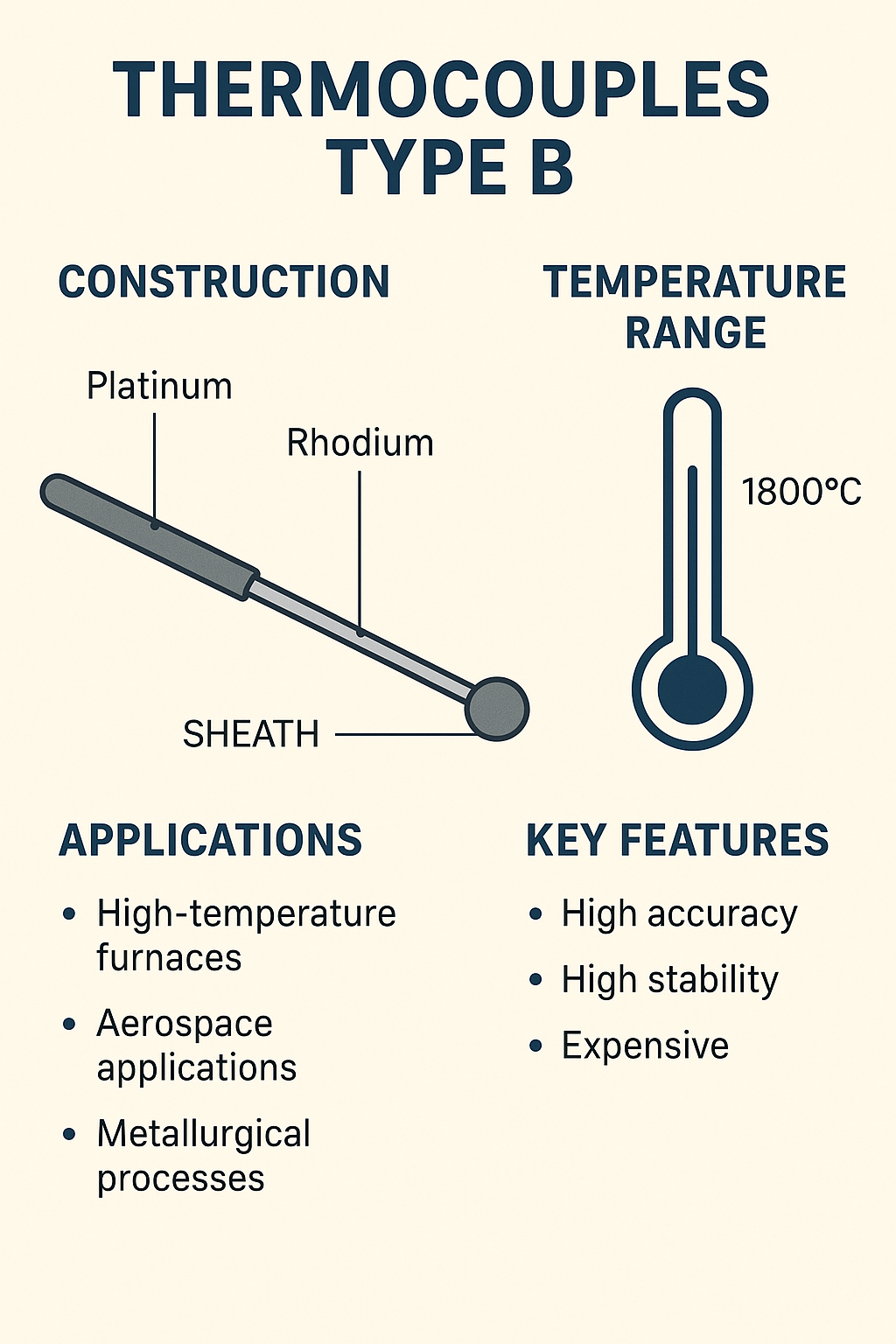
- Positive leg: Platinum with 30% Rhodium (Pt30%Rh)
- Negative leg: Platinum with 6% Rhodium (Pt6%Rh)
This unique combination gives Type B thermocouples their exceptional stability and high-temperature capability.
2. Temperature Range and Measurement Capabilities
One of the most notable features of Type B thermocouples is their ability to measure extremely high temperatures:
| Parameter | Value |
|---|---|
| Temperature Range | 0°C to 1700°C (32°F to 3092°F) continuous operation |
| Short-Term Maximum | Up to 1800°C (3272°F) |
| Accuracy (Standard Limits of Error) | ±0.5% or ±0.25% depending on calibration |
| EMF Output | Relatively low compared to base-metal thermocouples |
Unlike many other types, Type B thermocouples maintain stable readings even under prolonged high-temperature exposure.
3. Key Advantages of Thermocouples Type B
- Exceptional High-Temperature Performance: Suitable for extreme heat environments where other thermocouples degrade quickly.
- Long Service Life: Platinum and Rhodium alloys resist oxidation and contamination.
- Stable EMF Output: Minimal drift over time, ensuring consistent readings.
- Corrosion Resistance: Works well in oxidizing and inert atmospheres.
- No Need for Cold Junction Compensation Above 50°C: At higher reference temperatures, the voltage output is almost identical for 0°C and 50°C, simplifying calibration.
4. Limitations of Thermocouples Type B
While they offer excellent benefits, there are certain drawbacks:
- High Cost: Platinum and rhodium are expensive materials.
- Low Sensitivity: EMF output is lower than base-metal thermocouples, making them less responsive in low-temperature applications.
- Not Suitable for Reducing Atmospheres: Can suffer degradation if exposed to certain gases.
- Fragility: Platinum wires are softer and more prone to mechanical damage.
5. Applications of Thermocouples Type B
Due to their performance characteristics, Type B thermocouples are commonly used in:
- Steel and Metallurgical Industry: Monitoring molten metal temperatures in furnaces.
- Glass Manufacturing: Measuring glass melt temperatures during production.
- Ceramic Kilns: Controlling firing temperatures for precision manufacturing.
- Aerospace Industry: Testing high-temperature engine components.
- Research Laboratories: High-precision temperature measurement in experiments.
6. Installation and Protection
To extend the life of a Type B thermocouple, proper installation is essential:
- Use Protective Sheaths: Platinum or ceramic sheaths help prevent contamination.
- Avoid Reducing Atmospheres: Exposure to hydrogen or carbon monoxide can damage the sensor.
- Secure Mounting: Protect the wire from vibration and mechanical stress.
- Calibrate Regularly: Even with high stability, periodic calibration ensures accuracy.
7. Comparison Thermocouples Type B with Other Thermocouple Types
| Type | Max Temperature | Sensitivity | Cost | Typical Applications |
|---|---|---|---|---|
| Type K | ~1260°C | High | Low | General industrial |
| Type N | ~1300°C | Medium | Medium | Chemical resistance |
| Type S | ~1600°C | Low | High | Lab, glass, ceramics |
| Type B | ~1700°C | Low | Very High | Metallurgy, aerospace |
| Type R | ~1600°C | Low | High | Glass, ceramics, labs |
From the table, it is clear that Type B thermocouples excel in ultra-high-temperature applications, making them a premium choice for industries that require consistent accuracy.
8. Maintenance and Calibration Tips
- Avoid Mechanical Shock: Platinum wires are delicate.
- Check for Drift: Compare readings with a reference sensor periodically.
- Replace Worn Protection Tubes: Ceramic or platinum sheaths can degrade over time.
- Document Readings: Keeping historical data helps detect gradual drift or degradation.
9. Why Choose Thermocouples Type B for Your Application?
If your process involves sustained high temperatures above 1500°C, few sensors can match the performance of a Type B thermocouple. While the initial investment is higher, the extended lifespan, stability, and accuracy can make them more cost-effective in the long run.
Conclusion
Thermocouples Type B (Platinum / Rhodium) are specialized temperature sensors built for the most demanding industrial environments. Their combination of extreme temperature tolerance, stability, and resistance to oxidation makes them indispensable for metallurgy, glass manufacturing, ceramics, aerospace, and high-temperature research.
Investing in a high-quality Type B thermocouple ensures accurate, reliable, and long-term temperature measurement, safeguarding process quality and efficiency.