Thermistors are one of the most widely used temperature-sensing components in modern electronics. They are inexpensive, compact, highly sensitive, and ideal for precise temperature measurement and control. The word thermistor comes from the combination of thermal and resistor, indicating that their resistance changes significantly with temperature.
In this article, we will explore in detail what thermistor are, how they work, their different types, advantages, disadvantages, and common applications in real-world systems.
1. What is a Thermistor?
A thermistor is a type of resistor whose electrical resistance changes significantly with temperature. Unlike standard resistors, which are designed to maintain a fixed resistance, thermistors intentionally have a high temperature coefficient, meaning that small temperature changes cause large variations in resistance.
Thermistor are commonly used in:
- Temperature sensing and monitoring
- Overcurrent protection
- Temperature compensation in circuits
They are usually made from semiconductor materials such as metal oxides, which are sintered at high temperatures to achieve the desired electrical properties.
2. Working Principle of Thermistors
The working principle of a thermistor is based on the fact that the resistance of a semiconductor changes with temperature. When temperature changes, the number of charge carriers in the semiconductor changes, altering its resistance.
There are two main behaviors of thermistor:
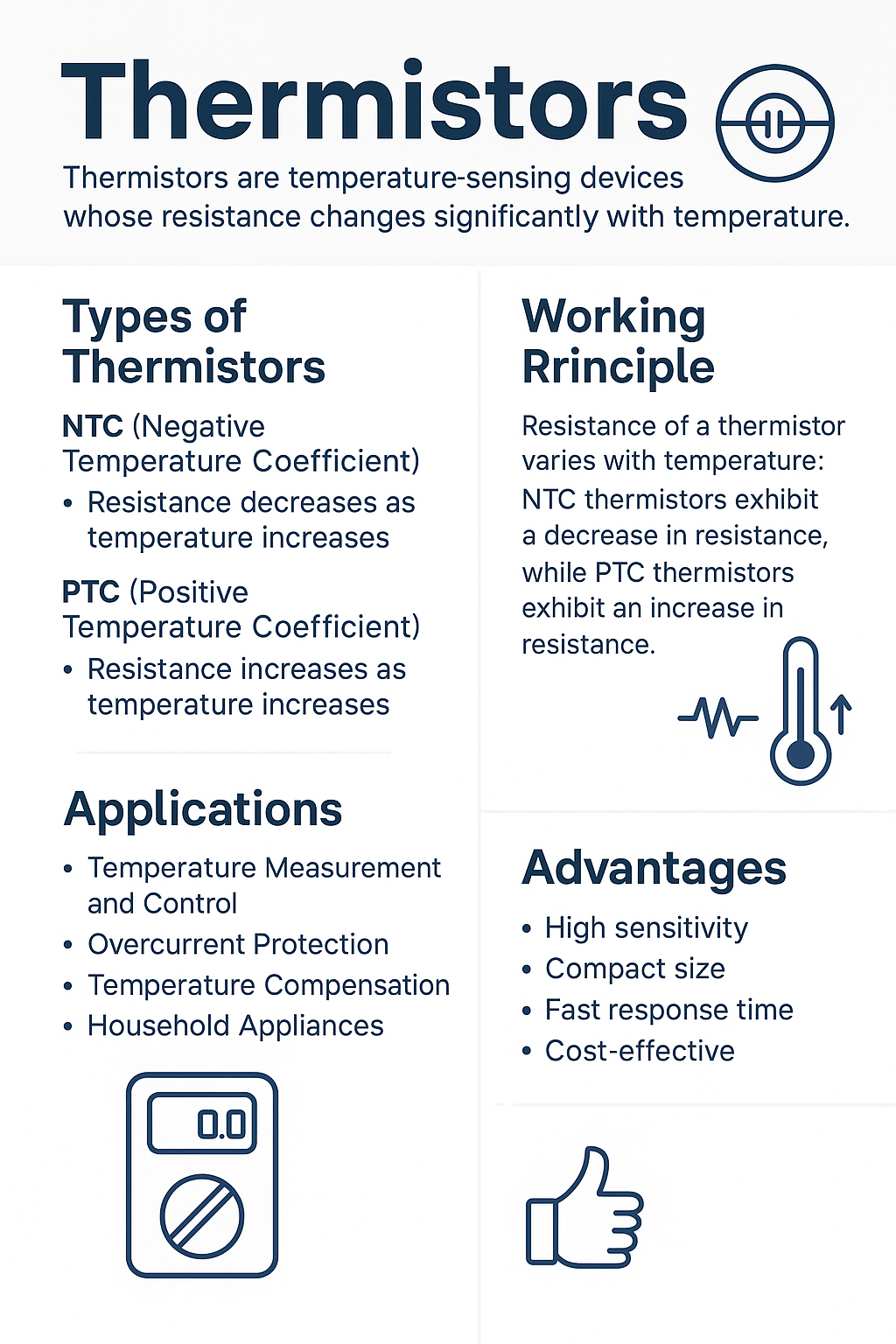
- NTC (Negative Temperature Coefficient) Thermistor – Resistance decreases as temperature increases.
- PTC (Positive Temperature Coefficient) Thermistor – Resistance increases as temperature increases.
This predictable change in resistance allows thermistors to be used as precise temperature sensors.
Formula for Temperature Coefficient: α=1R⋅dRdT\alpha = \frac{1}{R} \cdot \frac{dR}{dT}α=R1⋅dTdR
Where:
- α\alphaα = temperature coefficient
- RRR = resistance
- TTT = temperature in °C
3. Types of Thermistors
Thermistor are broadly categorized into two main types:
A. NTC (Negative Temperature Coefficient) Thermistors
- Resistance decreases with increasing temperature.
- Most commonly used for temperature measurement.
- Example applications: digital thermometers, climate control systems.
Advantages:
- High sensitivity
- Wide temperature range
- Suitable for precise measurements
Disadvantages:
- Non-linear response (requires calibration in some cases)
B. PTC (Positive Temperature Coefficient) Thermistors
- Resistance increases with increasing temperature.
- Often used for overcurrent protection or as resettable fuses.
- Example applications: motor protection, heating element control.
Advantages:
- Self-resetting function
- Reliable protection against overheating
Disadvantages:
- Limited accuracy for precise temperature sensing
4. Construction of Thermistors
Thermistor are typically made from ceramic materials composed of metal oxides such as manganese, nickel, cobalt, or copper. These are mixed, compressed into shape (beads, disks, or rods), and sintered at high temperatures to achieve the desired resistance-temperature characteristics.
Thermistors are available in various physical forms:
- Bead thermistor – Small size, fast response.
- Disk thermistor – Durable, used in industrial applications.
- Rod thermistor – Higher power handling capability.
5. Key Characteristics of Thermistors
When selecting a thermistor for an application, important parameters include:
- Resistance at 25°C (R25) – The nominal resistance at room temperature.
- Beta value (B value) – Determines the sensitivity to temperature changes.
- Tolerance – Accuracy of the resistance value.
- Operating temperature range – Minimum and maximum working temperatures.
- Response time – How quickly it reacts to temperature changes.
6. Applications of Thermistors
Thermistors are versatile components used across multiple industries. Common applications include:
Temperature Measurement and Control
- Digital thermometers
- Weather stations
- Air conditioning systems
Overcurrent and Overtemperature Protection
- Power supply circuits
- Battery packs
- Electric motors
Temperature Compensation
- Quartz oscillators
- LCD displays
- Precision measurement devices
Household Appliances
- Refrigerators
- Microwave ovens
- Washing machines
7. Advantages of Thermistors
- High sensitivity – Detects very small temperature changes.
- Compact size – Fits in small devices.
- Fast response time – Ideal for real-time applications.
- Cost-effective – Low manufacturing cost.
- Wide range of applications – From consumer electronics to industrial systems.
8. Disadvantages of Thermistors
- Non-linear characteristics – Requires calibration in some applications.
- Limited temperature range – Not suitable for extremely high temperatures (>300°C).
- Fragility – Ceramic material can be brittle.
9. How to Test a Thermistor
Testing a thermistor can be done using a digital multimeter:
- Measure resistance at room temperature – Compare with the rated R25 value.
- Apply heat or cold – Resistance should change according to the type (NTC or PTC).
- Check for open or short circuit – A faulty thermistor may show no resistance change.
10. Future Trends in Thermistor Technology
With the growing demand for smart electronics, thermistors are being integrated into:
- IoT-enabled temperature monitoring systems
- Automotive sensors for electric vehicles
- Medical devices for patient temperature tracking
New materials and manufacturing techniques are improving their linearity, durability, and precision, making thermistors even more reliable for future applications.
Conclusion
Thermistors are essential electronic components for temperature sensing, protection, and compensation. Their reliability, low cost, and high sensitivity make them a preferred choice in countless devices and systems. Whether it’s ensuring your laptop doesn’t overheat or keeping your refrigerator at the right temperature, thermistor are working silently in the background to maintain efficiency and safety.
By understanding their working principles, types, and applications, engineers and enthusiasts can make better decisions when selecting thermistor for their projects.