
Introduction of Rise of Radio Broadcasting
Long before television and the internet became dominant, radio broadcasting stood as the revolutionary medium that connected people across the globe. From the early 20th century, radio transformed communication, news delivery, entertainment, and culture. It bridged communities, spread information rapidly, and became a vital tool during both peacetime and war. The rise of radio broadcasting is not just a technological achievement—it is a cultural phenomenon that continues to influence how we communicate today.
This article explores the history, development, and cultural impact of radio broadcasting, tracing its journey from experimental beginnings to becoming a powerful force in global communication.
The Early Beginnings of Radio Broadcasting
The story of radio broadcasting begins in the late 19th and early 20th centuries, when inventors like Guglielmo Marconi, Nikola Tesla, and Reginald Fessenden pioneered wireless telegraphy. These early experiments allowed the transmission of signals without wires, a breakthrough that laid the foundation for radio communication.
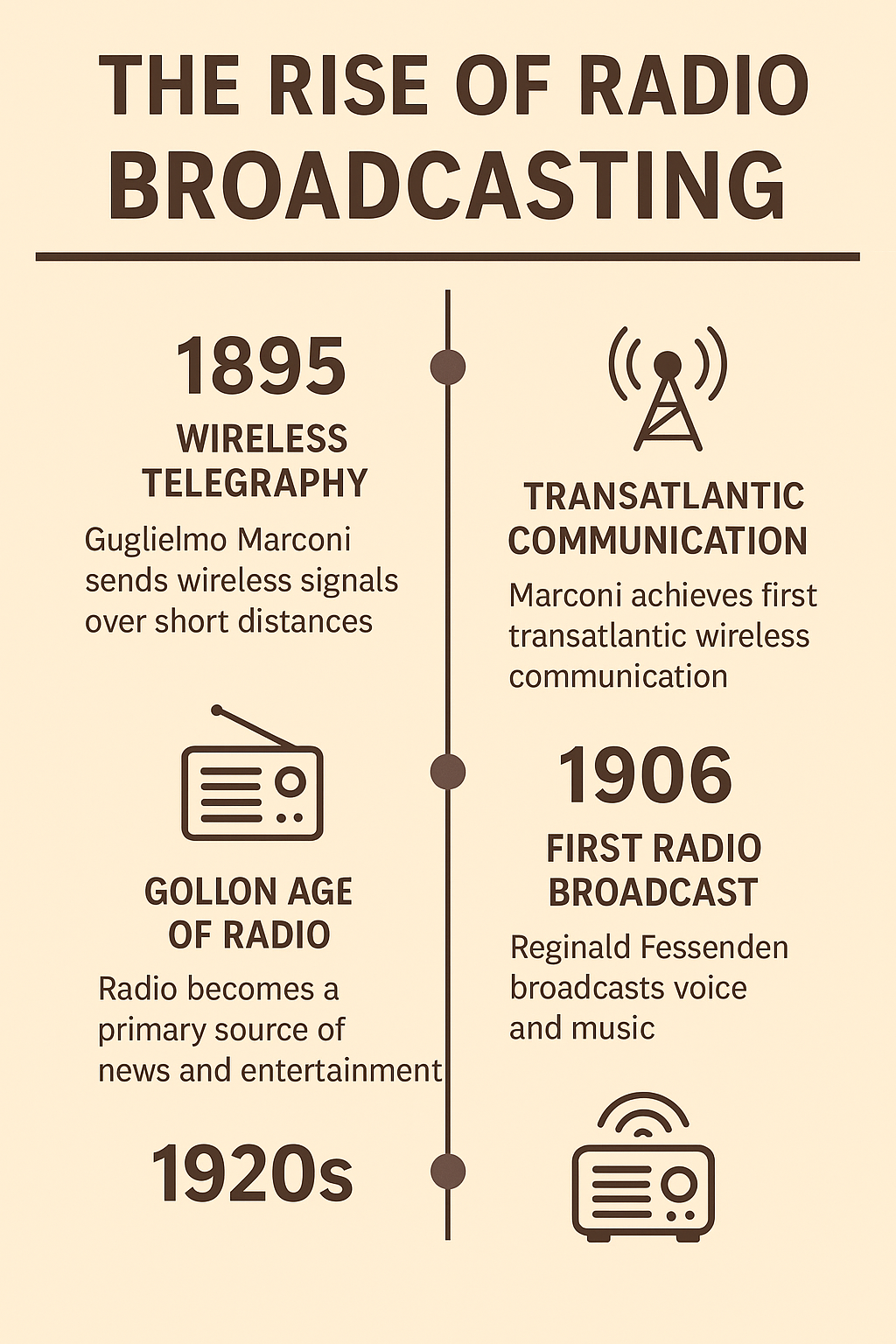
- 1895: Marconi successfully sent wireless signals over short distances.
- 1901: Marconi achieved the first transatlantic wireless communication, proving that radio waves could travel vast distances.
- 1906: Reginald Fessenden made the first radio broadcast of voice and music, which astonished ship operators accustomed only to Morse code.
By the 1920s, radio had moved beyond experimental stages, entering homes as a form of mass communication.
The Golden Age of Radio
The 1920s through the 1950s are often referred to as the “Golden Age of Radio.” During this period, radio became the primary source of information and entertainment for millions of people worldwide.
- News and Information: Radio made it possible to deliver breaking news instantly, transforming journalism.
- Entertainment: Families gathered around the radio to listen to dramas, comedies, and live music.
- Advertising: Businesses saw radio as an effective platform to reach mass audiences, fueling the rise of modern advertising.
- Politics and Propaganda: Leaders such as Franklin D. Roosevelt used radio broadcasts—famously his “Fireside Chats”—to communicate directly with citizens.
Radio stations multiplied rapidly, and programs were produced to cater to different interests, from music lovers to sports fans.
Radio Broadcasting During Wartime
Radio played a critical role during both World Wars.
- World War I: Radio was primarily used for military communication, enabling rapid coordination between ships, planes, and ground troops.
- World War II: Radio became both a weapon and a lifeline. It was used to spread propaganda, deliver speeches, and broadcast vital updates to civilians. Resistance movements often relied on clandestine radio stations to inspire hope and resistance against occupation.
Radio’s influence in wartime proved its power as a tool for mass communication and persuasion.
Cultural and Social Impact of Radio
Radio was more than just a technology; it was a cultural revolution.
- Unity Through Shared Experience: Millions of people could listen to the same broadcast simultaneously, creating a shared national and global experience.
- Rise of Popular Music: Radio stations introduced listeners to jazz, blues, rock ‘n’ roll, and other genres that shaped modern music culture.
- Education: Radio brought educational programs to rural and remote areas, providing access to knowledge that was otherwise unavailable.
- Community Building: Local radio stations fostered a sense of community identity, broadcasting regional news, weather, and cultural events.
Technological Advancements in Radio Broadcasting
As radio matured, technological innovations improved both quality and accessibility.
- AM to FM Radio: The shift from AM (Amplitude Modulation) to FM (Frequency Modulation) brought clearer sound quality and reduced interference.
- Portable Radios: By the mid-20th century, transistor radios made listening portable, further embedding radio in daily life.
- Satellite and Internet Radio: In the late 20th and early 21st centuries, radio expanded to digital formats, offering global reach through streaming services and apps.
The Decline and Evolution of Radio Broadcasting
With the rise of television in the 1950s and later the internet, radio lost its position as the dominant medium of mass communication. However, rather than disappearing, radio evolved.
- Talk Radio: Stations shifted toward talk shows, political debates, and call-in programs.
- Specialized Stations: FM radio created niche channels for rock, jazz, classical, and other genres.
- Internet Radio & Podcasts: Today, the concept of radio lives on through digital broadcasting, podcasts, and streaming platforms.
Radio adapted by finding new ways to stay relevant in a changing media landscape.
The Lasting Legacy of Radio
Radio’s legacy is immense. It demonstrated the power of broadcasting to inform, entertain, and unite people across vast distances. Modern communication technologies—including television, podcasts, and live streaming—owe much to the pioneering work of radio broadcasting.
Even in today’s digital era, radio remains vital in many parts of the world, especially in rural or underserved regions where internet access is limited. For emergency communication, public announcements, and cultural preservation, radio is still an essential tool.
Conclusion of Rise of Radio Broadcasting
The rise of radio broadcasting is a story of innovation, resilience, and cultural transformation. From Marconi’s early experiments to today’s digital streaming, radio has continually evolved to meet the needs of society.
While its golden age may have passed, radio’s influence lives on in every form of broadcasting and media we consume today. It was the original medium that proved the power of sound to connect humanity—and its impact will continue to resonate for generations.