Properties electromagnetic waves ~ Electromagnetic waves (EM waves) are a fundamental aspect of modern science and technology. They are responsible for carrying signals, energy, and information across vast distances, powering everything from mobile phones to satellite communication. To fully grasp their importance, one must understand the key properties that define them.
This article will delve into the primary characteristics of electromagnetic waves, including their speed, frequency, wavelength, polarization, amplitude, and energy. We will also explore how these properties affect real-world applications in communication systems, medical technology, and everyday electronics.
What Are Electromagnetic Waves?
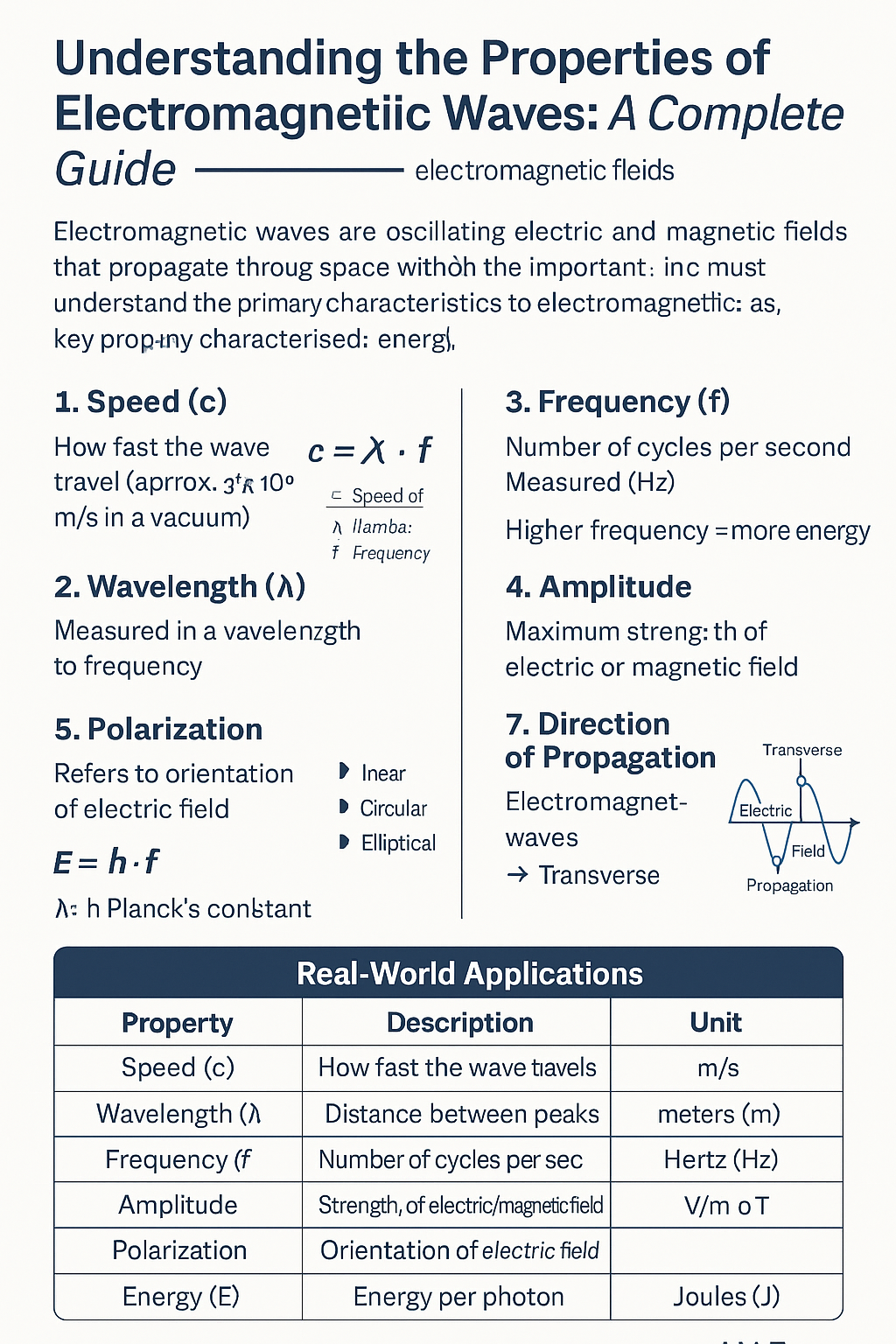
Electromagnetic waves are oscillating electric and magnetic fields that propagate through space without the need for a medium. These waves are part of the electromagnetic spectrum, which includes radio waves, microwaves, infrared, visible light, ultraviolet, X-rays, and gamma rays.
They travel at the speed of light (approximately 3 × 10⁸ m/s in a vacuum) and are characterized by several physical properties that determine their behavior and usage.
Key Properties Electromagnetic Waves
1. Properties Electromagnetic Waves: Speed (c)
In a vacuum, all electromagnetic waves travel at the same speed — the speed of light (c), which is approximately 299,792,458 meters per second (or ~3 × 10⁸ m/s). In other media (like glass or water), this speed is reduced based on the medium’s refractive index.
Formula:
c=λ⋅fc = \lambda \cdot fc=λ⋅f
Where:
- c = speed of light
- λ (lambda) = wavelength
- f = frequency
2. Wavelength (λ)
Wavelength is the distance between two consecutive peaks (or troughs) in the wave. It is usually measured in meters (m), centimeters (cm), or nanometers (nm), depending on the type of EM wave.
- Radio waves have long wavelengths (up to kilometers).
- Gamma rays have extremely short wavelengths (less than a nanometer).
Wavelength is inversely proportional to frequency:
λ=cf\lambda = \frac{c}{f}λ=fc
3. Frequency (f)
Frequency refers to the number of wave cycles that pass a point per second. It is measured in Hertz (Hz).
- Higher frequency = more energy (e.g., X-rays, gamma rays)
- Lower frequency = less energy (e.g., radio, microwave)
Frequency and wavelength are inversely related—as frequency increases, wavelength decreases.
4. Properties Electromagnetic Waves: Amplitude
Amplitude is the maximum strength of the electric or magnetic field in a wave. It is associated with the wave’s intensity or brightness (in the case of visible light) or power level (in radio signals).
A higher amplitude means a stronger wave, but it does not affect the frequency or speed of the wave.
5. Polarization
Polarization refers to the orientation of the electric field of the wave. Common types include:
- Linear polarization (horizontal or vertical)
- Circular polarization
- Elliptical polarization
Polarization is critical in communication systems, optics, and 3D technologies like polarized glasses.
6. Energy (E)
Energy carried by an electromagnetic wave is directly related to its frequency:
Formula:
E=h⋅fE = h \cdot fE=h⋅f
Where:
- E = energy
- h = Planck’s constant (6.626 × 10⁻³⁴ Js)
- f = frequency
Higher frequency waves (such as X-rays and gamma rays) carry more energy and can be ionizing — they can damage cells and tissues. Lower frequency waves (like radio) carry much less energy.
7. Properties Electromagnetic Waves: Direction of Propagation
Electromagnetic waves are transverse waves — the electric field, magnetic field, and direction of propagation are mutually perpendicular. This means the wave travels in a direction perpendicular to both the electric and magnetic fields.
Interaction of EM Waves with Matter
Depending on their frequency and energy, electromagnetic waves interact with matter in various ways:
- Reflection: Waves bounce back from surfaces (e.g., mirrors, radar).
- Refraction: Waves bend as they pass through different media (e.g., lenses).
- Diffraction: Waves spread out after passing through a small aperture.
- Absorption: Energy is absorbed by matter and converted to heat or other forms.
- Transmission: Waves pass through a material (e.g., light through glass).
Real-World Applications Based on Wave Properties
Understanding the properties of EM waves has led to countless technological advancements. Here are a few examples:
1. Communication
- Radio waves and microwaves are widely used in wireless communication, including radios, TVs, cellphones, and Wi-Fi.
- Polarization and frequency tuning are essential for signal clarity and avoiding interference.
2. Medical Imaging
- X-rays utilize high-frequency waves to capture images of bones and organs.
- MRI machines use radio waves and magnetic fields to generate detailed internal images.
3. Remote Sensing and Astronomy
- Different wavelengths are used to observe celestial bodies, weather patterns, and geological data.
- Infrared and ultraviolet telescopes reveal information invisible to the human eye.
4. Everyday Electronics
- Infrared is used in remote controls, thermal cameras, and night vision.
- Visible light is harnessed in fiber optics, laser pointers, and LEDs.
Conclusion of Properties Electromagnetic Waves
Electromagnetic waves are a foundational concept in physics and engineering, with wide-ranging applications in science and daily life. Their unique properties — speed, wavelength, frequency, polarization, amplitude, and energy — determine how they behave, interact with matter, and are utilized across industries.
Understanding these characteristics not only helps in academic settings but also empowers engineers, designers, and technicians to innovate more effective solutions in technology and communication.
✅ Quick Summary Properties Electromagnetic Waves Table
| Property | Description | Unit |
|---|---|---|
| Speed (c) | How fast the wave travels | m/s |
| Wavelength (λ) | Distance between peaks | meters (m) |
| Frequency (f) | Number of cycles per second | Hertz (Hz) |
| Amplitude | Strength of electric/magnetic field | V/m or T |
| Polarization | Orientation of electric field | – |
| Energy (E) | Energy per photon | Joules (J) |