Operational Amplifiers, commonly referred to as Op-Amps, are integral components in analog electronics. Since their invention in the 1960s, op-amps have revolutionized signal processing in countless applications — from simple amplifiers to complex filtering and control systems.
In this article, we’ll explore the core principles, common configurations, and real-world applications of operational amplifiers, along with their advantages, limitations, and key specifications.
1. What is an Operational Amplifier?
An operational amplifier (op-amp) is a high-gain electronic voltage amplifier with a differential input and, typically, a single-ended output. The term “operational” stems from the device’s early use in analog computers to perform mathematical operations such as addition, subtraction, integration, and differentiation.
A standard op-amp has:
- Two inputs: Inverting (−) and non-inverting (+)
- One output
- High input impedance (to prevent loading the previous stage)
- Low output impedance
- Very high voltage gain
2. Internal Structure and Symbol of Op-Amp
The internal structure of an op-amp consists of multiple transistor stages including differential amplifiers, level shifters, and output drivers. Although modern op-amps are built on integrated circuits (ICs), their equivalent block diagram typically consists of three main stages:
- Input Stage: A differential amplifier
- Intermediate Stage: Gain amplifier
- Output Stage: Buffer or push-pull amplifier
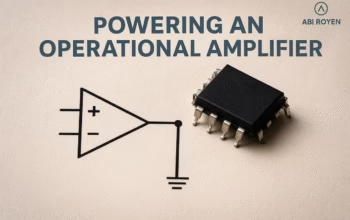
The circuit symbol of an op-amp is a triangle pointing to the right with the inverting (−) and non-inverting (+) inputs on the left and the output on the right.
3. Ideal vs. Practical Operational Amplifiers (Op-Amps) Characteristics
Ideal Op-Amp Characteristics:
- Infinite input impedance
- Zero output impedance
- Infinite open-loop gain
- Infinite bandwidth
- Zero offset voltage
- Infinite common-mode rejection ratio (CMRR)
Practical Op-Amp Characteristics:
- Very high, but finite input impedance (e.g., 1 MΩ to 10 MΩ)
- Low output impedance (e.g., <100 Ω)
- High open-loop gain (e.g., 100,000 or more)
- Limited bandwidth depending on the gain-bandwidth product
- Small offset voltage (e.g., in millivolts)
4. Basic Operational Amplifiers (Op-Amps) Configurations
Op-amps can be configured in various ways to perform different functions. Here are some common configurations:
A. Inverting Amplifier
- The input is applied to the inverting terminal.
- The non-inverting terminal is grounded.
- Provides amplification with phase inversion.
B. Non-Inverting Amplifier
- Input is applied to the non-inverting terminal.
- Provides amplification without phase inversion.
C. Voltage Follower (Buffer)
- The output is connected directly to the inverting input.
- Unity gain (Gain = 1), used for impedance matching.
D. Summing Amplifier
- Multiple inputs applied through resistors to the inverting input.
- Used to sum multiple signals (analog addition).
E. Differential Amplifier
- Amplifies the voltage difference between two input terminals.
- Used in analog signal processing and instrumentation.
F. Integrator and Differentiator
- Performs calculus operations on signals.
- Useful in analog computing and signal waveform shaping.
5. Operational Amplifiers (Op-Amps) Parameters and Specifications
When selecting an op-amp for a design, consider the following specifications:
- Slew Rate: How quickly the output changes in response to a rapid input change.
- Input Offset Voltage: The voltage difference needed between inputs to make the output zero.
- Gain-Bandwidth Product (GBP): Trade-off between gain and frequency.
- Common-Mode Rejection Ratio (CMRR): Ability to reject common-mode signals.
- Power Supply Rejection Ratio (PSRR): How well the op-amp rejects variations in power supply.
- Input Bias Current: Current flowing into the input terminals.
- Noise Performance: Important in audio and precision systems.

6. Powering an Operational Amplifiers (Op-Amps)
Op-amps can be powered in two main ways:
- Dual Supply (e.g., ±15V): Allows output swing around 0V (ideal for AC signals).
- Single Supply (e.g., 0V and +5V): Suitable for digital/low-voltage applications but requires careful biasing.
7. Applications of Operational Amplifiers (Op-Amps)
Op-amps are found in countless electronic systems. Common applications include:
- Signal Amplification: Audio preamplifiers, sensor signal conditioning
- Filters: Low-pass, high-pass, band-pass and notch filters
- Oscillators: Sine, square, and triangular wave generation
- Analog Computing: Integration, differentiation, logarithmic operations
- Voltage Comparators: Switching circuits, Schmitt triggers
- Analog-to-Digital and Digital-to-Analog Interfaces
- Instrumentation Amplifiers: Precision measurement systems
- Control Systems: PID controllers in automation
8. Popular Operational Amplifiers (Op-Amps) ICs
Some commonly used op-amp ICs include:
- LM741: General-purpose op-amp
- TL081/TL082: Low-noise JFET input op-amps
- LM324: Quad op-amp with single-supply operation
- OPA2134: High-fidelity audio op-amp
- AD620: Precision instrumentation amplifier
Each of these has specific benefits depending on your application (e.g., cost, noise, power consumption, precision).
9. Best Practices for Op-Amp Circuit Design
- Always decouple power supply lines with capacitors (e.g., 0.1 µF near IC pins).
- Use feedback resistors appropriately to control gain.
- Avoid floating inputs, which can cause unpredictable behavior.
- Consider input and output impedance matching.
- Watch out for slew rate limitations in fast signal environments.
- Be mindful of thermal drift and offset voltages in precision applications.
10. Conclusion of Operational Amplifiers (Op-Amps)
Operational amplifiers are versatile, powerful, and foundational components in the world of analog electronics. Whether you’re an engineering student, a hobbyist, or a professional, understanding how op-amps work and how to use them effectively will significantly enhance your ability to design, analyze, and troubleshoot analog circuits.
As electronics continue to evolve, op-amps remain a key building block, proving that despite being decades old, they are far from obsolete.
If you enjoyed this guide and want to learn more about electronics, tutorials, and component reviews, be sure to explore other articles on Abi Royen.