1. Introduction
Temperature measurement and control are essential in countless industries — from electronics and automotive to medical and household appliances. Among the many temperature-sensing devices available, NTC thermistors have gained popularity due to their high sensitivity, accuracy, and affordability.
NTC thermistors, short for Negative Temperature Coefficient thermistors, are a type of resistor whose resistance decreases as temperature increases. This unique property makes them highly effective for precise temperature monitoring and control.
In this article, we will explore what NTC thermistors are, how they work, their specifications, and common applications across industries.
2. What is an NTC Thermistor?
An NTC thermistor is a temperature-sensitive resistor made from semiconducting ceramic materials. The “negative temperature coefficient” refers to its characteristic behavior — as the temperature rises, the electrical resistance decreases exponentially.
The main material used in NTC thermistors is typically a combination of metal oxides such as manganese, nickel, cobalt, copper, or iron. These materials are sintered into a ceramic body that responds predictably to changes in temperature.
3. Working Principle of NTC Thermistors
The working principle of an NTC thermistor is based on semiconductor physics. In semiconductors, an increase in temperature excites more charge carriers (electrons and holes), which reduces resistance.
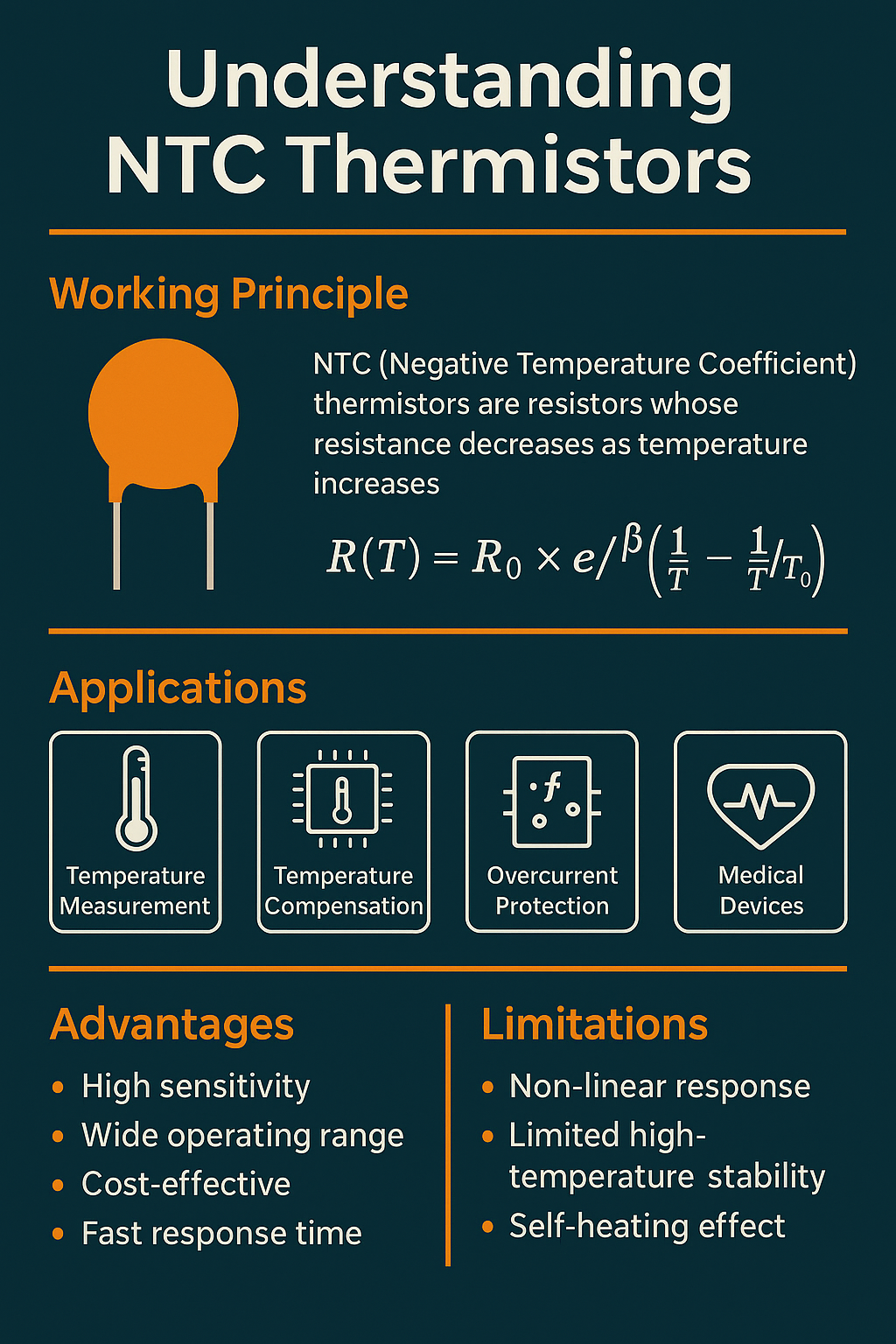
Mathematically, the resistance-temperature relationship of an NTC thermistor can be expressed as: R(T)=R0×eβ(1T−1T0)R(T) = R_0 \times e^{\beta \left( \frac{1}{T} – \frac{1}{T_0} \right)}R(T)=R0×eβ(T1−T01)
Where:
- R(T) = Resistance at temperature T (in Kelvin)
- R₀ = Resistance at reference temperature T₀
- β (Beta) = Material constant (K)
This exponential relationship means that small temperature changes can cause significant variations in resistance, enabling precise measurements.
4. Construction of NTC Thermistors
NTC thermistors come in various shapes and sizes, depending on their application. The most common types include:
- Bead type – Small beads of sintered metal oxides coated with glass for protection.
- Disc type – Flat, disc-shaped thermistors, often used in power circuits.
- Chip type – Suitable for PCB mounting in compact electronics.
- Probe type – Encased in stainless steel or epoxy resin for harsh environments.
These designs allow NTC thermistor to be customized for different temperature ranges and environmental conditions.
5. Key Characteristics of NTC Thermistors
When choosing an NTC thermistor, engineers consider several parameters:
- Resistance at 25°C (R25) – The nominal resistance at room temperature.
- Beta Value (β) – Defines the steepness of the resistance-temperature curve.
- Tolerance – Determines accuracy in temperature measurement.
- Operating Temperature Range – Commonly from −55°C to +150°C.
- Response Time – How quickly the thermistor reacts to temperature changes.
These characteristics make NTC thermistors highly versatile for both sensing and circuit protection applications.
6. Advantages of NTC Thermistors
NTC thermistor offer numerous benefits over other temperature-sensing devices:
- High sensitivity – Capable of detecting small temperature variations.
- Wide operating range – Suitable for extreme cold and heat.
- Cost-effective – Inexpensive compared to RTDs or thermocouples.
- Compact size – Ideal for space-limited applications.
- Fast response time – Quickly reacts to temperature changes.
These advantages explain why NTC thermistors are used in everything from household appliances to advanced medical devices.
7. Limitations of NTC Thermistors
Despite their advantages, NTC thermistor also have some limitations:
- Non-linear response – Requires calibration or linearization for certain applications.
- Limited high-temperature stability – Performance may degrade above certain limits.
- Self-heating effect – Passing too much current can artificially increase temperature readings.
Understanding these limitations helps in selecting the right thermistor for a specific application.
8. Common Applications of NTC Thermistors
NTC thermistor are used in a variety of industries due to their reliability and accuracy.
8.1 Temperature Measurement
- Digital thermometers
- HVAC systems
- Climate control devices
8.2 Temperature Compensation
- Compensating for temperature drift in electronics like oscillators, sensors, and LCD displays.
8.3 Overcurrent Protection
- Inrush current limiters for power supplies, where the NTC thermistor limits initial surge current when a device is powered on.
8.4 Medical Devices
- Patient monitoring systems
- Incubators
- Medical imaging equipment
8.5 Automotive Applications
- Engine coolant temperature monitoring
- Battery pack temperature sensing in electric vehicles
9. Installation and Usage Tips
When integrating NTC thermistors into a circuit, follow these guidelines:
- Avoid excessive current to prevent self-heating.
- Place thermistors close to heat sources for accurate temperature readings.
- Use protective coatings or housings in harsh environments.
- Calibrate regularly for long-term accuracy.
These practices ensure optimal performance and extended lifespan.
10. Future Trends in NTC Thermistor Technology
With advancements in materials science, NTC thermistors are becoming:
- More stable at higher temperatures.
- Smaller in size for microelectronic applications.
- Integrated with digital circuits for smart sensing solutions.
As demand for IoT-enabled temperature monitoring grows, NTC thermistor will play an increasingly important role in connected devices.
11. Conclusion
NTC thermistors are versatile, reliable, and cost-effective temperature sensors used in a wide range of applications. Their high sensitivity, compact size, and fast response time make them a preferred choice for engineers and designers worldwide.
Whether in industrial machines, automotive systems, or consumer electronics, NTC thermistor provide accurate and consistent temperature readings — ensuring safety, performance, and efficiency.