Introduction
Lighting systems play a crucial role in industrial facilities, directly influencing safety, productivity, and operational costs. Whether it’s a manufacturing plant, warehouse, refinery, or processing center, proper illumination ensures that workers can perform tasks efficiently and safely. In recent years, technological advancements in lighting—from high-efficiency LEDs to intelligent control systems—have transformed how industries approach workplace illumination.
This article explores the importance of lighting systems in industrial facilities, key types of industrial lighting, design considerations, benefits, and the role of modern innovations in creating sustainable, energy-efficient workplaces.
The Importance of Lighting Systems in Industrial Facilities
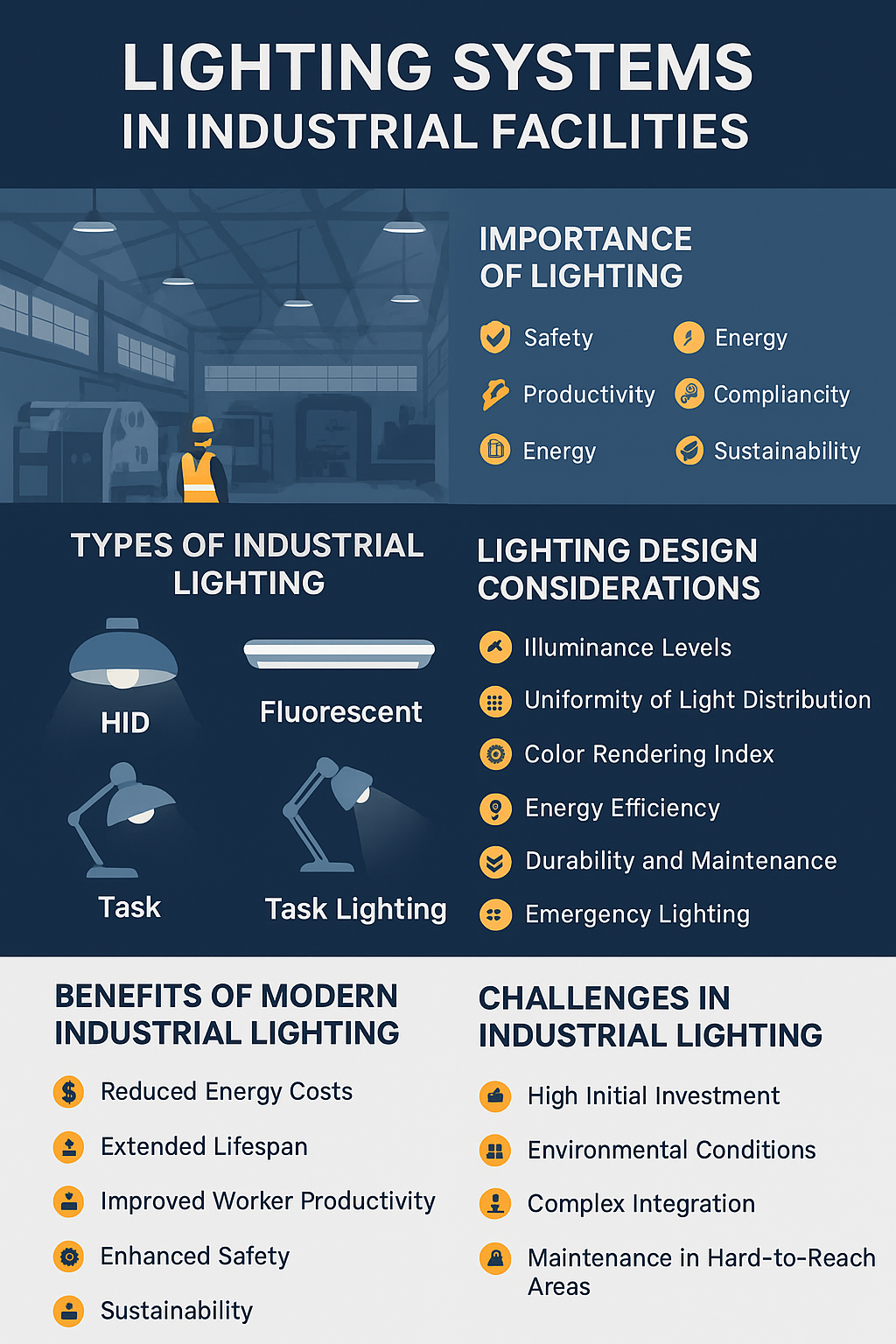
Lighting is more than just providing visibility; it directly impacts the core functions of an industrial facility. Below are the primary reasons why lighting systems are vital:
- Safety – Proper illumination reduces the risk of accidents, slips, falls, and machine-related hazards.
- Productivity – Adequate lighting improves workers’ focus, accuracy, and efficiency in performing tasks.
- Energy Management – Modern lighting systems help industries cut down on electricity consumption and costs.
- Compliance – Many industrial sectors must adhere to lighting standards and regulations for occupational health and safety.
- Sustainability – Efficient lighting supports green initiatives and reduces carbon footprint.
Types of Industrial Lighting Systems
Industrial facilities utilize various lighting solutions depending on the specific environment and work requirements. The most common include:
1. High-Intensity Discharge (HID) Lamps
Traditionally used in large warehouses and factories, HID lamps provide bright illumination over wide areas. However, they consume significant energy and generate heat.
2. Fluorescent Lighting
Common in production floors and offices within industrial sites, fluorescent lights offer better efficiency than HID but require frequent maintenance.
3. LED Lighting
Light Emitting Diode (LED) systems are now the preferred choice in industrial lighting. They provide high efficiency, long lifespan, and lower maintenance compared to traditional options. LEDs also offer flexibility in brightness and color temperature.
4. Task Lighting
Specific to workstations, task lighting enhances visibility for precision-oriented jobs, such as assembly or quality control.
5. Outdoor and Security Lighting
Industrial facilities require robust outdoor illumination for safety, security, and operations in loading docks, parking areas, and perimeter boundaries.
6. Smart Lighting Systems
Advanced facilities integrate smart lighting, which uses sensors, IoT connectivity, and automation to adjust illumination levels based on occupancy, daylight, and time schedules.
Key Considerations in Industrial Lighting Systems Design
Designing an effective lighting system in an industrial facility involves multiple factors:
- Illuminance Levels (Lux Standards) – Different tasks require specific brightness levels. For instance, inspection areas need higher lux compared to storage rooms.
- Uniformity of Light Distribution – Avoiding shadows and glare ensures safe and efficient operations.
- Color Rendering Index (CRI) – High CRI lighting improves color differentiation, critical in quality control processes.
- Energy Efficiency – Choosing energy-efficient lighting reduces operational costs significantly.
- Durability and Maintenance – Industrial environments may expose lights to dust, vibration, heat, or chemicals. Durable fixtures minimize downtime.
- Emergency Lighting – Backup systems must be in place to ensure safe evacuation during power outages.
- Integration with Control Systems – Smart controls optimize energy use while maintaining proper illumination.
Benefits of Modern Industrial Lighting Systems
Adopting modern lighting technologies such as LEDs and smart lighting brings several advantages:
- Reduced Energy Costs – LEDs consume up to 70% less energy than traditional systems.
- Extended Lifespan – LEDs can last up to 50,000 hours, reducing maintenance frequency.
- Improved Worker Productivity – Properly designed lighting enhances concentration and reduces fatigue.
- Enhanced Safety – Better illumination prevents workplace accidents.
- Sustainability – Lower energy consumption aligns with global sustainability goals.
- Flexibility and Control – Smart lighting allows customized brightness and automated scheduling.
Challenges in Industrial Lighting Systems
Despite the benefits, implementing lighting systems in industrial facilities comes with challenges:
- High Initial Investment – Upgrading to modern lighting can be costly upfront.
- Environmental Conditions – Dust, moisture, and extreme temperatures can affect lighting performance.
- Complex Integration – Smart lighting requires proper networking and control systems.
- Maintenance in Hard-to-Reach Areas – Some industrial sites have high ceilings or hazardous zones, making maintenance difficult.
Future Trends in Industrial Lighting Systems
The future of industrial lighting is shaped by advancements in technology and sustainability initiatives:
- Human-Centric Lighting (HCL) – Lighting systems that adjust color temperature to support workers’ circadian rhythms.
- Wireless and IoT Integration – Enhanced connectivity for real-time monitoring and energy optimization.
- Solar-Powered Industrial Lighting – Reducing dependence on grid electricity.
- AI-Powered Lighting Control – Predictive adjustments to maximize efficiency and safety.
- Integration with Smart Factories – Lighting as part of Industry 4.0 for complete automation and energy management.
Conclusion
Lighting systems in industrial facilities are critical to ensuring safety, productivity, and efficiency. With the rise of LED and smart lighting technologies, industries can achieve significant cost savings, reduce environmental impact, and create safer workplaces. By considering illuminance standards, durability, and integration with modern control systems, facility managers can design effective lighting solutions that meet both current and future needs.
As industrial operations continue evolving, lighting will remain a cornerstone of sustainable and intelligent facility management.