
Introduction
In today’s digital and automated world, sensors play a crucial role in making systems more intelligent and responsive. One of the most common and versatile sensors is the light sensor. From turning on streetlights at night to adjusting the brightness of your smartphone screen, light sensors are embedded in countless devices that we use daily. But what exactly are light sensors, how do they work, and where are they applied?
This article will provide a comprehensive explanation of light sensors, covering their definition, working principles, main types, and various applications across industries.
What is a Light Sensors?
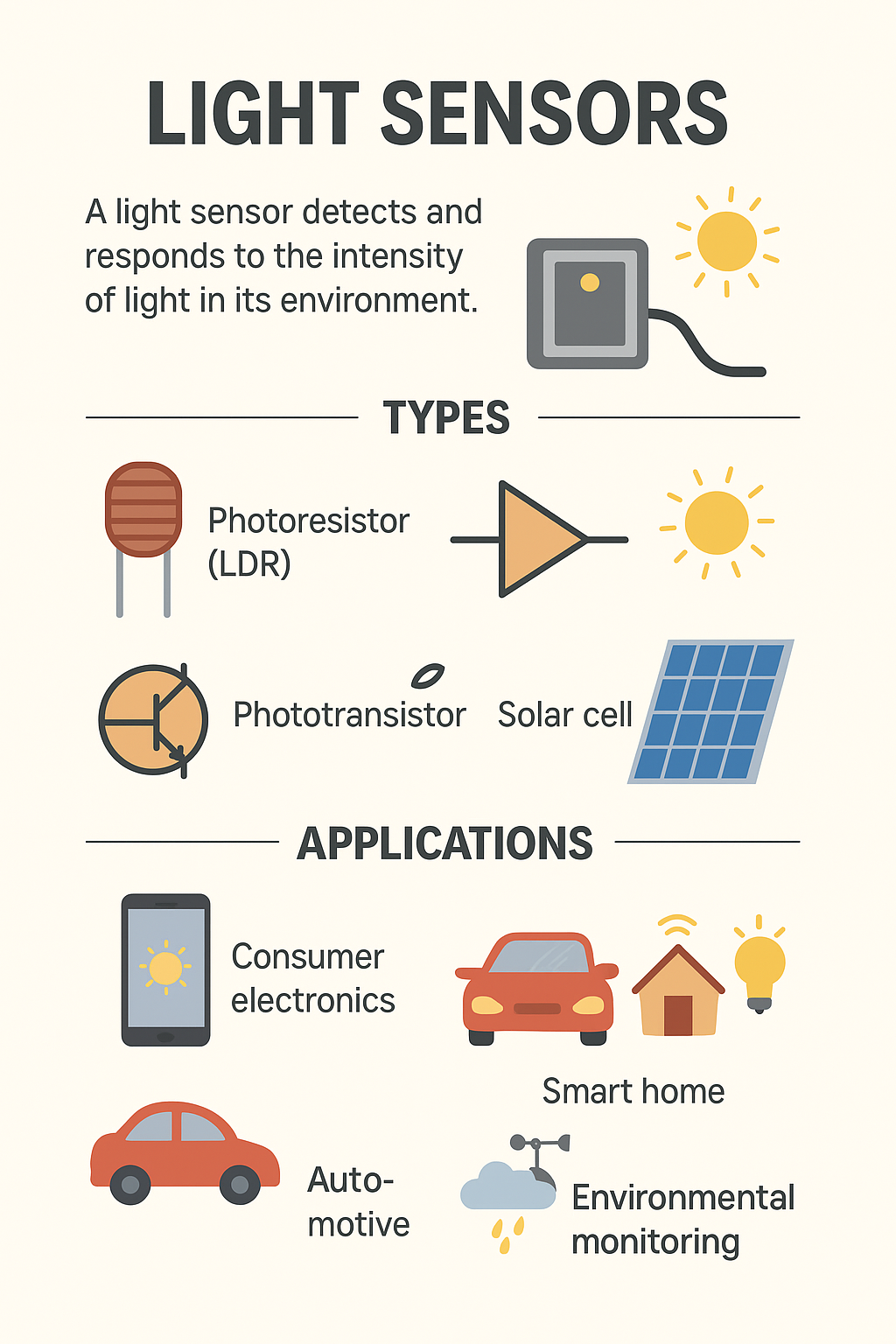
A light sensor is an electronic component that detects and responds to the intensity of light in its environment. The sensor converts light energy (photons) into an electrical signal, which can then be measured, processed, or used to trigger an action.
Light sensors are also known as photo sensor because they rely on the principle of photoelectric effect—where light falling on a material generates an electric current or changes its resistance.
In simple terms, a light sensor tells a system how bright or dark the surroundings are, enabling automation and better control of devices.
Working Principle of Light Sensors
Light sensors operate based on the photoelectric effect or changes in resistance due to illumination. The process can be summarized in three steps:
- Light Detection – When light strikes the sensor’s surface, photons transfer their energy to electrons in the material.
- Electrical Conversion – This energy generates an electric current (in photodiodes and phototransistors) or changes the resistance of the material (in photoresistors or LDRs).
- Signal Output – The change is converted into an output signal that can be measured, displayed, or used to control a device.
For example, in a smartphone, the light sensor detects ambient brightness and adjusts the screen illumination for better visibility and battery efficiency.
Types of Light Sensors
There are several types of light sensors, each with unique features and applications. The most widely used are:
1. Photoresistor (LDR – Light Dependent Resistor)
- A photoresistor changes its resistance depending on the amount of light falling on it.
- In bright light, resistance decreases, while in darkness, resistance increases.
- Commonly used in streetlights, night lamps, and light-sensitive alarms.
2. Photodiode
- A photodiode is a semiconductor device that converts light into current.
- It has fast response time, high sensitivity, and is often used in optical communication systems, smoke detectors, and medical instruments.
3. Phototransistor
- Similar to photodiodes but with amplification, making them more sensitive.
- Used in automatic lighting systems, robotics, and safety devices.
4. Solar Cells (Photovoltaic Cells)
- These sensors not only detect light but also generate electrical power.
- Widely used in solar panels for renewable energy applications.
5. Charge-Coupled Device (CCD) and CMOS Sensors
- Found in cameras and imaging devices.
- Convert light into electronic signals to capture images.
Applications of Light Sensors
Light sensors are essential in various industries and everyday applications. Below are the most significant uses:
1. Consumer Electronics
- Smartphones use light sensors for auto-brightness adjustment.
- Laptops use them for screen dimming to save power.
2. Automotive Industry
- Modern cars use light sensors for automatic headlights, adjusting brightness depending on day or night conditions.
- Used in rain sensors, where light reflection changes help detect water on windshields.
3. Smart Home Automation
- Light sensors enable automatic lighting systems, turning lights on/off based on natural light levels.
- Used in security systems, such as motion-activated floodlights.
4. Industrial Applications
- Used in manufacturing plants for object detection and quality control.
- Employed in robotics for navigation and obstacle detection.
5. Healthcare and Medical Devices
- Used in pulse oximeters, which measure oxygen levels by detecting light absorption in blood.
- Applied in medical imaging systems for better precision.
6. Environmental Monitoring
- Light sensors are used in weather stations to measure sunlight levels.
- Essential in greenhouses to monitor and regulate plant growth conditions.
7. Renewable Energy Systems
- Solar tracking systems use light sensor to optimize panel orientation for maximum energy absorption.
Advantages of Light Sensors
- Energy Efficiency: Reduces unnecessary energy consumption by automating lighting.
- Convenience: Enhances comfort in devices like smartphones and smart homes.
- Accuracy: Provides precise measurements for scientific and industrial applications.
- Versatility: Can be used across multiple sectors, from healthcare to automation.
Challenges and Limitations Light Sensors
Despite their benefits, light sensors also face certain challenges:
- Environmental Sensitivity: Dust, fog, or dirt can affect accuracy.
- Calibration Needs: Some sensors require frequent calibration for reliable performance.
- Limited Range: Specific sensors are only effective in certain light intensity ranges.
Future of Light Sensors Technology
With the rise of smart cities, IoT (Internet of Things), and AI-driven automation, light sensor will play an even bigger role. Future innovations may include:
- Ultra-sensitive sensors for self-driving cars.
- Miniaturized sensors for wearable devices.
- Integrated sensors with AI for adaptive decision-making.
The future promises smarter, faster, and more energy-efficient light detection technologies that will power everything from homes to industries.
Conclusion
Light sensor are one of the most vital components in modern technology. Their ability to detect and respond to changes in light makes them indispensable in electronics, automotive, healthcare, environmental monitoring, and beyond. As the demand for automation and energy efficiency grows, the role of light sensors will continue to expand, shaping a smarter and more sustainable future.