Introduction
Inductors Based Core Material ~ Inductors are fundamental passive components used in a wide range of electronic and electrical circuits. Their main function is to store energy in the form of a magnetic field when current flows through them. While the construction of an inductor may seem simple—consisting of a wire coil—the core material plays a vital role in determining its electrical properties, efficiency, and application suitability.
This article explores inductors based on core material, including air core, iron core, ferrite core, and powdered iron core inductors. We will discuss their characteristics, advantages, disadvantages, and practical applications in modern technology.
What is an Inductor?
An inductor is a coil of conducting wire that generates a magnetic field when current passes through it. The ability of an inductor to resist changes in current is measured in Henries (H), known as inductance.
The performance of an inductor depends largely on two aspects:
- Number of turns in the coil
- Core material used
The core material enhances or influences the magnetic field, thereby altering the inductance value and efficiency of the component.
Classification of Inductors Based Core Material
Inductors are classified into several types depending on the material used in the core:
1. Air Core Inductors
Air core inductors use non-magnetic materials such as plastic, ceramic, or simply air as the core.
- Properties:
- Low inductance values
- No core saturation
- High-frequency performance
- Advantages:
- Suitable for high-frequency applications
- No hysteresis losses
- Simple construction
- Disadvantages:
- Larger size for higher inductance values
- Inefficient at low frequencies
- Applications:
- Radio frequency (RF) circuits
- Tuned circuits in communication systems
Read More: Understanding Air Core Inductors: Design, Applications, and Advantages
2. Iron Core Inductors
Iron core inductors use laminated iron as the core material to enhance inductance.
- Properties:
- High inductance values
- Strong magnetic field
- Core saturation possible
- Advantages:
- Compact design for higher inductance
- Cost-effective for power applications
- Disadvantages:
- Hysteresis and eddy current losses
- Not suitable for high-frequency applications
- Applications:
- Power supplies
- Transformers
- Audio frequency circuits
Read More: Understanding Iron Core Inductors: Applications, Advantages, and Design Considerations
3. Ferrite Core Inductors
Ferrite cores are made from ceramic-like magnetic materials consisting of iron oxides combined with other elements such as nickel, zinc, or manganese.
- Properties:
- High magnetic permeability
- Low electrical conductivity (reduces eddy current losses)
- Lightweight and compact
- Advantages:
- Excellent for high-frequency circuits
- Reduced core losses
- Versatile in different shapes (toroid, rod, bead)
- Disadvantages:
- Brittle and fragile
- Saturation at high currents
- Applications:
- Switch-mode power supplies (SMPS)
- RF circuits
- Noise suppression in electronic devices
Read More: Understanding Ferrite Core Inductors: Applications, Advantages, and Construction
4. Powdered Iron Core Inductors
Powdered iron cores are made from finely ground iron particles mixed with a binder.
- Properties:
- Distributed air gaps within the material
- Moderate permeability
- Good temperature stability
- Advantages:
- High energy storage capability
- Reduced core saturation effects
- Stable performance under varying conditions
- Disadvantages:
- Higher losses compared to ferrite cores at high frequencies
- Limited use in very high-frequency circuits
- Applications:
- DC-DC converters
- Power factor correction circuits
- Energy storage applications
Read More: Powdered Iron Core Inductors: Structure, Applications, and Advantages in Modern Electronics
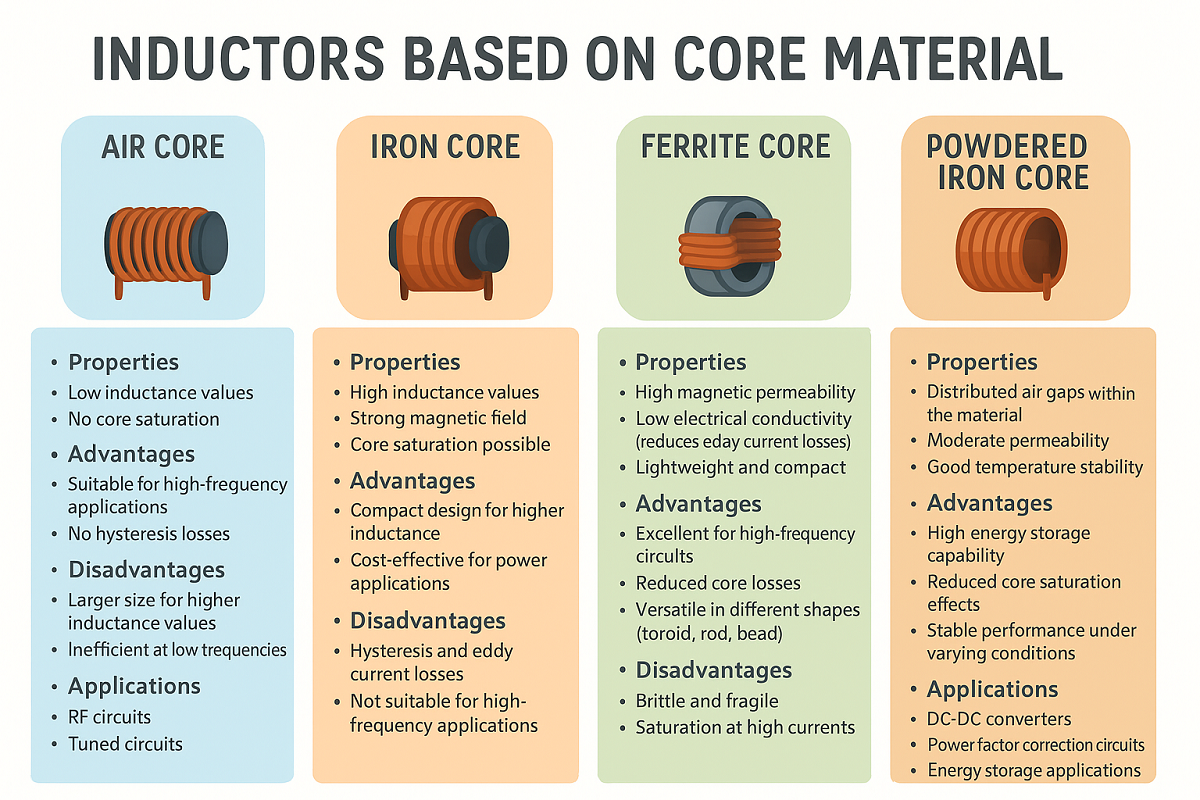
Comparison Table of Inductors Based Core Material
| Core Type | Frequency Range | Inductance | Losses | Applications |
|---|---|---|---|---|
| Air Core | High | Low | Very Low | RF, Tuned Circuits |
| Iron Core | Low to Medium | High | High | Transformers, Power Supplies |
| Ferrite Core | High | Medium to High | Low | SMPS, RF, Noise Suppression |
| Powdered Iron Core | Low to Medium | Medium | Moderate | DC-DC Converters, Energy Storage |
Factors Affecting Inductors Based Core Material Selection
Choosing the right inductor core material depends on:
- Operating Frequency – Air and ferrite cores are preferred for high-frequency, while iron cores are ideal for low-frequency.
- Power Handling – Iron and powdered iron cores are suited for power applications.
- Size Constraints – Ferrite cores allow compact designs.
- Losses and Efficiency – Applications requiring high efficiency prefer ferrite cores due to low losses.
Applications of Inductors Based Core Material
- Air Core Inductors: RF tuning, communication circuits, filters.
- Iron Core Inductors: Transformers, chokes, audio devices, power amplifiers.
- Ferrite Core Inductors: Mobile chargers, SMPS, radio circuits, EMI suppression.
- Powdered Iron Core Inductors: Power electronics, converters, energy storage, PFC circuits.
Conclusion of Inductors Based Core Material
Inductors are indispensable in electronic and electrical systems, and their performance is heavily influenced by the core material used. Air core inductors excel at high frequencies, iron core inductors are perfect for power handling, ferrite cores are highly efficient for RF and SMPS applications, while powdered iron cores offer stability and energy storage advantages.
Understanding these core material differences allows engineers and electronics enthusiasts to select the most suitable inductor for specific applications, ensuring optimal performance and efficiency.
By carefully choosing the right inductor core, modern technology—from smartphones and communication systems to power converters and industrial machinery—continues to advance efficiently.