Introduction of Hyundai Heavy Industries (HHI)
Hyundai Heavy Industries Co., Ltd. (HHI) is widely recognized as the world’s largest shipbuilder and one of the most prominent players in the global marine and industrial engineering sectors. Based in Ulsan, South Korea, HHI has redefined the limits of shipbuilding, offshore oil and gas engineering, and heavy machinery manufacturing. Its remarkable rise from a modest start to a multinational powerhouse is a testament to South Korea’s industrial transformation and HHI’s relentless innovation.
The Origin and Early Development of Hyundai Heavy Industries (HHI)
Founded in 1972 by the visionary industrialist Chung Ju-yung, Hyundai Heavy Industries was established with a bold ambition — to build a world-class shipyard from scratch in Ulsan. The company launched its first two vessels in 1974, just two years after its inception. Despite limited experience and resources, HHI quickly gained international recognition for quality and speed.
The support of the Hyundai Group, which already had a strong presence in the automotive and construction sectors, helped lay the foundation for HHI’s growth. Ulsan became home to what is now considered the world’s largest shipyard, with over 7.5 million square meters of integrated shipbuilding facilities.
Hyundai Heavy Industries (HHI) Core Business Divisions
Hyundai Heavy Industries operates through several major divisions that form the backbone of its global operations:
1. Hyundai Heavy Industries (HHI): Shipbuilding Division
This is the flagship division that has made HHI a household name in global maritime circles. It produces:
- Oil tankers
- LNG carriers
- Container ships
- Bulk carriers
- Naval ships and destroyers
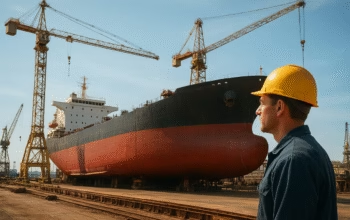
HHI’s shipbuilding division is known for its block construction method, where large parts of a ship are built simultaneously and assembled like Lego blocks, allowing faster delivery times without compromising quality.
2. Hyundai Heavy Industries (HHI): Offshore & Engineering
This division focuses on constructing:
- Fixed platforms
- Floating production storage and offloading (FPSO) units
- Jack-up rigs
- Subsea pipelines and equipment
It serves major oil companies and contributes to energy security worldwide. HHI’s offshore platforms can be found in the North Sea, Middle East, Southeast Asia, and West Africa.
3. Hyundai Heavy Industries (HHI): Marine Engine & Machinery
HHI is also one of the largest manufacturers of marine diesel engines globally. It produces:
- Two-stroke and four-stroke engines
- Propulsion systems
- Eco-friendly hybrid engines
Their HiMSEN (Hyundai Medium Speed Engine) series is widely used in marine and power generation applications.
4. Industrial Plant & Engineering
This division designs and constructs power plants, oil refineries, and petrochemical facilities, primarily in Asia and the Middle East.
5. Hyundai Heavy Industries (HHI): Electro Electric Systems
HHI manufactures high-quality transformers, switchgears, and smart grid systems — essential components for power distribution and industrial automation.

Innovations and Environmental Commitment
In recent years, HHI has invested heavily in green ship technology, including:
- Dual-fuel engines
- LNG and ammonia-powered vessels
- Smart ship solutions
- Ballast water treatment systems
HHI is also developing autonomous ships and digital twin systems for predictive maintenance and energy optimization. These innovations not only reduce operating costs but also contribute to global decarbonization efforts.
Notable Projects and Achievements
Some landmark achievements of Hyundai Heavy Industries include:
- Over 2,300 ships delivered to more than 50 countries since its founding.
- Building the world’s largest container ship (23,000+ TEU) in collaboration with shipping giant HMM.
- Supplying warships and submarines to the Republic of Korea Navy, enhancing national defense capabilities.
- Leading offshore oil projects for Total, Shell, BP, and Saudi Aramco.
HHI’s scale and speed are unmatched, with the ability to build more than 80 vessels per year.
Challenges and Global Competition
Despite its strengths, HHI faces strong competition from other Asian shipbuilders, including:
- Daewoo Shipbuilding & Marine Engineering (DSME)
- Samsung Heavy Industries (SHI)
- China State Shipbuilding Corporation (CSSC)
In 2020, HHI attempted a merger with DSME to consolidate market strength, but regulatory concerns, especially from the European Union, delayed the approval process.
Additionally, fluctuating oil prices, changing environmental regulations, and global economic instability require continuous innovation and adaptation from HHI.
Digital Transformation and Smart Shipyards
HHI is actively implementing Industry 4.0 technologies across its operations:
- Robotics and automation
- Artificial Intelligence (AI)-driven ship design
- IoT sensors for real-time monitoring
- Augmented Reality (AR) tools for maintenance and assembly
The “Smart Shipyard” initiative enables precise control over supply chains, workforce management, and predictive analytics, reducing costs and increasing competitiveness.
Global Impact and Future Outlook
Hyundai Heavy Industries is not just a shipbuilder — it’s an emblem of Korean engineering excellence and global industrial leadership. With rising demand for eco-friendly ships, offshore wind farms, and digital vessels, HHI is strategically positioned for the next wave of maritime innovation.
Through continued investment in R&D, global partnerships, and a commitment to sustainability, HHI is poised to lead the industry for decades to come.
Conclusion of Hyundai Heavy Industries (HHI)
Hyundai Heavy Industries stands as a towering figure in the global maritime world — an industry leader that has continuously adapted and innovated. From humble beginnings to becoming a cornerstone of South Korea’s industrial success, HHI is a symbol of ambition, precision, and resilience.
As shipping moves toward decarbonization, digitization, and automation, HHI’s role in shaping the future of the world’s oceans will only grow stronger.