Introduction of How Do Diodes Work?
How Do Diodes Work? ~ In the world of electronics, diodes are among the simplest yet most essential components. If you have ever wondered how power supplies convert AC into DC, how LED lights glow, or how circuits prevent current from flowing backward, the answer lies in diodes. These small semiconductor devices play a massive role in making modern electronics possible.
This article provides a comprehensive guide to how diodes work, their construction, types, and applications. By the end, you’ll understand not only the basic function of diodes but also their importance in technology.
What Is a Diode?
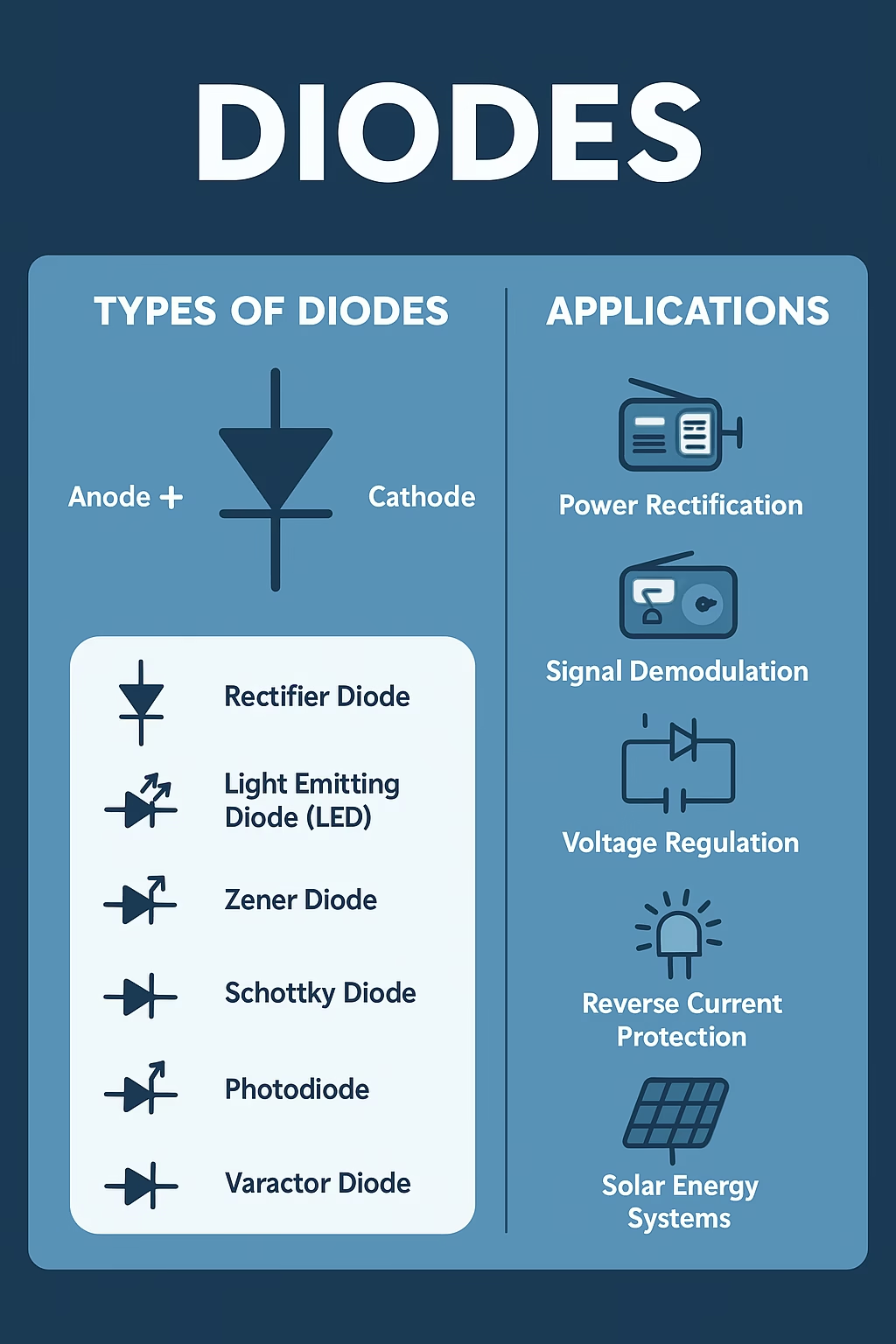
A diode is a two-terminal electronic component that allows current to flow in only one direction. Think of it as a one-way valve for electricity. It has two main terminals:
- Anode (+): Positive side of the diode.
- Cathode (−): Negative side of the diode.
When the anode is connected to a higher voltage than the cathode, the diode conducts electricity. However, if the polarity is reversed, it blocks current.
This one-way property makes diodes indispensable in electronics, particularly in rectification, switching, and signal processing.
Basic Working Principle of a Diode
To understand how diodes work, we need to look at their semiconductor structure. Diodes are made from silicon or sometimes germanium, which are materials that can conduct electricity under certain conditions.
A diode is created by combining two semiconductor regions:
- P-type (positive): Contains “holes” (missing electrons).
- N-type (negative): Contains free electrons.
Where these two regions meet, a PN junction forms.
How Current Flows in a Diode:
- Forward Bias (Conducting Mode):
- When the anode is connected to positive voltage and the cathode to negative, electrons and holes are pushed toward the junction.
- The barrier breaks down, allowing current to flow.
- Reverse Bias (Blocking Mode):
- When the anode is negative and the cathode is positive, electrons are pulled away from the junction.
- The barrier becomes stronger, preventing current flow.
This explains why diodes behave like a one-way switch.
Key Characteristics of a Diode
When analyzing diodes, some electrical characteristics are essential:
- Forward Voltage Drop (Vf):
- Silicon diodes typically have a forward voltage drop of 0.7V.
- Germanium diodes drop around 0.3V.
- Reverse Breakdown Voltage (Vz):
- Maximum reverse voltage before the diode conducts in reverse (e.g., in Zener diodes).
- Reverse Current (Leakage):
- A tiny current that flows even in reverse bias.
- Switching Speed:
- Important in digital and high-frequency applications.
Different Types of Diodes and Their Functions
While all diodes share the basic principle of one-way conduction, various types exist for specialized applications.
1. Rectifier Diode
- Converts AC (Alternating Current) into DC (Direct Current).
- Commonly used in power supplies.
2. Light Emitting Diode (LED)
- Emits light when current flows through it.
- Widely used in displays, indicators, and lighting.
3. Zener Diode
- Designed to work in reverse bias at a specific voltage.
- Used for voltage regulation.
4. Schottky Diode
- Has a very low forward voltage drop (0.2–0.3V).
- Common in high-speed switching circuits.
5. Photodiode
- Converts light into electrical current.
- Used in solar cells, cameras, and sensors.
6. Varactor Diode
- Acts as a voltage-controlled capacitor.
- Used in RF circuits and tuning applications.
Applications of Diodes
Diodes are essential in countless electronic devices. Here are some key applications:
1. Power Rectification
- Diodes convert AC to DC in power supplies.
- Bridge rectifiers use four diodes for full-wave rectification.
2. Signal Demodulation
- In radios, diodes extract audio signals from carrier waves.
3. Voltage Regulation
- Zener diodes stabilize voltage in circuits.
4. Reverse Current Protection
- Prevents damage by blocking incorrect polarity connections.
5. Clipping and Clamping Circuits
- Modify or shape signal waveforms.
6. LED Lighting and Displays
- LEDs provide efficient, low-power lighting solutions.
7. Solar Energy Systems
- Photodiodes and blocking diodes improve solar panel efficiency.
Real-World Examples of Diodes in Action
- Smartphones: LEDs are used for display backlighting and camera flashes.
- Computers: Rectifier diodes in power supplies convert AC wall power to DC.
- Cars: Diodes protect circuits from alternator surges.
- Home Electronics: Remote controls use infrared LEDs for communication.
Advantages and Limitations of Diodes
Advantages:
- Small and inexpensive.
- Essential for AC-to-DC conversion.
- Fast switching capability.
- Useful in both power and signal applications.
Limitations:
- Forward voltage drop reduces efficiency.
- Limited reverse voltage handling.
- Cannot amplify signals (unlike transistors).
Future Trends in Diode Technology
With advancements in semiconductor materials, diodes are becoming more efficient and versatile. Gallium Nitride (GaN) and Silicon Carbide (SiC) diodes are emerging for high-power and high-frequency applications, particularly in electric vehicles, renewable energy, and 5G technology.
Conclusion of How Do Diodes Work?
Diodes may seem small and simple, but they are the backbone of modern electronics. From converting power in your laptop charger to lighting up LED displays, diodes ensure electronic systems function efficiently.
Understanding how diodes work—their structure, operation, and applications—provides a strong foundation for anyone learning electronics. Whether you are a student, engineer, or hobbyist, knowing the role of diodes is crucial for designing and working with circuits.