
The Heterojunction Bipolar Transistor (HBT) is an advanced semiconductor device widely used in high-frequency and high-speed electronics. It is a variation of the conventional Bipolar Junction Transistor (BJT) but incorporates heterojunctions—interfaces between two different semiconductor materials with distinct bandgap energies. This unique design allows HBTs to overcome many limitations of traditional BJTs, making them essential in RF communication, microwave systems, and optoelectronic devices.
In this article, we will explore the structure, working principle, advantages, and real-world applications of HBTs, as well as their role in modern electronic systems.
1. Introduction to Heterojunction Bipolar Transistor (HBT)
Traditional BJTs are based on homojunctions, where all three layers (emitter, base, and collector) are made of the same semiconductor material (e.g., silicon). While effective, BJTs suffer from limitations in speed, efficiency, and leakage when operating at very high frequencies.
To solve this problem, researchers introduced the heterojunction concept, where two dissimilar semiconductor materials are used at the junction, such as Gallium Arsenide (GaAs), Indium Phosphide (InP), or Gallium Nitride (GaN). The resulting device is called a Heterojunction Bipolar Transistor (HBT).
By using different materials with varying bandgaps, HBTs provide higher electron mobility, reduced base resistance, improved current gain, and superior high-frequency performance compared to conventional BJTs.
2. Structure of an Heterojunction Bipolar Transistor (HBT)
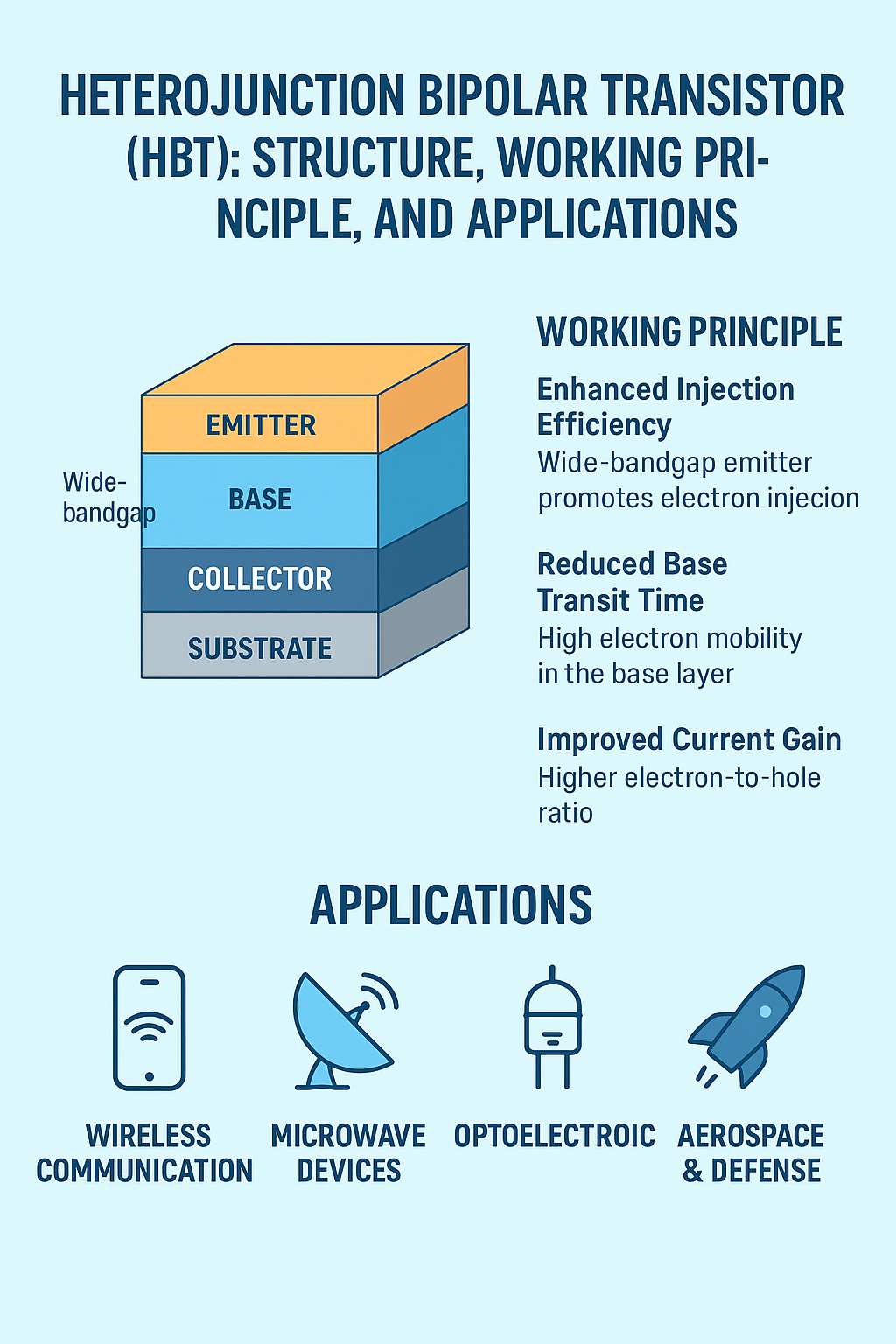
The structure of an HBT is similar to that of a conventional BJT but with a crucial difference: the emitter-base junction is a heterojunction instead of a homojunction.
Key Layers of HBT:
- Emitter:
- Made from a wide-bandgap semiconductor (e.g., AlGaAs, InGaP).
- Prevents hole injection into the emitter and enhances electron injection efficiency.
- Base:
- Constructed from a narrower bandgap semiconductor (e.g., GaAs, InGaAs).
- Allows for faster carrier transport due to high electron mobility.
- Collector:
- Similar to conventional transistors, it collects carriers injected from the base.
- Substrate:
- Often made from GaAs, InP, or Si, depending on the desired frequency and efficiency.
This bandgap engineering enables HBTs to achieve high current gain and excellent frequency response, which is critical for RF and microwave applications.
3. Working Principle of Heterojunction Bipolar Transistor (HBT)
The operation of an HBT is based on the same principles as a BJT, with current controlled by the injection of minority carriers across the base-emitter junction. However, the heterojunction design introduces major improvements:
- Enhanced Injection Efficiency:
The wide-bandgap emitter restricts hole injection while promoting electron injection into the base. - Reduced Base Transit Time:
Since the base material has high electron mobility, carriers travel faster, increasing the speed of the device. - Improved Current Gain:
A higher ratio of injected electrons to holes results in higher current amplification (β).
The result is a transistor that can operate efficiently at gigahertz (GHz) frequencies with low noise and high linearity.
4. Advantages of HBT over BJT
HBTs offer several advantages that make them superior to conventional BJTs in specific applications:
- High-Speed Performance:
Capable of operating in the GHz frequency range, making them ideal for RF communication. - Low Power Consumption:
HBTs provide high efficiency, especially in portable and wireless devices. - High Gain and Linearity:
Useful in amplifier circuits where signal distortion must be minimized. - Low Noise Characteristics:
Essential for sensitive communication systems like satellites and radar. - Temperature Stability:
HBTs are less sensitive to temperature variations compared to BJTs. - Integration Compatibility:
They can be integrated into complex semiconductor processes like GaAs and InP technologies for monolithic microwave integrated circuits (MMICs).
5. Applications of Heterojunction Bipolar Transistor (HBT)
The exceptional characteristics of HBTs make them indispensable in various fields:
a. Wireless Communication Systems
- Used in RF power amplifiers for mobile phones, Wi-Fi, and Bluetooth devices.
- Critical in 4G and 5G base stations for efficient signal transmission.
b. Microwave and Millimeter-Wave Devices
- Found in satellite communications, radar systems, and microwave radios.
- Operate efficiently at very high frequencies where BJTs and MOSFETs struggle.
c. Optoelectronic Devices
- Integrated into laser drivers, photodetectors, and optical communication systems.
- Provide high-speed switching for data transmission over optical fibers.
d. Aerospace and Defense
- Used in low-noise amplifiers (LNAs), phase shifters, and transceivers for radar and defense applications.
e. Mixed-Signal and Analog Circuits
- Deployed in high-speed digital-analog converters (DACs) and clock recovery circuits.
6. HBT vs Other Transistors
It is helpful to compare HBTs with other transistor technologies:
- HBT vs BJT:
HBT offers higher frequency response and better efficiency. - HBT vs MOSFET:
MOSFETs dominate in low-frequency and digital circuits, but HBTs excel in RF and analog applications. - HBT vs HEMT (High Electron Mobility Transistor):
HEMTs provide even higher frequency operation, but HBTs offer better linearity and integration for certain RF circuits.
7. Future of HBT Technology
With the rapid expansion of 5G, IoT, and satellite communication systems, the demand for HBT technology is increasing. Future advancements include:
- GaN-based HBTs for even higher power handling.
- Integration with CMOS technology for cost-effective, large-scale production.
- Improved energy efficiency for sustainable electronics.
HBTs will continue to play a vital role in enabling faster, more reliable, and energy-efficient communication networks.
Conclusion of Heterojunction Bipolar Transistor (HBT)
The Heterojunction Bipolar Transistor (HBT) is a groundbreaking advancement in semiconductor technology that overcomes the limitations of traditional BJTs. With its superior high-frequency performance, low noise, and high efficiency, HBT has become a cornerstone in RF amplifiers, microwave systems, and optoelectronics.
As communication technology advances toward 6G, satellite internet, and high-speed optical systems, the relevance of HBTs will only grow. For engineers and technology enthusiasts, understanding HBT is essential for grasping the future of modern electronics.