Electromagnetic waves concept ~ Electromagnetic (EM) waves are a cornerstone of modern science and technology. From enabling wireless communication to supporting medical imaging, these waves are everywhere around us—even if we can’t see them with the naked eye. In this article, we will explore what electromagnetic waves are, how they behave, their various types, and how they’re applied in real-life scenarios.
What Are Electromagnetic Waves?
Electromagnetic waves are waves of energy that consist of oscillating electric and magnetic fields. These fields are perpendicular to each other and to the direction in which the wave travels. Unlike mechanical waves, EM waves do not require a medium to propagate—they can travel through a vacuum.
Key Characteristics of Electromagnetic Waves:
- Transverse nature: Electric and magnetic fields are perpendicular to each other.
- Self-propagating: Once initiated, EM waves can propagate independently.
- Speed of light: In a vacuum, all EM waves travel at approximately 3 x 10⁸ meters per second.
- Frequency and wavelength: They are inversely related. Higher frequency means shorter wavelength and vice versa.
The Electromagnetic Spectrum
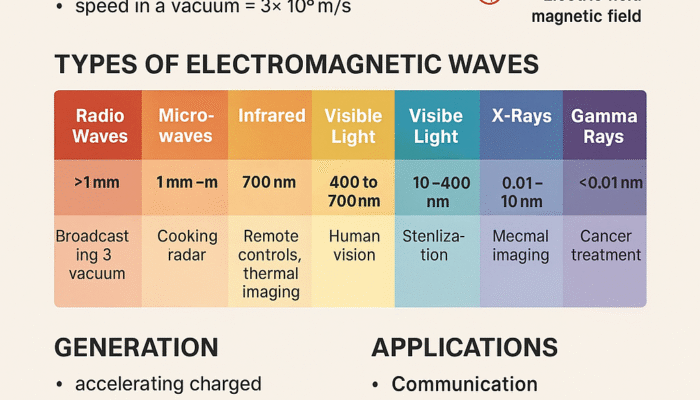
The electromagnetic spectrum encompasses all types of EM radiation, from low-frequency radio waves to high-frequency gamma rays. Here’s an overview of the spectrum, categorized by increasing frequency:
| Type | Wavelength | Frequency | Common Applications |
|---|---|---|---|
| Radio Waves | >1 mm | <300 GHz | Broadcasting, GPS, Wi-Fi |
| Microwaves | 1 mm – 1 m | 300 MHz – 300 GHz | Cooking, radar, satellite |
| Infrared (IR) | 700 nm – 1 mm | 300 GHz – 430 THz | Remote controls, thermal cameras |
| Visible Light | 400–700 nm | 430–770 THz | Human vision, optics |
| Ultraviolet (UV) | 10–400 nm | 770 THz – 30 PHz | Sterilization, tanning |
| X-rays | 0.01–10 nm | 30 PHz – 30 EHz | Medical imaging |
| Gamma Rays | <0.01 nm | >30 EHz | Cancer treatment, nuclear physics |
Wave Properties of EM Radiation
Every electromagnetic wave has certain properties:
- Amplitude (A): Determines the strength or intensity of the wave.
- Wavelength (λ): The distance between two consecutive crests or troughs.
- Frequency (f): The number of oscillations per second, measured in Hertz (Hz).
- Speed (c): In a vacuum, c = λ × f = 3 × 10⁸ m/s.
How Are Electromagnetic Waves Concept Generated?
EM waves are typically generated when charged particles accelerate. For instance:
- Antennas emit radio waves when alternating current passes through them.
- Thermal radiation occurs when heat causes particles to vibrate and release IR waves.
- Atomic transitions produce visible, UV, and X-rays when electrons shift energy levels.
Applications of Electromagnetic Waves Concept
Electromagnetic waves play a vital role across various sectors:
1. Communication
- Radio waves are used for AM/FM radio, walkie-talkies, and maritime communication.
- Microwaves enable satellite communications, Wi-Fi, and mobile phones.
2. Medicine
- X-rays allow doctors to see inside the human body.
- Infrared is used in thermal imaging for detecting fevers or inflammation.
- Gamma rays are used in cancer radiotherapy and sterilization.
3. Industry and Science
- Microwaves are used in radar systems for navigation and weather prediction.
- UV light helps in curing plastics, disinfection, and forensic analysis.
4. Everyday Technology
- Remote controls use infrared.
- LED lights emit visible EM radiation efficiently.
- Solar panels absorb visible and infrared light to generate electricity.
Electromagnetic Waves Concept in Nature
In nature, EM waves are emitted by:
- The sun, which radiates across the full spectrum, including visible, UV, and IR.
- Lightning, which generates radio waves.
- Distant stars and galaxies, which astronomers study using telescopes designed to detect X-rays, radio waves, and more.
Safety and Health Considerations
While EM waves are essential, some types can be hazardous:
- Excessive exposure to UV rays can cause skin damage or cancer.
- Prolonged exposure to X-rays or gamma rays can damage cells and DNA.
- Microwave and radio frequency radiation, though generally safe in low doses, must be regulated near industrial sources.
Safety Tip: Devices like microwave ovens and X-ray machines are shielded to prevent excessive exposure.
Scientific Breakthroughs Using EM Waves
Electromagnetic wave theory has led to groundbreaking discoveries, such as:
- Wireless power transfer
- Fiber optic communication
- MRI scanning
- Hubble and James Webb space telescopes
Summary Table: Electromagnetic Waves Concept and Their Uses
| EM Wave Type | Main Use |
|---|---|
| Radio | Broadcasting, navigation |
| Microwave | Radar, communication |
| Infrared | Heating, night vision |
| Visible Light | Illumination, imaging |
| UV | Sterilization, security |
| X-Ray | Medical diagnostics |
| Gamma Ray | Radiotherapy, nuclear science |
Conclusion Electromagnetic Waves Concept
Understanding electromagnetic waves is essential for grasping how our world is connected and how technology works. Whether it’s tuning in to a radio station, taking an X-ray, or browsing the internet on a smartphone, you are using electromagnetic waves. Their versatility and ubiquitous presence make them one of the most impactful discoveries in physics.
As technology continues to evolve, so too will our methods of generating, controlling, and using electromagnetic waves for the betterment of society.