
Introduction of Coupling Capacitor
In the world of electronics, capacitors are among the most versatile and widely used components. They serve in energy storage, filtering, tuning, and many other functions. One particular type of application is the coupling capacitor, a capacitor used to transfer alternating current (AC) signals from one circuit stage to another while blocking direct current (DC).
Coupling capacitors are critical in amplifiers, signal processing circuits, and communication systems, where they maintain the integrity of signals while isolating unwanted DC components. This article explores the definition, working principle, importance, and real-world applications of coupling capacitors to help you understand their role in electronic design.
What is a Coupling Capacitor?
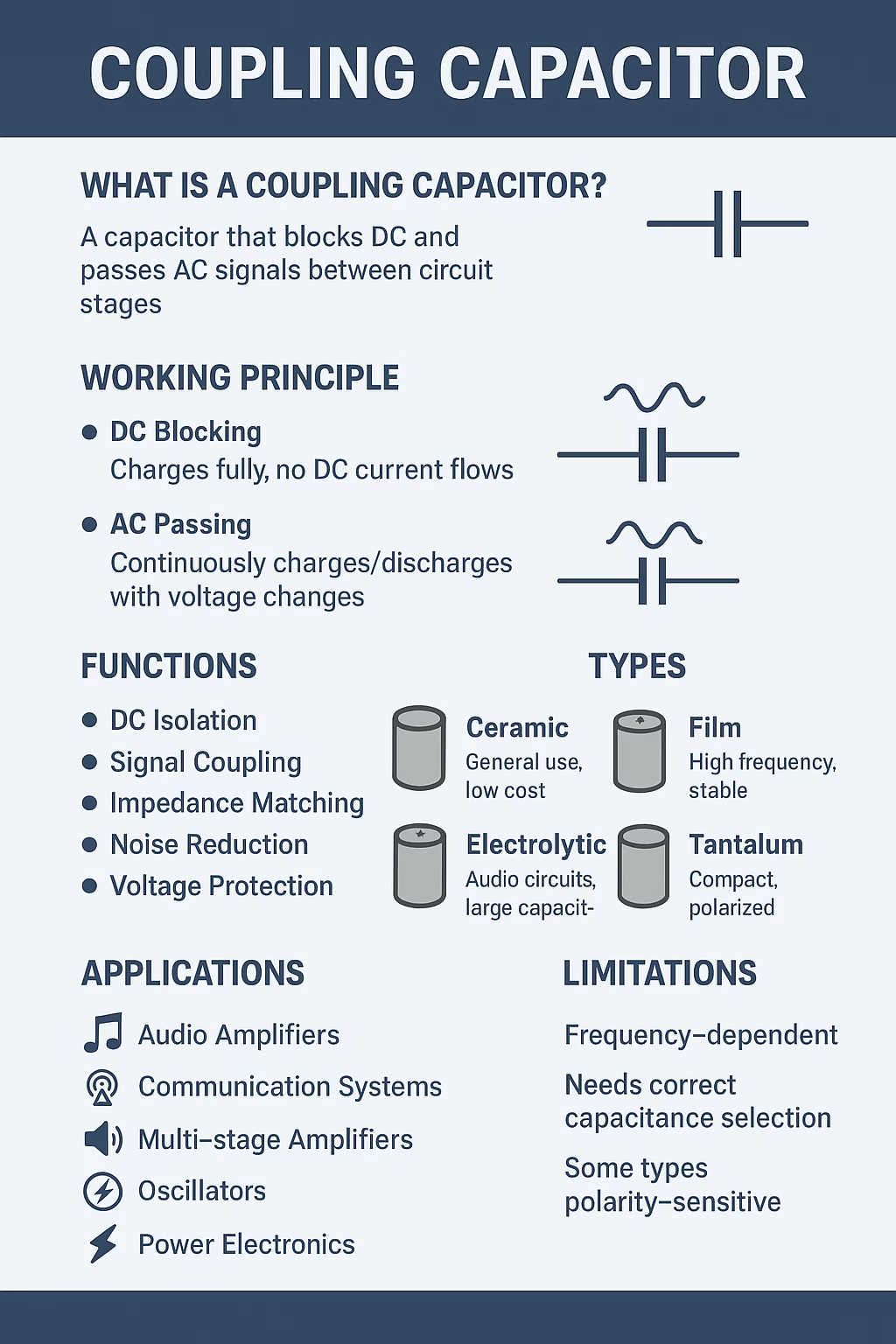
A coupling capacitor is a capacitor placed between two circuit stages to allow AC signals to pass through while preventing the DC bias voltage from transferring between stages.
- Primary Role: To isolate DC components while enabling the smooth transmission of AC signals.
- Secondary Role: To protect sensitive parts of a circuit from unwanted DC interference.
For example, in an audio amplifier, a coupling capacitor allows the audio signal (AC) to pass to the next stage while blocking DC bias that could distort or damage subsequent circuits.
How Does a Coupling Capacitor Work?
To understand its operation, it’s important to know the capacitor’s fundamental property:
- A capacitor blocks DC after being fully charged.
- A capacitor allows AC signals to pass, because the continuous change in voltage across its plates causes a charging and discharging effect.
Working Principle
- DC Blocking: When a DC voltage is applied, the capacitor initially charges but soon reaches a steady state where no current flows. Thus, the DC part of the signal is blocked.
- AC Passing: When an AC signal is applied, the capacitor continuously charges and discharges as the voltage changes, effectively transmitting the AC signal.
This selective transmission is the foundation of a coupling capacitor’s function in amplifiers, filters, and communication systems.
Key Functions of a Coupling Capacitor
- DC Isolation: Prevents unwanted DC voltage from passing to the next stage of a circuit.
- Signal Coupling: Ensures only the desired AC signal is transmitted without distortion.
- Impedance Matching: Helps match the impedance between circuit stages to minimize signal loss.
- Noise Reduction: Reduces unwanted interference by blocking DC offsets.
- Voltage Protection: Protects sensitive components from excessive DC voltage.
Types of Coupling Capacitor
Coupling capacitors can be made from various dielectric materials depending on their application. Common types include:
- Ceramic Capacitors: Widely used due to their affordability and reliability.
- Electrolytic Capacitors: Suitable for applications requiring large capacitance values, such as audio circuits.
- Film Capacitors: Preferred for high-frequency applications due to their stability and low distortion.
- Tantalum Capacitors: Compact with high capacitance but used with caution due to polarity sensitivity.
Applications of Coupling Capacitor
Coupling capacitors are indispensable in many areas of electronics. Some notable applications include:
1. Audio Systems
In amplifiers and sound systems, coupling capacitors block DC bias while allowing audio signals to pass. This ensures that only the pure sound signal reaches the next stage.
2. Communication Circuits
In radio frequency (RF) and communication systems, coupling capacitors allow signal transmission between circuit stages while eliminating DC interference that could distort the communication signal.
3. Amplifiers
In multi-stage amplifiers, coupling capacitors transfer the amplified signal from one stage to another while isolating DC. Without them, DC from one stage could alter the biasing of the next stage, causing distortion or malfunction.
4. Oscillators
Coupling capacitors play a role in frequency-determining circuits, ensuring stable oscillations without DC interference.
5. Power Electronics
In inverter and converter circuits, coupling capacitors are used to block DC while ensuring AC power transfer.
Advantages of Coupling Capacitor
- Simple and cost-effective component.
- Provides reliable AC transmission.
- Protects circuits from DC damage.
- Reduces noise and distortion in signals.
- Available in a wide range of values and materials.
Limitations of Coupling Capacitor
While coupling capacitors are vital, they have some drawbacks:
- Frequency Dependence: Their effectiveness decreases at very low frequencies due to capacitive reactance.
- Capacitance Value Sensitivity: If not chosen correctly, they may distort signals or attenuate low-frequency components.
- Polarity Concerns: Electrolytic capacitors require correct polarity to function safely.
How to Choose the Right Coupling Capacitor
When selecting a coupling capacitor, consider the following factors:
- Capacitance Value: Should be chosen based on the lowest frequency of the signal to avoid attenuation.
- Voltage Rating: Must be higher than the maximum voltage in the circuit.
- Dielectric Type: Depending on the application (e.g., ceramic for high-frequency, electrolytic for audio).
- Size and Cost: Depending on circuit design constraints.
Formula for Selection
The reactance of a capacitor is given by:
Xc=1/2πfC
Where:
- XcX = Capacitive reactance (ohms)
- f = Frequency (Hz)
- C = Capacitance (farads)
To ensure minimal attenuation, the capacitive reactance should be much smaller than the input resistance of the next stage.
Conclusion
A coupling capacitor is a simple yet essential component in electronic circuits. Its ability to block DC while transmitting AC signals makes it indispensable in amplifiers, audio systems, communication devices, and many other applications. By ensuring signal integrity, impedance matching, and noise reduction, coupling capacitors play a vital role in the smooth functioning of modern electronic devices.
When choosing a coupling capacitor, careful consideration of capacitance value, frequency response, and dielectric type ensures optimal performance. As technology evolves, coupling capacitors will continue to be a cornerstone in circuit design, proving that even small components can have a huge impact on electronics.