Ferrite beads are essential components in electronic circuits, particularly when it comes to noise suppression and electromagnetic interference (EMI) filtering. While their function may seem simple from the outside, the internal construction and material composition of ferrite beads are engineered with precision. This article dives deep into the construction of ferrite beads, exploring their materials, physical structures, design variations, and manufacturing processes.
1. What Is a Ferrite Bead?
A ferrite bead, also known as a ferrite choke or EMI filter, is a passive electronic component designed to suppress high-frequency noise in electronic circuits. It acts like a low-pass filter, allowing low-frequency signals to pass while attenuating high-frequency noise. This is achieved through a combination of inductance and magnetic losses.
2. Basic Construction of Ferrite Beads
At a high level, a ferrite bead consists of two main elements:
- Ferrite Core: The core is made from a ceramic compound of iron oxide mixed with other metals like manganese, zinc, or nickel.
- Conductive Path (Winding or Through-wire): A conductive wire or embedded conductor that passes through or is wound around the ferrite core.
These components are sometimes enclosed in a casing or integrated directly into printed circuit boards (PCBs), depending on their application.
3. Ferrite Core Materials
The material composition of the ferrite core is crucial to its performance. The core must exhibit specific magnetic and resistive properties to suppress high-frequency noise. Common types of ferrite materials used include:
- MnZn (Manganese-Zinc Ferrite):
- High permeability
- Suitable for frequencies below 5 MHz
- Commonly used in power applications
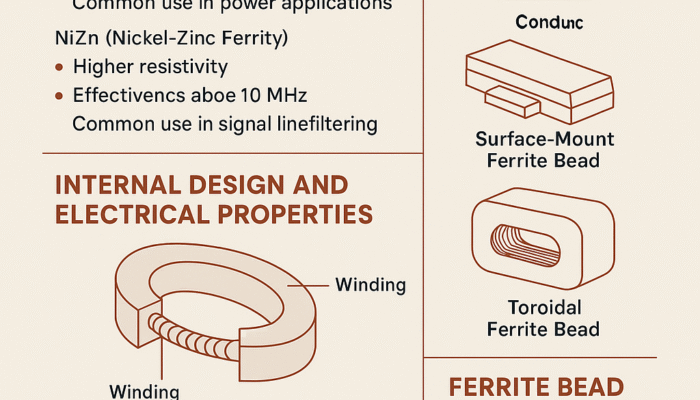
- NiZn (Nickel-Zinc Ferrite):
- Higher resistivity
- Effective at frequencies above 10 MHz
- Common in signal line filtering
These materials are sintered at high temperatures to create a ceramic-like magnetic core with high magnetic losses at high frequencies — a property that helps in absorbing and dissipating EMI.
4. Types of Construction of Ferrite Beads
There are different construction styles of ferrite beads depending on their application. The main types include:
A. Through-Hole Ferrite Beads (Axial or Radial)
- A cylindrical ferrite core with a leaded wire running through the center.
- Simple construction, easy to implement in older or high-power PCB designs.
- Good for high-current applications.
B. Construction of Ferrite Beads Surface-Mount Ferrite Beads (SMD)
- Compact rectangular or cylindrical shapes designed for automated PCB assembly.
- Ideal for space-constrained and high-frequency circuits.
- Encapsulated with epoxy resin or ceramic coatings.
C. Toroidal Ferrite Beads
- Wire wound around a toroidal (doughnut-shaped) ferrite core.
- Offers excellent EMI suppression due to closed magnetic path.
- Used in power supplies and RF circuits.
5. Internal Design and Electrical Properties
A ferrite bead works by combining inductive reactance and resistive losses at high frequencies. Its impedance increases with frequency, making it ideal for attenuating unwanted RF signals.
Internally, the construction ensures:
- Controlled Impedance Curve: Designed to peak at certain frequency ranges.
- High-Frequency Suppression: Due to eddy currents and hysteresis loss in the ferrite core.
- Thermal Stability: Material choice and sintering ensure reliable performance over temperature variations.
6. Ferrite Bead Manufacturing Process
The manufacturing of ferrite beads involves multiple steps:
- Material Preparation:
- Iron oxide and other metal oxides are mixed and milled into fine powder.
- Binders and additives are added for shaping and sintering.
- Pressing and Shaping:
- The powder is pressed into desired shapes (e.g., toroid, cylinder, or block).
- Sintering:
- The shaped cores are sintered at high temperatures (over 1000°C) in a controlled atmosphere to form the ceramic-like ferrite structure.
- Machining and Coating:
- Post-sintering, the ferrite cores are ground, polished, and coated (if necessary) for electrical insulation or protection.
- Assembly:
- For wire-based designs, conductive wires are inserted or wound.
- For SMDs, terminals are attached and soldered.
- Testing and Quality Control:
- Finished beads undergo electrical and mechanical testing to verify impedance, current rating, and frequency performance.
7. Key Parameters in Ferrite Bead Design
When designing or selecting ferrite beads, engineers consider several key specifications:
- Impedance (Ω) at specific frequency (usually 100 MHz)
- DC resistance (DCR)
- Rated current (maximum continuous current)
- Operating temperature range
- Frequency response (attenuation vs frequency)
These parameters are influenced directly by the bead’s internal construction and material.
8. Applications and Importance of Construction
The quality and style of ferrite bead construction impact its performance across applications like:
- Consumer Electronics: Smartphones, laptops, TVs for signal filtering
- Automotive Systems: Noise suppression in engine control units (ECUs)
- Industrial Equipment: Reducing EMI in power supplies and PLCs
- Medical Devices: Protecting sensitive analog circuitry
- Communication Devices: Preventing high-frequency interference in data lines
A poorly constructed ferrite bead can cause overheating, insufficient filtering, or circuit malfunction.
9. Innovations in Ferrite Bead Construction
Recent advancements focus on:
- Miniaturization: Ultra-compact SMD beads for modern compact devices
- Broadband Filtering: Enhanced materials with wide frequency suppression
- Integrated Passive Devices (IPDs): Ferrite integrated with capacitors and resistors in a single chip
Conclusion of Construction of Ferrite Beads
The construction of ferrite beads plays a critical role in their ability to filter unwanted high-frequency noise in electronic systems. From choosing the right core material to designing the proper shape and impedance characteristics, manufacturers and engineers must carefully align the bead’s structure with its intended application. Understanding these construction details enables more effective noise suppression, better circuit performance, and greater reliability in today’s high-speed electronic environments.
Whether you’re designing a PCB or troubleshooting EMI issues, recognizing the intricacies of ferrite bead construction helps you make better design decisions.