Introduction of Classification of Electronic Components
Electronic components are the fundamental building blocks of all electronic circuits. From the simplest LED flashlight to advanced computers and communication systems, electronic components play a vital role in enabling functionality. Understanding the classification of electronic components is essential for students, hobbyists, and professionals in the field of electronics.
This article explores the classification of electronic components into three major categories: passive components, active components, and electromechanical components. We will cover their definitions, functions, examples, and applications in real-world electronics.
1. What Are Electronic Components?
Electronic components are individual devices or elements within an electronic circuit that perform specific functions such as amplification, switching, signal modulation, or power regulation. They can be discrete components (such as resistors, diodes, capacitors) or integrated devices (such as microcontrollers and ICs).
The classification of electronic components is generally based on their function, energy requirements, and behavior in an electronic circuit.
Read More about What Are Electronic Components? A Complete Beginner’s Guide
2. Main Classification of Electronic Components
Electronic components are usually divided into three broad categories:
- Passive Components – Do not require external power to operate.
- Active Components – Require an external power source and can control electron flow.
- Electromechanical Components – Convert electrical signals into mechanical movement or vice versa.
Let’s explore each category in detail.
3. Passive Components
Definition
Passive components are electronic parts that cannot introduce power gain to a circuit. They only absorb, store, or release energy. These components do not require an external power supply to function.
Key Passive Components
- Resistors – Control the flow of current by offering resistance.
- Example: Carbon film resistor, variable resistor (potentiometer).
- Applications: Voltage divider, current limiting.
- Capacitors – Store and release electrical energy in the form of an electric field.
- Example: Ceramic capacitor, electrolytic capacitor.
- Applications: Power supply filtering, signal coupling.
- Inductors – Store energy in the form of a magnetic field.
- Example: Air-core inductor, ferrite-core inductor.
- Applications: Power supply filtering, RF tuning.
- Transformers – Transfer electrical energy between two circuits using magnetic induction.
- Applications: Voltage step-up/step-down, isolation in power systems.
Characteristics of Passive Components
- Do not amplify signals.
- Do not require external power.
- Used for energy storage, filtering, or resistance.
Read More about Understanding Passive Electronic Components: Types, Functions, and Applications
4. Active Components
Definition
Active components are devices that can amplify signals, control electron flow, and require an external power source to operate. They are the heart of modern electronics, found in microprocessors, communication devices, and power electronics.
Key Active Components
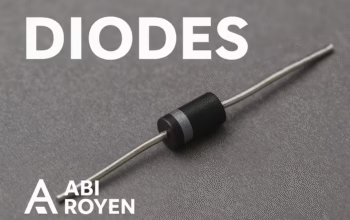
- Diodes – Allow current to flow in one direction only.
- Types: Rectifier diode, Zener diode, Light Emitting Diode (LED).
- Applications: Rectification, voltage regulation, light emission.
- Transistors – Used for amplification and switching.
- Types: Bipolar Junction Transistor (BJT), Field-Effect Transistor (FET).
- Applications: Signal amplification, logic circuits, switching regulators.
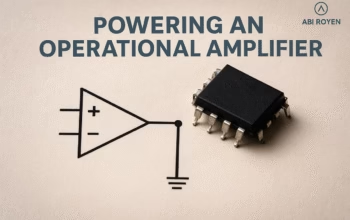
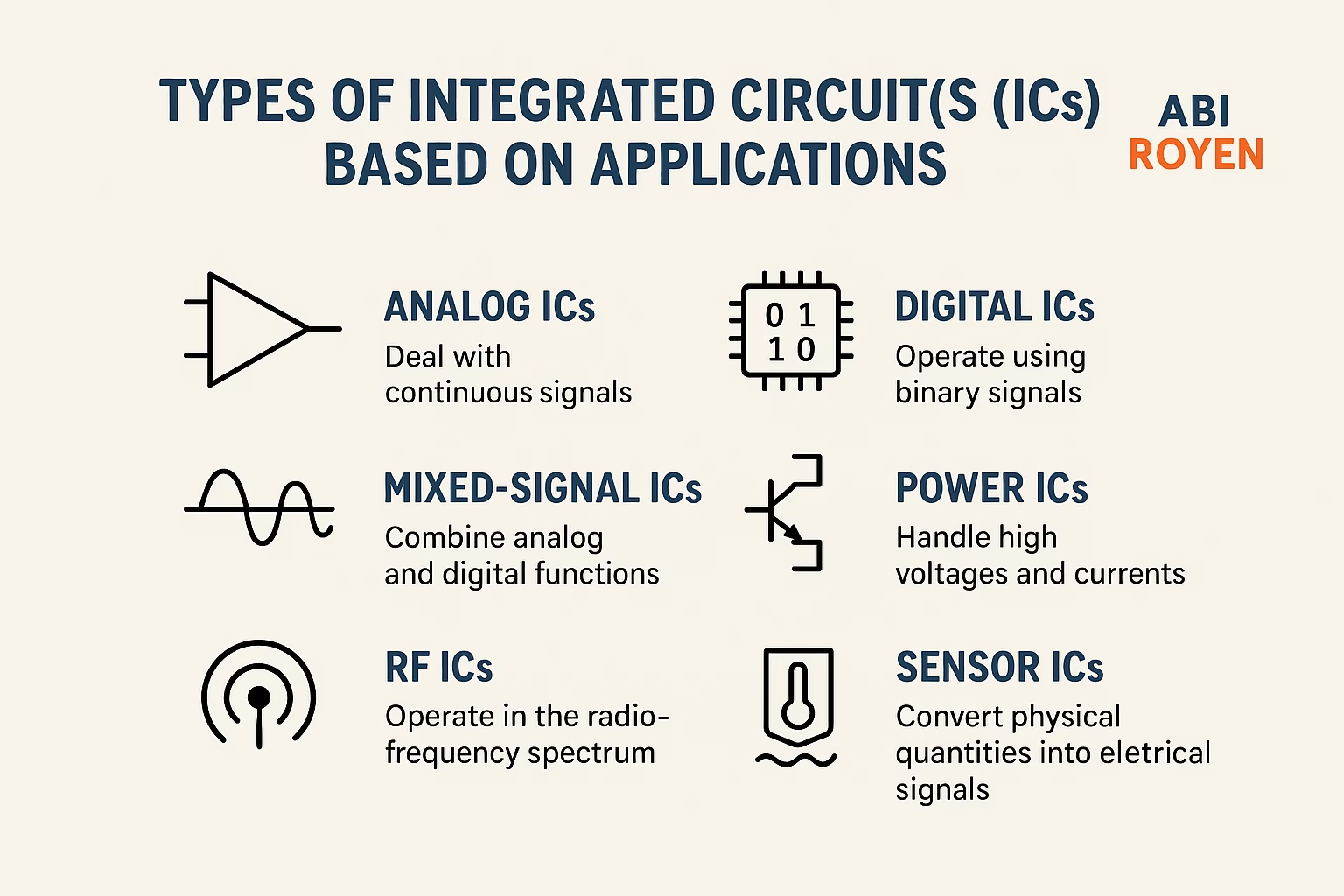
- Integrated Circuits (ICs) – Miniaturized circuits containing multiple transistors, resistors, and capacitors.
- Types: Analog ICs, Digital ICs, Mixed-signal ICs.
- Applications: Microcontrollers, amplifiers, logic gates.
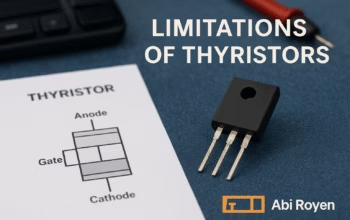
- Thyristors (SCRs) – Semiconductor devices used for high-power switching.
- Applications: Motor control, power conversion.
Characteristics of Active Components
- Require external power to function.
- Capable of amplification and signal modulation.
- Essential for computing, communication, and control systems.
Read More about Understanding Active Electronic Components: Types, Functions, and Applications
5. Electromechanical Components
Definition
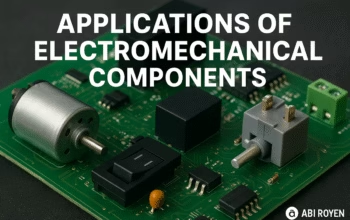
Electromechanical components are devices that use electrical energy to create mechanical movement, or vice versa. These are crucial for interaction between electronic circuits and mechanical systems.
Key Electromechanical Components
- Relays – Electrically operated switches used to control circuits.
- Applications: Automation, motor control, safety systems.
- Switches – Manually operated devices for turning circuits ON or OFF.
- Applications: Everyday electronic appliances, control panels.
- Motors – Convert electrical energy into mechanical motion.
- Types: DC motors, Stepper motors, Servo motors.
- Applications: Robotics, fans, industrial machines.
- Generators – Convert mechanical energy into electrical energy.
- Applications: Power generation, renewable energy systems.
Characteristics of Electromechanical Components
- Convert energy between electrical and mechanical forms.
- Involve moving parts (unlike passive or active components).
- Widely used in automation and control systems.
Read More about Electromechanical Components: Types, Functions, and Applications

6. Differences Between Passive, Active, and Electromechanical Components
| Feature | Passive Components | Active Components | Electromechanical Components |
|---|---|---|---|
| Power Requirement | No external power needed | Require external power | May or may not require power |
| Function | Store, resist, or filter energy | Amplify and control current | Convert electrical ↔ mechanical energy |
| Examples | Resistor, Capacitor, Inductor | Diode, Transistor, IC | Relay, Motor, Switch |
| Applications | Filtering, tuning, dividing voltage | Amplification, computing, regulation | Automation, actuation, control |
7. Applications of Electronic Components in Daily Life
- Consumer Electronics: Smartphones, laptops, televisions.
- Automotive Industry: Engine control units, sensors, electric motors.
- Medical Devices: ECG machines, MRI scanners, pacemakers.
- Industrial Automation: Robotics, programmable logic controllers (PLCs).
- Renewable Energy: Solar inverters, wind turbine controllers.
Every sector relies on the proper classification and application of electronic components for efficiency and reliability.
Read More about
8. Why Classification of Electronic Components Matters
Understanding how electronic components are classified is crucial because:
- It simplifies circuit design.
- Helps engineers choose the right component for a specific function.
- Improves troubleshooting and repair processes.
- Enhances learning for students and beginners.
Conclusion of Classification of Electronic Components
The classification of electronic components into passive, active, and electromechanical categories provides a structured way to understand their roles in electronic circuits. Passive components handle energy storage and resistance, active components amplify and control signals, while electromechanical components bridge the gap between electronics and mechanical systems.
By mastering this classification, students, hobbyists, and professionals can design, analyze, and repair electronic circuits with greater confidence.