Inductors are fundamental passive components widely used in electronics, yet they often receive less attention compared to resistors and capacitors. Selecting the correct inductor can significantly impact the efficiency, performance, and reliability of your circuit. Whether you are an engineer designing a power supply, a hobbyist building a radio circuit, or a student learning electronics, understanding how to choose the right inductor is essential.
This article provides a comprehensive guide to choosing an inductor, covering its types, parameters, applications, and best practices.
What is an Inductor?
An inductor is a passive component that stores energy in a magnetic field when current flows through it. It typically consists of a wire wound into a coil, sometimes around a magnetic core. Inductors resist changes in current, making them useful in filtering, energy storage, tuning circuits, and managing electromagnetic interference (EMI).
The unit of inductance is the Henry (H), but practical inductors are often measured in millihenries (mH), microhenries (µH), or even nanohenries (nH).
Why Choose the Right Inductor Matters
Inductor choice is not arbitrary. Using the wrong inductor can lead to issues such as:
- Circuit inefficiency (higher power losses)
- Overheating due to excessive current
- Poor signal filtering in audio or RF circuits
- Noise problems in sensitive electronics
- System failure in power supply designs
Therefore, correct inductor selection is vital for stability, efficiency, and safety in circuits.
Key Parameters to Consider When Choose the Right Inductor
When selecting an inductor, several parameters should be taken into account:
1. Inductance Value (L)
- Defines how much energy the inductor can store.
- Measured in Henry (H), typically in µH or mH for practical circuits.
- Choose the value based on your circuit requirement, such as in filtering, resonance, or energy storage.
2. Rated Current
- The maximum current the inductor can handle without saturating or overheating.
- Exceeding this current can lead to core saturation, causing reduced inductance and inefficiency.
3. DC Resistance (DCR)
- Represents the resistance of the inductor’s winding.
- Lower DCR means less power loss, making it important for power supply and high-efficiency circuits.
4. Quality Factor (Q Factor)
- Describes the efficiency of the inductor at a specific frequency.
- A higher Q indicates lower losses, which is important in RF and communication circuits.
5. Self-Resonant Frequency (SRF)
- The frequency at which the inductor stops behaving as an inductor and starts to act like a capacitor due to parasitic effects.
- Ensure the SRF is well above your operating frequency.
6. Core Material
- Air Core: Ideal for high-frequency applications but physically larger.
- Ferrite Core: Common for switching power supplies and EMI suppression.
- Iron Powder Core: Stable over temperature and useful in RF circuits.
7. Size and Packaging
- For compact electronics, SMD (Surface-Mount Device) inductors are popular.
- For higher currents, through-hole inductors with larger cores are preferred.
Types of Inductors and Their Applications
Understanding different inductor types helps in selecting the right one for your project.
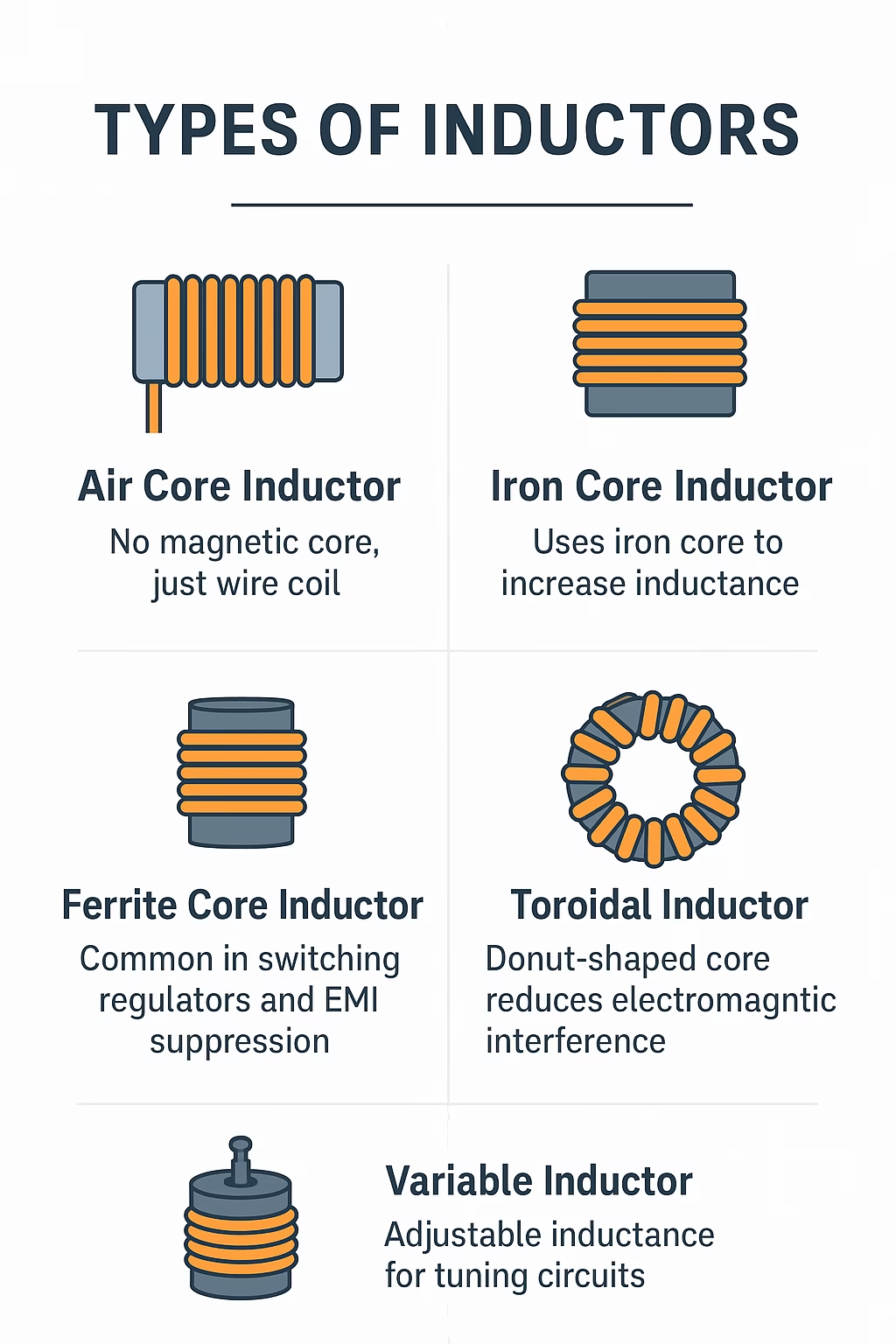
- Air Core Inductors
- No magnetic core, just wire coil.
- Best for RF circuits, radio tuning, and high-frequency filters.
- Iron Core Inductors
- Uses iron core to increase inductance.
- Suitable for low-frequency applications like audio equipment and power supplies.
- Ferrite Core Inductors
- Common in switching regulators and EMI suppression.
- High permeability and efficiency.
- Toroidal Inductors
- Donut-shaped core reduces electromagnetic interference.
- Used in power electronics and transformers.
- Variable Inductors
- Adjustable inductance for tuning circuits.
- Common in radios and communication systems.
Step-by-Step Guide to Choose the Right Inductor
Here is a structured approach to selecting the right inductor:
- Define Circuit Requirement
- Is it for filtering, energy storage, resonance, or EMI suppression?
- Determine Operating Frequency
- High-frequency circuits require inductors with high SRF and low losses.
- Calculate Inductance Value (L)
- Use circuit equations or simulation software to estimate the required inductance.
- Check Current Rating
- Ensure the inductor can handle peak and average currents without saturation.
- Consider Core Type
- Air core for RF, ferrite for power, iron powder for stability.
- Review Size and Mounting
- SMD for compact devices, through-hole for higher current handling.
- Verify with Datasheets
- Always consult manufacturer specifications before finalizing.
Practical Applications of Inductors
- Power Supplies
- Used in DC-DC converters, energy storage, and smoothing ripple.
- Filters
- Low-pass, high-pass, and band-pass filters rely on inductors with capacitors.
- Transformers
- Inductors are the building blocks of transformers for voltage conversion.
- RF Circuits
- Tuning circuits in radios and wireless communication.
- EMI Suppression
- Choke inductors block unwanted high-frequency noise.
Tips for Beginners and Hobbyists
- Start with commonly available inductors like 10 µH, 100 µH, and 1 mH.
- Use online calculators or simulation tools (LTspice, Multisim) to test values.
- When unsure, choose an inductor with a higher current rating than your estimated need.
- Always double-check core type and self-resonant frequency.
Conclusion of Choose the Right Inductor
Choosing the right inductor is a balance of inductance value, current rating, frequency response, and core type. By understanding these parameters and following a structured selection process, engineers and hobbyists can design more efficient, reliable, and noise-free circuits.
The next time you’re working on a power supply, filter, or RF application, take the time to carefully evaluate your inductor choice—it can make a world of difference in performance.