Inductors are fundamental passive components widely used in electrical and electronic circuits. Their primary function is to store energy in a magnetic field when electrical current flows through them. While their functionality might seem simple at first glance, understanding the various characteristics of inductors is essential for effective circuit design and troubleshooting. These characteristics influence the inductor’s behavior in both AC and DC systems, impacting the performance, stability, and efficiency of electrical systems.
In this comprehensive article, we will explore the main characteristics of inductors, including inductance, resistance, core type, frequency behavior, and more. Whether you are a student, engineer, or hobbyist, understanding these parameters will give you a deeper insight into how inductors function and how to use them effectively in practical applications.
What Is an Inductor?
An inductor is a passive two-terminal electrical component that resists changes in current. It typically consists of a coil of conducting wire, often wound around a magnetic or non-magnetic core. When current flows through the coil, a magnetic field is created, which stores energy.
The unit of inductance is the Henry (H). Inductors are found in power supplies, filters, transformers, radios, and various electronic systems, especially in circuits where current regulation, filtering, or energy storage is required.
Key Characteristics of Inductors
Understanding the following characteristics is crucial when selecting or analyzing inductors in any electronic design.
1. Inductance (L)
- Definition: Inductance is the ability of an inductor to oppose changes in current. It quantifies how much magnetic flux is produced for a given current.
- Measured in: Henry (H), typically millihenries (mH) or microhenries (µH) in practical circuits.
- Influencing Factors:
- Number of coil turns
- Coil diameter
- Length of the coil
- Core material (air, ferrite, iron)
Higher inductance results in a stronger opposition to changes in current, making it suitable for filtering low-frequency signals.
2. DC Resistance (DCR)
- Definition: The resistance of the coil wire when direct current flows through it.
- Measured in: Ohms (Ω)
- Importance: Lower DCR indicates lower energy loss and heat generation. However, some designs require a certain resistance value for stabilization or damping.
3. Characteristics of Inductors Core Material
- Air Core: Lightweight and linear with frequency, but lower inductance.
- Ferrite Core: High magnetic permeability, ideal for high-frequency applications.
- Iron Core: High inductance and used in power applications, but prone to saturation.
The core material greatly influences the inductance, efficiency, and frequency response of the inductor.
4. Saturation Current
- Definition: The maximum current an inductor can carry before the core saturates and inductance drops significantly.
- Why It Matters: If an inductor operates near or beyond saturation, performance drops, and heat increases.
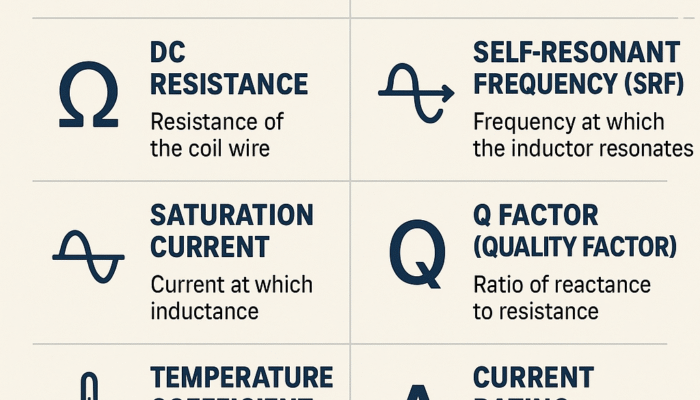
5. Self-Resonant Frequency (SRF)
- Definition: The frequency at which the inductive reactance equals the capacitive reactance due to parasitic capacitance, resulting in resonance.
- Above SRF: The inductor behaves like a capacitor and becomes ineffective.
- Design Implication: Always use inductors below their SRF for expected performance.
6. Characteristics of Inductors Q Factor (Quality Factor)
- Definition: The ratio of reactance to resistance (Q = XL / R). It indicates how efficiently an inductor stores energy versus losing it.
- Higher Q: Means lower energy loss.
- Application: Critical in RF circuits, filters, and resonant circuits where high performance is needed.
7. Temperature Coefficient
- Definition: Describes how inductance changes with temperature.
- Positive Coefficient: Inductance increases with temperature.
- Negative Coefficient: Inductance decreases with temperature.
- Relevance: Important in precision circuits and environments with variable temperatures.
8. Characteristics of Inductors Current Rating
- Definition: The maximum continuous current the inductor can safely handle without excessive temperature rise or magnetic saturation.
- Note: Always choose inductors rated higher than the circuit’s maximum operating current to ensure reliability.
9. Size and Mounting Type
- Through-Hole Inductors: Robust, better heat dissipation, used in power circuits.
- Surface Mount Inductors (SMD): Compact, ideal for high-density PCB layouts.
Physical size affects power rating and inductance. Larger inductors generally have higher ratings.
Inductor Behavior in Circuits
In DC Circuits:
- Initially resists current changes.
- Eventually behaves like a short circuit after reaching steady-state.
- Voltage across the inductor drops to zero once current is stable.
In AC Circuits:
- Constantly opposes changes in current.
- The inductive reactance increases with frequency (XL = 2πfL).
- Acts as a frequency-dependent resistor.
Applications of Inductors Based on Characteristics of Inductors
- Power Supplies: Energy storage and filtering of ripple currents.
- Filters: Low-pass, high-pass, and band-pass filters in audio and RF applications.
- Transformers: Energy transfer through mutual inductance.
- Chokes: Block high-frequency noise while allowing DC or low-frequency currents.
- Tuning Circuits: Used in combination with capacitors to create resonant circuits.
How to Choose the Right Inductor
When selecting an inductor, consider:
- Required inductance value
- Operating frequency
- DC resistance (DCR)
- Core material and shape
- Current and voltage ratings
- Mounting preference (SMD or through-hole)
Tip: Always check the manufacturer’s datasheet for critical parameters like SRF, saturation current, and temperature ratings.
Conclusion of Characteristics of Inductors
Inductors are indispensable components in electronics, and understanding their characteristics is vital for designing efficient and reliable circuits. From inductance and resistance to core materials and Q factor, each attribute affects how an inductor performs under various electrical conditions.
Whether you are designing a power supply, a communication device, or an audio filter, choosing the right inductor and knowing its behavior ensures optimal circuit functionality. Always consider your application’s specific requirements and consult component datasheets to make informed decisions.
📌 For more in-depth articles on electronic components, visit:
🌐 Abi Royen – abiroyen.com