Introduction
Electronic components form the backbone of modern technology. Every device, from a smartphone to an advanced aerospace system, relies on these components to function effectively. Understanding the applications of electronic components not only highlights their importance but also reveals how they enable innovation across diverse industries.
This article explores the practical applications of electronic components such as resistors, capacitors, diodes, transistors, semiconductors, and sensors in different fields, including consumer electronics, industrial automation, automotive systems, healthcare, aerospace, and renewable energy.
1. Overview of Electronic Components
Electronic components are physical devices used in electronic circuits to control the flow of current, store energy, or perform specific functions. They are broadly divided into active components (such as transistors and diodes) and passive components (such as resistors, capacitors, and inductors).
- Resistors: Control current flow and divide voltage.
- Capacitors: Store and release electrical energy.
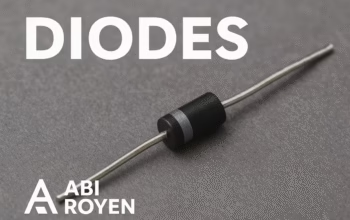
- Diodes: Allow current to flow in one direction only.
- Transistors: Amplify signals and act as electronic switches.
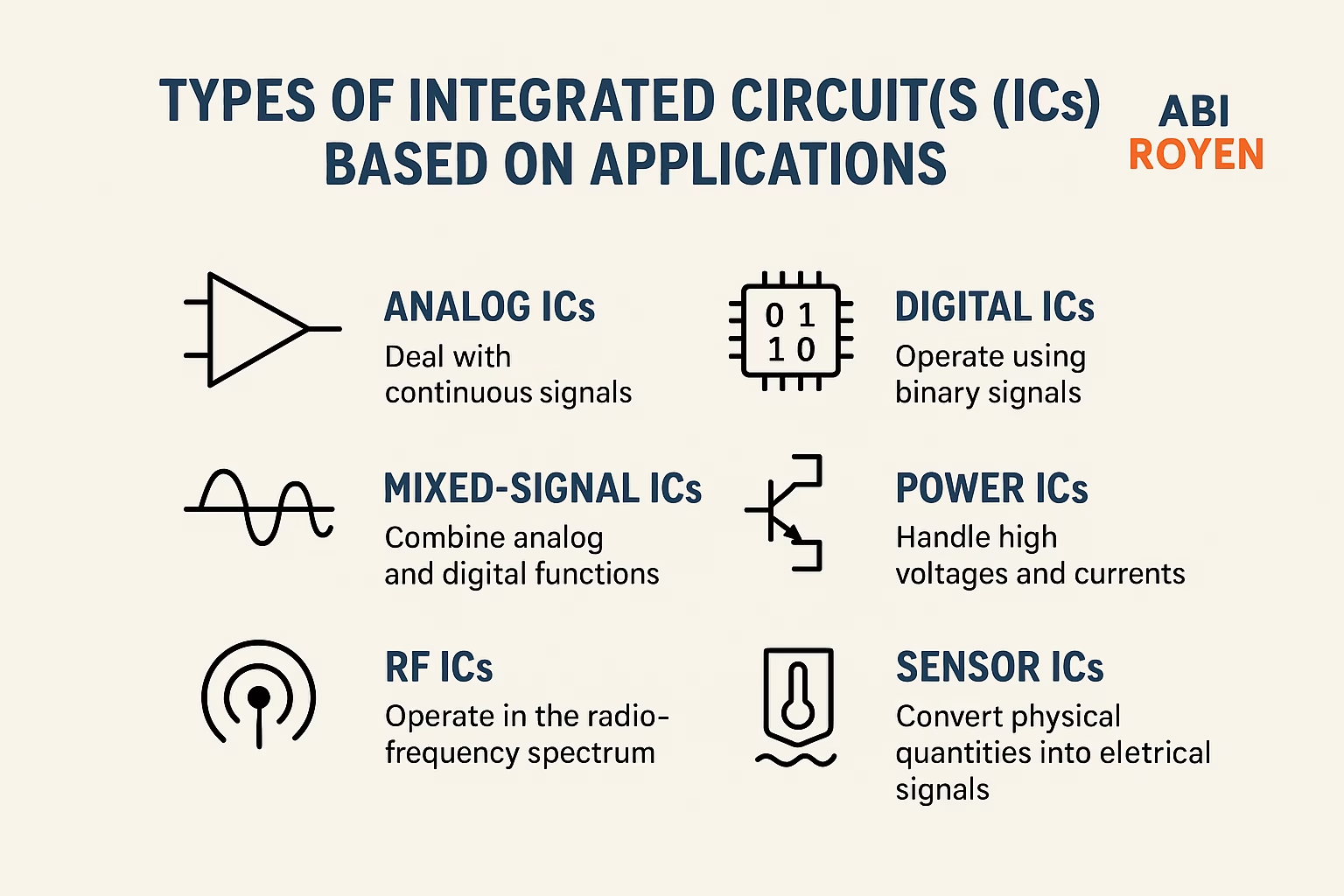
- Integrated Circuits (ICs): Combine multiple components into a single chip.
- Sensors: Detect physical changes (temperature, light, motion, etc.) and convert them into electrical signals.
These components are combined to build circuits that drive real-world applications.
2. Applications of Electronic Components in Consumer Electronics
Consumer electronics is one of the largest markets for electronic components. Devices like smartphones, laptops, televisions, and wearable gadgets rely heavily on advanced circuits.
- Resistors and capacitors regulate voltage and stabilize power supply.
- Transistors enable high-speed processing in microprocessors.
- Sensors power features like facial recognition, fingerprint scanning, and touchscreens.
- Batteries and power management ICs ensure efficient energy usage.
For example, in smartphones, sensors detect orientation, while ICs manage communication, display, and storage functions.
3. Applications of Electronic Components in Automotive Industry
Modern vehicles are increasingly becoming electronic machines on wheels. Electronic components play critical roles in safety, performance, and connectivity.
- Sensors monitor tire pressure, detect obstacles, and assist with parking.
- Microcontrollers regulate engine performance and fuel efficiency.
- Capacitors and diodes stabilize voltage in automotive electronics.
- Semiconductors drive electric vehicle (EV) powertrains.
Advanced driver assistance systems (ADAS) and electric mobility would not be possible without these components.
4. Applications of Electronic Components in Industrial Automation
Factories and industrial processes are heavily automated today, relying on electronics for precision and efficiency.
- Programmable Logic Controllers (PLCs) use ICs and transistors to control machinery.
- Sensors detect pressure, temperature, and flow rates in industrial equipment.
- Resistors and capacitors ensure stability in high-power circuits.
- Power electronics (IGBTs, MOSFETs) manage motors and heavy machinery.
These applications reduce human error, improve productivity, and support Industry 4.0 transformations.

5. Applications of Electronic Components in Healthcare and Medical Devices
The healthcare sector depends on accurate and reliable electronic systems. From patient monitoring to diagnostic imaging, electronic components are essential.
- Sensors measure vital signs like heart rate, oxygen levels, and blood pressure.
- ICs process medical imaging data (MRI, CT scans).
- Capacitors and batteries provide stable power in portable medical devices.
- Diodes and LEDs are used in medical lasers and phototherapy equipment.
Wearable health trackers and telemedicine devices also rely on miniature, low-power electronic components.
6. Applications in Aerospace and Defense
In aerospace and defense, reliability and precision are critical. Electronic components are designed to withstand extreme conditions.
- Radiation-hardened semiconductors are used in satellites.
- Sensors support navigation, altimetry, and environmental monitoring.
- Capacitors and resistors regulate high-frequency signals in radar systems.
- Microprocessors and ICs manage avionics and defense communication systems.
These components enable safer flights, advanced surveillance, and space exploration.
7. Applications in Renewable Energy
Sustainable energy solutions rely on electronics for conversion, storage, and distribution.
- Power electronics (IGBTs, MOSFETs) manage solar inverters and wind turbines.
- Capacitors smooth fluctuations in renewable power systems.
- Sensors monitor environmental data to optimize performance.
- Batteries and ICs ensure efficient energy storage and smart grid integration.
Without electronic components, renewable energy systems would not function efficiently or safely.
8. The Future of Electronic Components Applications
The future promises even broader applications of electronic components, especially with the growth of:
- Internet of Things (IoT): Billions of devices interconnected through sensors and ICs.
- Artificial Intelligence (AI): Specialized processors and neural network chips.
- 5G and Beyond: High-frequency components for faster communication.
- Quantum Computing: Advanced transistors and superconducting circuits.
As technology evolves, the demand for smaller, faster, and more efficient components will continue to grow.
Conclusion
Electronic components are the invisible yet powerful enablers of modern technology. From the smartphone in your pocket to the spacecraft exploring distant planets, these components drive progress across industries.
Understanding their applications helps us appreciate their critical role in shaping the future of electronics and innovation. For industries and engineers, keeping pace with advancements in electronic components is essential for staying competitive and meeting the demands of an increasingly digital world.