1. Introduction
Analytical instrumentation plays a critical role in scientific research, quality control, and industrial process optimization. These instruments are designed to measure, analyze, and interpret physical or chemical properties of materials with high precision. From environmental monitoring to pharmaceutical testing, analytical tools ensure that data is accurate and reliable, supporting informed decision-making in various industries.
This article explores the principles behind analytical instrumentation, common types of analytical tools, and their applications across different sectors.
2. What is Analytical Instrumentation?
Analytical instrumentation refers to the collection of devices and systems used to detect, measure, and evaluate the composition or properties of substances. These instruments provide quantitative and qualitative data, enabling scientists, engineers, and technicians to understand material characteristics and behavior.
Some examples of analytical instrumentation include spectrometers, chromatographs, particle size analyzers, and thermal analyzers. These tools are vital for ensuring product quality, complying with regulations, and improving process efficiency.
3. Principles of Analytical Instrumentation
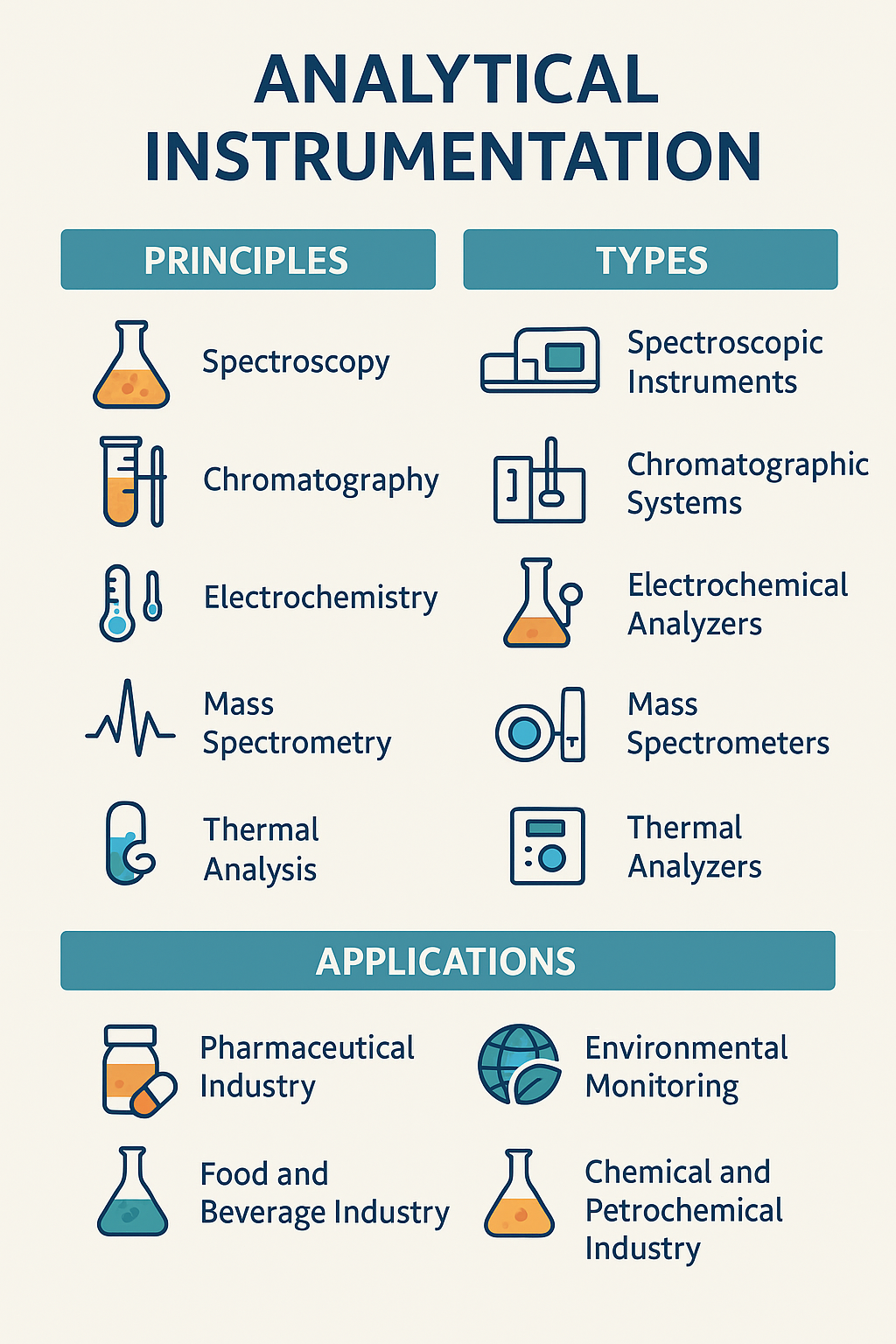
Analytical instruments operate on various scientific principles, depending on their measurement objectives. The main principles include:
- Spectroscopy – Uses the interaction of light with matter to analyze composition (e.g., UV-Vis, IR, Atomic Absorption Spectroscopy).
- Chromatography – Separates components in a mixture for analysis (e.g., Gas Chromatography, Liquid Chromatography).
- Electrochemistry – Measures electrical signals related to chemical reactions (e.g., pH meters, ion-selective electrodes).
- Mass Spectrometry – Identifies and quantifies compounds based on their mass-to-charge ratio.
- Thermal Analysis – Monitors changes in material properties as a function of temperature.
By combining these principles, modern analytical systems can deliver high accuracy, reproducibility, and sensitivity.
4. Types of Analytical Instrumentation
Analytical instruments can be classified based on the property they measure or the method they use. The main categories include:
4.1 Spectroscopic Instruments
- UV-Vis Spectrophotometers – Measure light absorption for concentration determination.
- Infrared (IR) Spectrometers – Identify molecular structures through IR light absorption patterns.
- Atomic Absorption Spectrometers (AAS) – Detect metal concentrations in samples.
4.2 Chromatographic Systems
- Gas Chromatography (GC) – Separates volatile compounds for analysis.
- High-Performance Liquid Chromatography (HPLC) – Separates non-volatile or thermally unstable compounds.
4.3 Electrochemical Analyzers
- pH Meters – Measure acidity or alkalinity in solutions.
- Conductivity Meters – Assess ionic content in water or solutions.
4.4 Mass Spectrometers
- Quadrupole Mass Spectrometers – Common for environmental and pharmaceutical analysis.
- Time-of-Flight (TOF) MS – Suitable for high-resolution measurements.
4.5 Thermal Analyzers
- Differential Scanning Calorimeters (DSC) – Study phase transitions like melting and crystallization.
- Thermogravimetric Analyzers (TGA) – Measure weight changes as a function of temperature.
5. Applications of Analytical Instrumentation
Analytical instruments are applied in a wide range of sectors:
5.1 Pharmaceutical Industry
- Drug purity testing
- Active ingredient quantification
- Quality control during production
5.2 Environmental Monitoring
- Air and water quality analysis
- Detection of hazardous pollutants
- Soil contamination assessment
5.3 Food and Beverage Industry
- Nutritional content analysis
- Detection of contaminants like pesticides and heavy metals
- Shelf-life and stability studies
5.4 Chemical and Petrochemical Industry
- Process monitoring and optimization
- Catalyst performance evaluation
- Composition analysis of raw materials and products
5.5 Academic and Research Laboratories
- Fundamental research on material properties
- Development of new chemical processes
- Data generation for publications and patents
6. Advantages of Analytical Instrument
- High Accuracy – Ensures precise and repeatable measurements.
- Speed – Allows for rapid testing and decision-making.
- Automation – Many instruments can operate with minimal manual intervention.
- Multi-Parameter Analysis – Capable of detecting multiple characteristics in a single run.
7. Challenges in Analytical Instrumentation
Despite their benefits, analytical instruments face several challenges:
- High Initial Cost – Advanced equipment can be expensive.
- Maintenance Requirements – Regular calibration and servicing are needed for accuracy.
- Skilled Operation – Trained personnel are required to interpret results correctly.
- Sample Preparation – Some methods require complex preparation steps that can affect speed.
8. Future Trends in Analytical Instrumentation
Technological advancements are making analytical instrumentation more powerful, compact, and connected. Key trends include:
- Miniaturization – Portable devices for field analysis.
- Automation & AI Integration – Faster, smarter data analysis with minimal human error.
- Green Analytical Chemistry – Environmentally friendly methods that reduce chemical waste.
- Remote Monitoring – Instruments connected via IoT for real-time, off-site data access.
9. Conclusion
Analytical instrumentation is indispensable in modern science, industry, and research. By delivering accurate and reliable data, these tools enable better decision-making, quality assurance, and compliance with regulations. As technology evolves, analytical systems will become even more efficient, intelligent, and sustainable, further enhancing their role in advancing human knowledge and industrial productivity.