
Types of Active Components ~ In the world of electronics, active components are indispensable. Unlike passive components that can only store or dissipate energy, active electronic components can control the flow of electricity, amplify signals, and perform logical operations. These components are powered by an external energy source and are essential in building functional electronic circuits.
This article provides an in-depth look at the types of active electronic components, their functions, how they work, and where they are used in real-world applications.
What Are Active Electronic Components?
Active electronic components are devices that can inject power into an electronic circuit and typically require an external power source to operate. They are capable of amplifying electrical signals or controlling the current flow, making them crucial in signal processing, computing, and power regulation.
Key Characteristics:
- Require an external power source
- Can control and amplify electrical signals
- Made from semiconductor materials
- Play an essential role in both analog and digital electronics
Main Types of Active Components
Here are the most common types of active electronic components:
1. Transistors
Definition:
A transistor is a semiconductor device that can act as a switch or amplifier. It is the backbone of most electronic systems and is present in everything from mobile phones to computers.
Types of Transistors:
- Bipolar Junction Transistor (BJT): Uses both electrons and holes for conduction. It has three terminals: base, collector, and emitter.
- Field Effect Transistor (FET): Uses an electric field to control the flow of current. Common types include MOSFETs and JFETs.
Functions:
- Amplification of weak signals
- Switching operations in digital logic circuits
- Voltage regulation and modulation
Applications:
- Audio amplifiers
- Microprocessors
- Power control systems
- Radio frequency transmission
Read More: Understanding Transistors: Types, Functions, and Applications in Modern Electronics
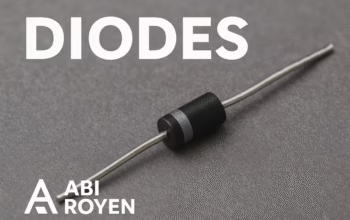
2. Types of Active Components Diodes
Definition:
A diode is a semiconductor device that allows current to flow in only one direction, offering rectification and signal demodulation.
Types of Diodes:
- PN Junction Diode
- Zener Diode (voltage regulation)
- Light Emitting Diode (LED)
- Schottky Diode (fast switching)
- Photodiode (light-sensitive)
Functions:
- Rectification of AC to DC
- Voltage regulation
- Signal demodulation
- Light emission or detection
Applications:
- Power supply circuits
- Communication systems
- Solar energy systems
- Optical sensors
Read More: Understanding Diodes: Types, Functions, and Applications in Electronics
3. Integrated Circuits (ICs)
Definition:
Integrated circuits are complex assemblies of thousands or millions of transistors, resistors, and capacitors fabricated on a single semiconductor wafer, typically silicon.
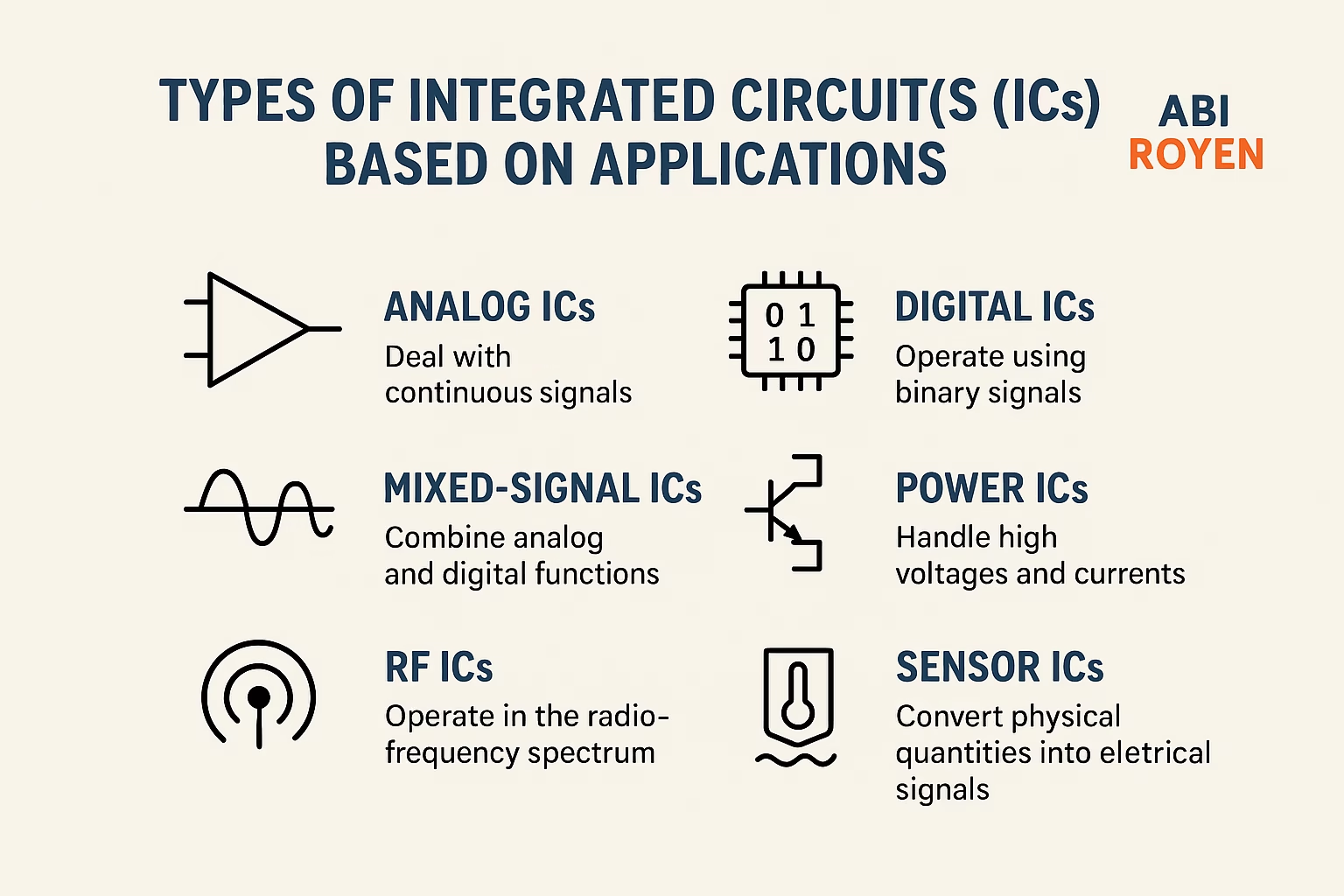
Types of ICs:
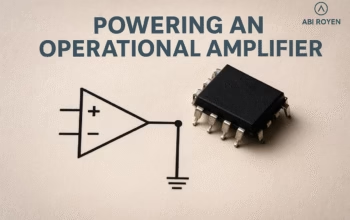
- Analog ICs (e.g., operational amplifiers)
- Digital ICs (e.g., logic gates, microcontrollers)
- Mixed-Signal ICs (contain both analog and digital components)
Functions:
- Perform signal processing
- Execute logic operations
- Control system functions in embedded devices
Applications:
- Computers and mobile devices
- Audio and video equipment
- Industrial automation
- Robotics and control systems
Read More: Understanding Integrated Circuits (ICs): Types, Functions, and Applications in Modern Electronics
4. Types of Active Components Thyristors
Definition:
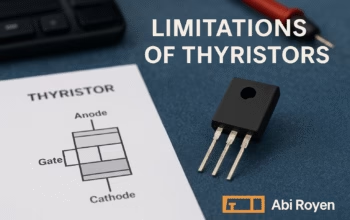
Thyristors are four-layered semiconductor devices that act as bistable switches. Once activated, they remain in the conducting state until the current falls below a threshold.
Types of Thyristors:
- SCR (Silicon Controlled Rectifier)
- Triac
- Diac
Functions:
- Control high-voltage power systems
- Provide switching in AC applications
- Act as rectifiers with control features
Applications:
- Motor speed controls
- Light dimmers
- AC power switching
- Battery chargers
Read More: Thyristors: Operation, Types, and Applications in Power Electronics
5. Phototransistors and Optoelectronic Components
Definition:
Phototransistors are transistors that are activated by light rather than electrical signals. Optoelectronic components convert light into electricity or vice versa.
Functions:
- Detect light and convert it into current
- Used in optical communication and sensors
Applications:
- Remote control receivers
- Light sensors
- Optical encoders
- Security systems
Read More:
Phototransistor: Function, Working Principle, and Applications in Modern Technology
Why Active Components Matter in Electronics
Active components are vital for the functionality and intelligence of modern circuits. They allow for the amplification, switching, modulation, and signal processing that passive components alone cannot provide.
Without them:
- Computers couldn’t process data
- Mobile phones wouldn’t function
- Amplifiers couldn’t increase signal power
- Digital logic wouldn’t exist
Read More:
Choosing the Right Active Component
When designing a circuit, choosing the appropriate active component depends on:
- Voltage and current requirements
- Speed of operation
- Size constraints
- Power efficiency
- Cost and availability
For example, MOSFETs are ideal for high-speed switching in power electronics, while BJTs are often used in analog circuits where linearity is needed.
Read More:
Conclusion Types of Active Components
Understanding the types of active electronic components is crucial for anyone involved in electronics design, repair, or innovation. From simple amplifiers to complex microprocessors, these components form the core of modern electronic devices.
As technology evolves, the role of active components will only become more significant, driving the next generation of smart, efficient, and compact electronic systems.
Explore More on Abi Royen
To dive deeper into electronics and learn more about components, circuits, and how devices work, visit Abi Royen’s official website. Get expert insights, detailed guides, and practical tips for all things electronics.