Introduction of Power Electronics Devices Work
Power electronics is one of the most critical fields in modern electrical and electronic engineering. From smartphones and household appliances to renewable energy systems and electric vehicles, power electronics devices play a vital role in controlling, converting, and managing electrical energy efficiently. Understanding how power electronics devices work is essential for engineers, students, and technology enthusiasts alike.
This article provides a comprehensive explanation of power electronics devices, their principles of operation, types, applications, and their importance in today’s technology-driven world.
What Are Power Electronics Devices?
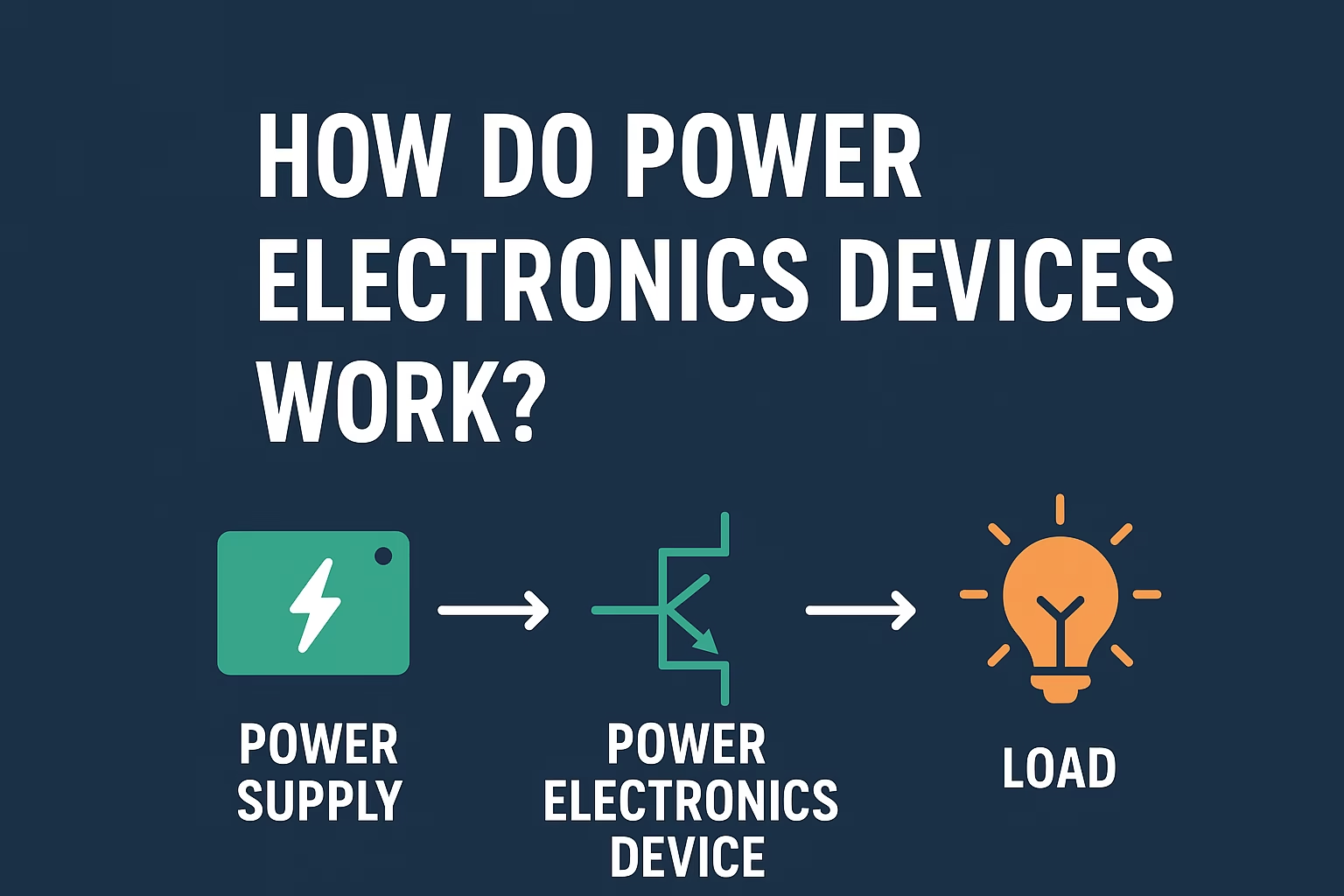
Power electronics devices are semiconductor-based components designed to convert and control electric power efficiently. Unlike conventional electronic devices that primarily deal with small signals, power electronics deals with high voltages, currents, and power levels.
These devices form the backbone of power conversion systems, ensuring that electrical energy is delivered in the right form, frequency, and voltage for different applications.
Principles of Power Electronics Devices
To understand how these devices work, let’s break down their main principles:
- Switching Operation
- Power electronics devices often function as high-speed electronic switches.
- Instead of dissipating energy like resistors, they turn on and off rapidly to control current flow with minimal power loss.
- Energy Conversion
- They convert electrical energy from one form to another:
- AC to DC (Rectification)
- DC to AC (Inversion)
- AC to AC (Cycloconversion or AC regulators)
- DC to DC (Choppers or DC converters)
- They convert electrical energy from one form to another:
- Control Systems
- Modern power electronics devices are integrated with control circuits and microcontrollers to regulate speed, torque, voltage, and frequency in various applications.
Types of Power Electronics Devices
Power electronics devices can be broadly categorized into semiconductor switching devices and passive components. Here are the most common ones:
1. Diodes
- Function as one-way switches.
- Commonly used in rectifiers to convert AC into DC.
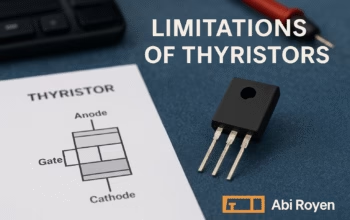
2. Thyristors (SCRs – Silicon Controlled Rectifiers)
- Act as controlled switches.
- Suitable for high-power applications such as motor drives, HVDC systems, and industrial converters.
3. MOSFETs (Metal-Oxide-Semiconductor Field-Effect Transistors)
- Known for high switching speed and efficiency.
- Widely used in low-to-medium power applications such as power supplies, inverters, and converters.
4. IGBTs (Insulated Gate Bipolar Transistors)
- Combine the high efficiency of MOSFETs and the high-current capability of BJTs.
- Extensively used in medium-to-high power applications like electric vehicles and renewable energy systems.
5. GTOs (Gate Turn-Off Thyristors)
- Similar to thyristors but can be turned off using gate signals.
- Common in high-voltage direct current (HVDC) transmission.
6. Passive Components
- Capacitors, inductors, and transformers are used alongside semiconductor devices to filter, store, and transfer energy.
How Do Power Electronics Devices Work?
Let’s take a closer look at their working principle through practical examples:
- AC to DC Conversion (Rectifiers)
- A diode allows current to pass only in one direction, blocking the reverse flow.
- In full-wave rectifiers, multiple diodes are arranged in a bridge configuration to convert both halves of the AC waveform into DC.
- DC to AC Conversion (Inverters)
- MOSFETs or IGBTs switch on and off rapidly under control circuits.
- The switching sequence produces an alternating current waveform from a DC source, often filtered to resemble sinusoidal AC.
- DC to DC Conversion (Choppers)
- Used in applications like voltage regulation in laptops or electric vehicles.
- The devices chop the input DC voltage at high frequency and then regulate it to desired levels.
- AC to AC Conversion (Cycloconverters/AC Voltage Controllers)
- Thyristors or triacs adjust the phase angle of AC input to control voltage and frequency for applications like variable speed drives.
Applications of Power Electronics Devices
Power electronics devices are essential across industries. Here are some major applications:
- Renewable Energy Systems
- Solar inverters convert DC from photovoltaic panels into usable AC.
- Wind turbine systems use converters for grid synchronization.
- Electric Vehicles (EVs)
- IGBTs and MOSFETs control battery charging, motor drives, and regenerative braking.
- Industrial Applications
- Variable Frequency Drives (VFDs) for motor speed control.
- HVDC power transmission for long-distance, efficient energy transfer.
- Consumer Electronics
- Power adapters, chargers, LED drivers, and UPS systems rely heavily on power electronics.
- Smart Grids
- Advanced converters and inverters enable better energy management, storage integration, and efficient power distribution.
Advantages of Power Electronics Devices
- High Efficiency – Minimal energy loss during conversion.
- Compact Size – Modern semiconductor devices are smaller and lighter.
- Precise Control – Capable of fine regulation of voltage, current, and frequency.
- Flexibility – Adaptable to different power conversion needs.
- Reliability – Solid-state design ensures durability and reduced maintenance.
Challenges in Power Electronics
Despite their advantages, these devices also face certain challenges:
- Heat Management – Switching at high frequencies generates heat, requiring advanced cooling systems.
- Electromagnetic Interference (EMI) – High-speed switching can cause noise in nearby electronic systems.
- Material Limitations – Traditional silicon-based devices face limits at very high voltages and temperatures.
Future of Power Electronics Devices
The future of power electronics looks promising with advancements in semiconductor materials and design:
- Wide Bandgap Semiconductors (SiC and GaN)
- Silicon Carbide (SiC) and Gallium Nitride (GaN) devices are more efficient, smaller, and capable of operating at higher voltages and temperatures.
- Integration with Artificial Intelligence (AI)
- Smart control systems using AI will enable predictive maintenance and real-time optimization.
- Support for Renewable Energy Expansion
- As renewable energy becomes dominant, efficient power converters will be essential for storage, distribution, and grid stability.
- Electric Mobility Growth
- EVs and hybrid vehicles will rely even more on IGBTs, MOSFETs, and advanced power modules.
Conclusion of Power Electronics Devices Work
Power electronics devices are at the heart of modern energy systems. They efficiently control and convert electrical energy for countless applications—from consumer electronics to large-scale renewable energy and industrial systems.
Understanding how power electronics devices work helps engineers and researchers design better, more efficient systems, paving the way for innovations in smart grids, renewable integration, and electric mobility. As technology continues to evolve, power electronics will remain a cornerstone of progress in energy and electronics industries.