
Introduction of Inductor Care and Usage
Inductor Care and Usage ~ Inductors are one of the most vital passive components in electronics. Whether in power supplies, filters, communication devices, or energy storage systems, inductors play a critical role in controlling current and voltage behaviors. Despite their robustness, inductors require proper care and correct usage to maintain their performance and extend their life expectancy.
This article provides an in-depth guide on inductor care and usage, covering handling practices, storage, troubleshooting, maintenance strategies, and common applications. By the end, you will have the knowledge to optimize the performance of inductors in both professional and hobbyist electronic projects.
Understanding Inductors: A Quick Overview
Before diving into care and usage, it’s important to understand what inductors are and why they are so crucial in electronics.
- Definition: An inductor is a passive electrical component that stores energy in a magnetic field when current flows through it.
- Basic Principle: Based on Faraday’s Law of Electromagnetic Induction, inductors resist changes in current by generating a counter-electromotive force (EMF).
- Core Types: Air core, iron core, ferrite core, and toroidal inductors.
- Key Parameters: Inductance (measured in Henrys), current rating, saturation current, resistance, and Q factor.
Inductors are found in devices such as:
- Power supplies (DC-DC converters, switching regulators)
- Audio equipment (crossover networks)
- Communication systems (filters, RF circuits)
- Energy storage devices
Inductor Care and Usage: Best Practices for Inductor Care
Even though inductors are relatively durable compared to other components, they can degrade or fail if neglected. Below are essential inductor care practices:
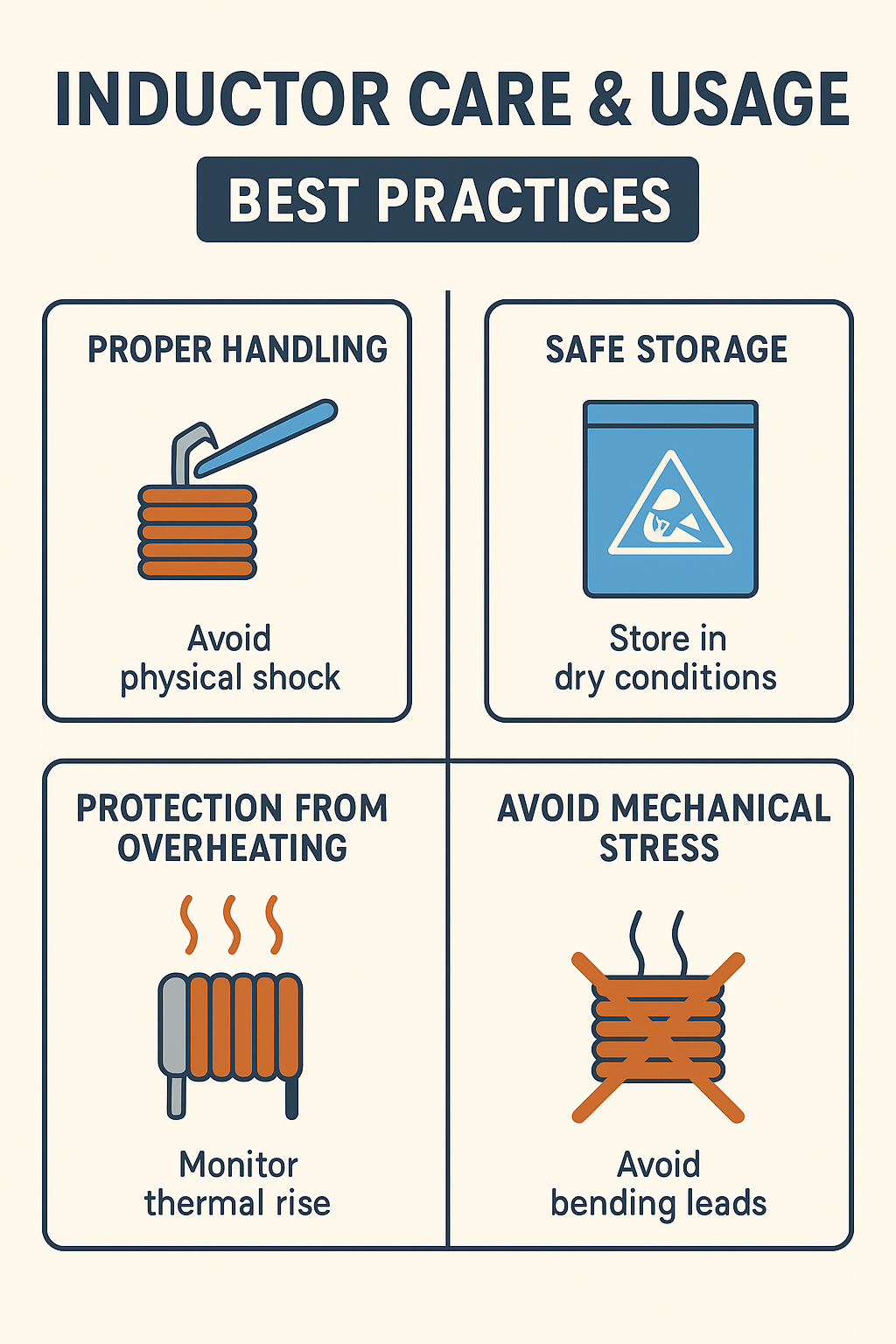
1. Proper Handling
- Avoid dropping or applying physical shock, as this can damage the core or windings.
- Use anti-static precautions, especially with sensitive RF inductors.
- Handle with tweezers or insulated tools when possible.
2. Safe Storage Conditions
- Store inductors in a dry environment to prevent corrosion of leads and core materials.
- Avoid extreme temperatures that may cause insulation degradation.
- Keep them in anti-static bags for sensitive components.
3. Protection from Overheating
- Ensure inductors are not exposed to excessive current beyond their rated limits.
- Monitor thermal rise during operation, especially in power circuits.
- Use proper heat dissipation techniques, such as spacing and airflow in PCB design.
4. Avoid Mechanical Stress
- Do not bend or twist the leads excessively during PCB assembly.
- Apply the correct soldering technique (controlled temperature, minimal contact time) to prevent insulation damage.
5. Prevent Magnetic Interference
- Keep inductors away from strong external magnetic fields.
- For sensitive circuits, use shielding or layout techniques to reduce electromagnetic interference (EMI).
Inductor Care and Usage: Correct Usage of Inductors in Circuits
Using inductors properly is essential to ensure circuit stability and efficiency.
1. Matching Inductor Specifications to Application
- Inductance Value: Must be chosen according to circuit requirements (e.g., filtering or energy storage).
- Current Rating: Ensure the inductor can handle peak currents without saturating.
- Resistance (DCR): Lower resistance reduces energy losses.
- Frequency Response: High-frequency applications require specialized RF inductors.
2. PCB Layout Considerations
- Place inductors away from sensitive analog signals to reduce noise.
- Keep traces short and thick to minimize resistance and heat buildup.
- Use ground planes for improved EMI performance.
3. Usage in Power Electronics
- In buck and boost converters, inductors regulate current flow and store energy.
- Ensure proper core material selection for switching frequencies.
- Always design with a safety margin above rated current capacity.
4. Applications in Communication and RF
- Inductors are vital in LC filters, oscillators, and impedance matching.
- For RF circuits, use high-Q inductors to minimize signal loss.
- Avoid using general-purpose inductors in precision RF applications.
Common Issues with Inductors and Troubleshooting
Even with good care, inductors can experience performance issues. Below are common problems and solutions:
1. Overheating
- Cause: Excessive current or poor ventilation.
- Solution: Use higher-rated inductors, improve cooling, or redesign circuit for better efficiency.
2. Core Saturation
- Cause: Current exceeds the inductor’s saturation limit.
- Solution: Select inductors with higher saturation current ratings.
3. Mechanical Noise (Buzzing/Humming)
- Cause: Magnetic vibration at certain frequencies.
- Solution: Use inductors with better mechanical stability or apply damping materials.
4. Corrosion and Oxidation
- Cause: Exposure to moisture.
- Solution: Store in dry environments, use protective coatings if needed.
5. Inductance Drift
- Cause: Temperature changes or core degradation.
- Solution: Use inductors with temperature-stable materials.
Maintenance Tips for Longevity
Inductors can last for many years if properly maintained. Here are some proactive strategies:
- Regularly inspect inductors in high-power equipment for signs of discoloration or overheating.
- Test inductance periodically with an LCR meter to detect drift.
- Replace aging inductors before they fail in mission-critical systems.
- Clean dust and debris from circuit boards to prevent heat retention.
Future Trends in Inductor Technology
The electronics industry is continuously innovating in inductor design and materials. Key trends include:
- Miniaturization: Smaller inductors with higher performance for compact devices.
- High-frequency inductors: Designed for 5G and advanced wireless communication.
- Integrated inductors: On-chip inductors for system-on-chip (SoC) solutions.
- Eco-friendly materials: Lead-free, RoHS-compliant inductors to meet environmental standards.
Conclusion of Inductor Care and Usage
Inductors may appear simple, but their role in electronics is profound. Proper care, correct usage, and regular maintenance ensure inductors deliver reliable performance across countless applications—from power electronics to communication systems.
By understanding handling practices, selecting the right inductor, preventing common issues, and following best maintenance strategies, engineers and enthusiasts alike can maximize the lifespan and efficiency of inductors in their circuits.