Introduction of Voyager 1 Launch
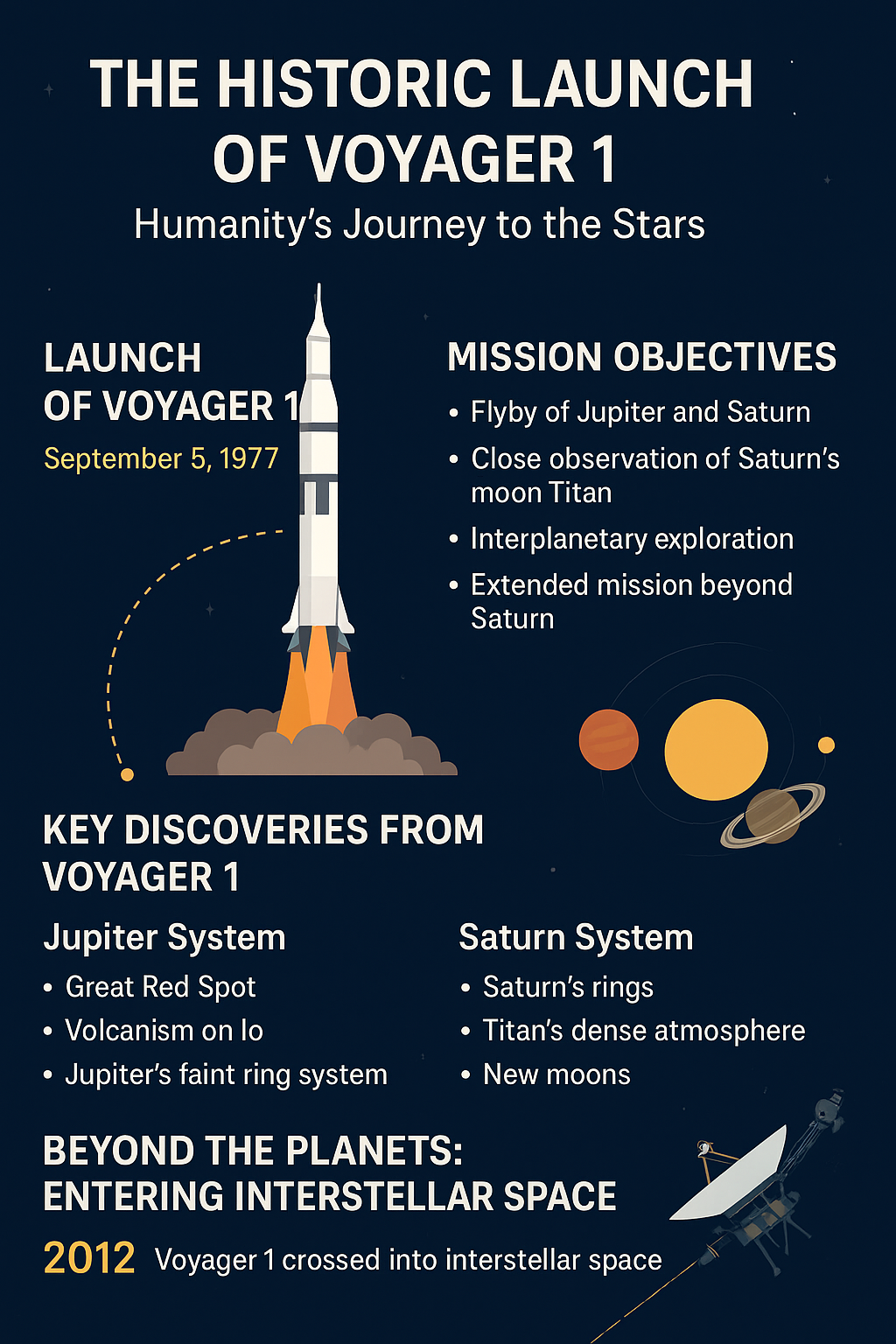
On September 5, 1977, humanity took one of its most significant steps into the cosmos with the Voyager 1 Launch, a robotic spacecraft built by NASA. Originally designed to study the outer planets, Voyager 1 has since gone far beyond its initial mission. It is now the farthest human-made object from Earth, traveling through interstellar space and continuing to send valuable scientific data back home. The story of Voyager 1’s launch is not only about a spacecraft but also about human curiosity, innovation, and the quest to understand the universe.
Background: The Space Race and Planetary Missions
During the 1960s and 1970s, space exploration was dominated by the space race between the United States and the Soviet Union. While early missions focused on the Moon, scientists soon realized that exploring the outer planets offered new opportunities for groundbreaking discoveries.
NASA developed the Voyager program as part of a series of planetary exploration missions. The program took advantage of a rare planetary alignment that occurs once every 176 years, allowing a spacecraft to use gravity assist maneuvers to slingshot from one planet to another. This alignment made it possible to explore multiple outer planets using minimal fuel.
Voyager 1 Launch
Voyager 1 was launched from Cape Canaveral, Florida, on September 5, 1977, aboard a Titan IIIE rocket. Interestingly, Voyager 1 was launched after its twin, Voyager 2, which departed on August 20, 1977. Despite this, Voyager 1’s faster trajectory allowed it to reach Jupiter and Saturn before Voyager 2.
The spacecraft itself weighed about 722 kilograms (1,592 pounds) and carried a suite of instruments designed to study planetary atmospheres, magnetic fields, radiation, and moons. Powered by radioisotope thermoelectric generators (RTGs), Voyager 1 was engineered to operate far from the Sun, where solar panels would be ineffective.
Mission Objectives
The primary goals of Voyager 1 included:
- Flyby of Jupiter and Saturn – To study the atmospheres, magnetospheres, and moons of these gas giants.
- Close observation of Saturn’s moon Titan – Titan’s thick atmosphere intrigued scientists, making it a high-priority target.
- Interplanetary exploration – To measure cosmic rays, solar wind, and the outer reaches of the Sun’s magnetic field.
- Extended mission beyond Saturn – To explore the heliosphere and eventually interstellar space.
Key Discoveries from Voyager 1
Voyager 1’s journey through the outer planets yielded many groundbreaking discoveries:
- Jupiter System
- Captured detailed images of Jupiter’s Great Red Spot and turbulent atmosphere.
- Discovered active volcanism on Io, the first observed outside Earth.
- Revealed Jupiter’s faint ring system.
- Saturn System
- Sent back high-resolution images of Saturn’s rings, showing intricate structures.
- Conducted a close flyby of Titan, revealing a dense nitrogen atmosphere.
- Observed several new moons around Saturn.
These discoveries transformed our understanding of the outer solar system and influenced later missions such as Cassini-Huygens.
Beyond the Planets: Entering Interstellar Space
After its planetary encounters, Voyager 1 continued its journey outward. In 2012, NASA announced that Voyager 1 had crossed into interstellar space, making it the first human-made object to do so. This milestone confirmed that the spacecraft had passed beyond the influence of the Sun’s solar wind and entered a region dominated by particles from other stars.
Voyager 1 still sends data back to Earth, providing insights into the interstellar medium, cosmic rays, and magnetic fields. Despite being billions of kilometers away, it continues to communicate using the Deep Space Network (DSN).
The Golden Record: Humanity’s Message to the Cosmos
Perhaps the most iconic feature of Voyager 1 is the Golden Record. Designed by a team led by Carl Sagan, the record contains sounds, images, and messages representing the diversity of life and culture on Earth. It includes greetings in 55 languages, music from various cultures, natural sounds, and scientific diagrams.
The Golden Record serves as a symbolic gesture, a time capsule of humanity, should Voyager 1 ever be discovered by an extraterrestrial civilization.
Voyager 1’s Legacy
The launch of Voyager 1 was more than just a scientific mission—it became a symbol of human exploration and resilience. Some of its lasting impacts include:
- Scientific Achievement: Provided unprecedented data about the outer planets and interstellar space.
- Engineering Excellence: Demonstrated the durability of spacecraft technology, operating for nearly five decades.
- Cultural Significance: Inspired generations through the Golden Record and the concept of reaching beyond the solar system.
- Interstellar Exploration: Paved the way for future missions that may one day send probes to nearby stars.
Future of Voyager 1
Although Voyager 1 continues to function, its power supply is diminishing. NASA estimates that by the 2030s, the spacecraft will no longer have enough energy to operate its instruments. Even when silent, Voyager 1 will continue to drift through the galaxy as a relic of human achievement, carrying our message to the stars.
Conclusion of Voyager 1 Launch
The launch of Voyager 1 in 1977 was not only a milestone in space exploration but also a profound statement about humanity’s place in the universe. From its groundbreaking planetary discoveries to its historic entry into interstellar space, Voyager 1 embodies the human spirit of curiosity and exploration. As it continues its journey beyond the stars, Voyager 1 reminds us that our quest for knowledge is limitless—and that our reach can extend to the very edge of the cosmos.