Introduction of First Electronic Television Transmission (TV)
The invention of television is one of the most remarkable technological breakthroughs of the 20th century. While earlier attempts at creating a visual broadcast relied on mechanical systems, the First Electronic Television Transmission (TV) marked the beginning of modern broadcasting as we know it today. This milestone transformed communication, entertainment, and culture, shaping the way societies interact with information and media.
This article explores the history behind the first electronic television transmission, the key figures involved, and its long-lasting impact on the world.
Early Attempts at Television
Before the electronic television, inventors experimented with mechanical television systems. These devices relied on spinning disks with holes or mirrors to scan and project images.
- Paul Nipkow (1884): Invented the Nipkow disk, a mechanical scanning device that became a foundation for early television concepts.
- John Logie Baird (1920s): Demonstrated mechanical television transmissions in Britain, but the system produced low-quality, flickering images.
Although groundbreaking, mechanical televisions had severe limitations in image quality, synchronization, and scalability. A new approach was needed—one that used electronics instead of mechanical parts.
The Birth of Electronic Television
The leap from mechanical to electronic television was made possible through advancements in cathode ray tubes (CRT) and electronic scanning.
- Vladimir Zworykin: A Russian-born engineer who worked for RCA, he developed the iconoscope, an early electronic camera tube.
- Philo Farnsworth: An American inventor credited with creating the first fully electronic television system.
Farnsworth’s design used an image dissector tube to capture and transmit images electronically, eliminating the mechanical limitations of earlier systems.
The First Electronic Television Transmission (TV)
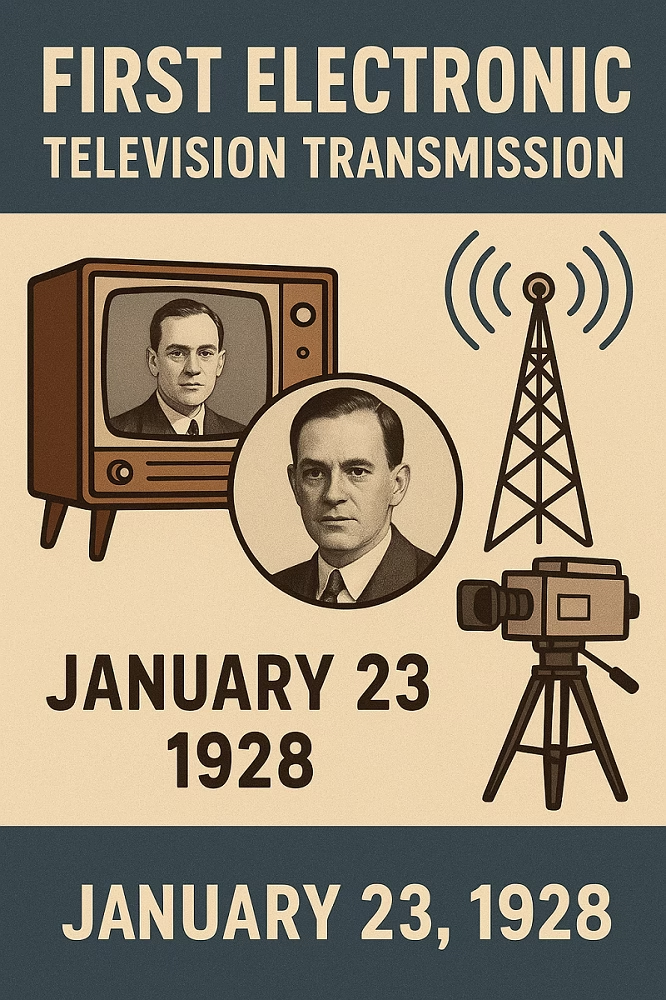
On September 7, 1927, Philo Farnsworth successfully transmitted the first electronic television image in his San Francisco laboratory. The image was a simple horizontal line, but it marked a historic milestone in communication technology.
Soon after, Farnsworth improved the system to transmit more complex images, including simple shapes and eventually live human faces. This breakthrough confirmed that television could be practical, scalable, and superior to mechanical systems.
RCA vs. Farnsworth: The Patent Battle
The invention of electronic television led to fierce disputes between inventors and corporations.
- RCA, led by David Sarnoff and Vladimir Zworykin, tried to dominate the television market.
- Philo Farnsworth, despite being a young independent inventor, fought to protect his patents.
After years of legal battles, Farnsworth’s patents were recognized, cementing his role as the true pioneer of electronic television. However, RCA’s resources allowed it to commercialize television on a massive scale, especially after the 1939 World’s Fair in New York, where TV was officially introduced to the public.
Impact of the First Electronic Television Transmission (TV)
The success of the first electronic television transmission set the stage for television to become the dominant medium of the 20th century. Its impact can be seen in several areas:
1. Mass Communication
Television allowed instant transmission of news, entertainment, and cultural content across large distances, reshaping how societies consumed information.
2. Entertainment Industry
Movies, dramas, sports, and live events could now be broadcast directly into homes, creating a new era of entertainment.
3. Education and Knowledge Sharing
Television became a powerful educational tool, used in schools and universities to deliver visual learning materials.
4. Global Politics and Society
Television brought major political events, such as presidential debates and world conflicts, directly to the public, influencing public opinion and democracy.
5. Technology Evolution
The electronic television laid the foundation for further innovations, including color television, satellite broadcasting, cable TV, and modern digital streaming platforms.
Comparison: Mechanical vs. Electronic Television
| Feature | Mechanical Television | Electronic Television |
|---|---|---|
| Image Quality | Low resolution, flickering | Clearer, stable images |
| Technology | Rotating disks, mechanical scanning | Electronic scanning using CRTs |
| Reliability | Prone to mechanical breakdowns | More stable and scalable |
| Commercial Success | Limited and experimental | Became the global standard |
This comparison highlights why Farnsworth’s electronic system replaced earlier mechanical attempts almost immediately.
Legacy of the First Electronic Television Transmission (TV)
Today, it is almost impossible to imagine a world without television. From news broadcasting to entertainment, advertising, and even education, television remains one of the most influential mediums ever created.
The first electronic transmission in 1927 was not just a scientific breakthrough; it was a cultural shift that paved the way for a global information society.
Even though inventors like Farnsworth often did not receive as much fame or financial success as corporations like RCA, their contributions remain at the core of modern communication technology.
Conclusion of First Electronic Television Transmission (TV)
The first electronic television transmission in 1927 revolutionized human communication forever. What began as a simple experiment by Philo Farnsworth evolved into a technology that shaped the 20th and 21st centuries. From mechanical beginnings to today’s high-definition digital streaming, television continues to connect, inform, and entertain billions worldwide.
The story of the first electronic television reminds us that technological innovation often starts with bold ideas, persistence, and the vision of individuals who dare to imagine a new way of seeing the world.