R&D in different industries ~ Research and Development (R&D) is the backbone of innovation across industries. It drives new product development, improves processes, reduces costs, and fosters competitive advantages. Whether in pharmaceuticals, agriculture, software, or manufacturing, R&D is the catalyst that pushes boundaries, transforms ideas into reality, and shapes the future.
In this article, we’ll explore how R&D functions and evolves across various sectors, examining the role it plays, industry-specific challenges, recent trends, and the future landscape of innovation.
1. What is Research and Development (R&D)?
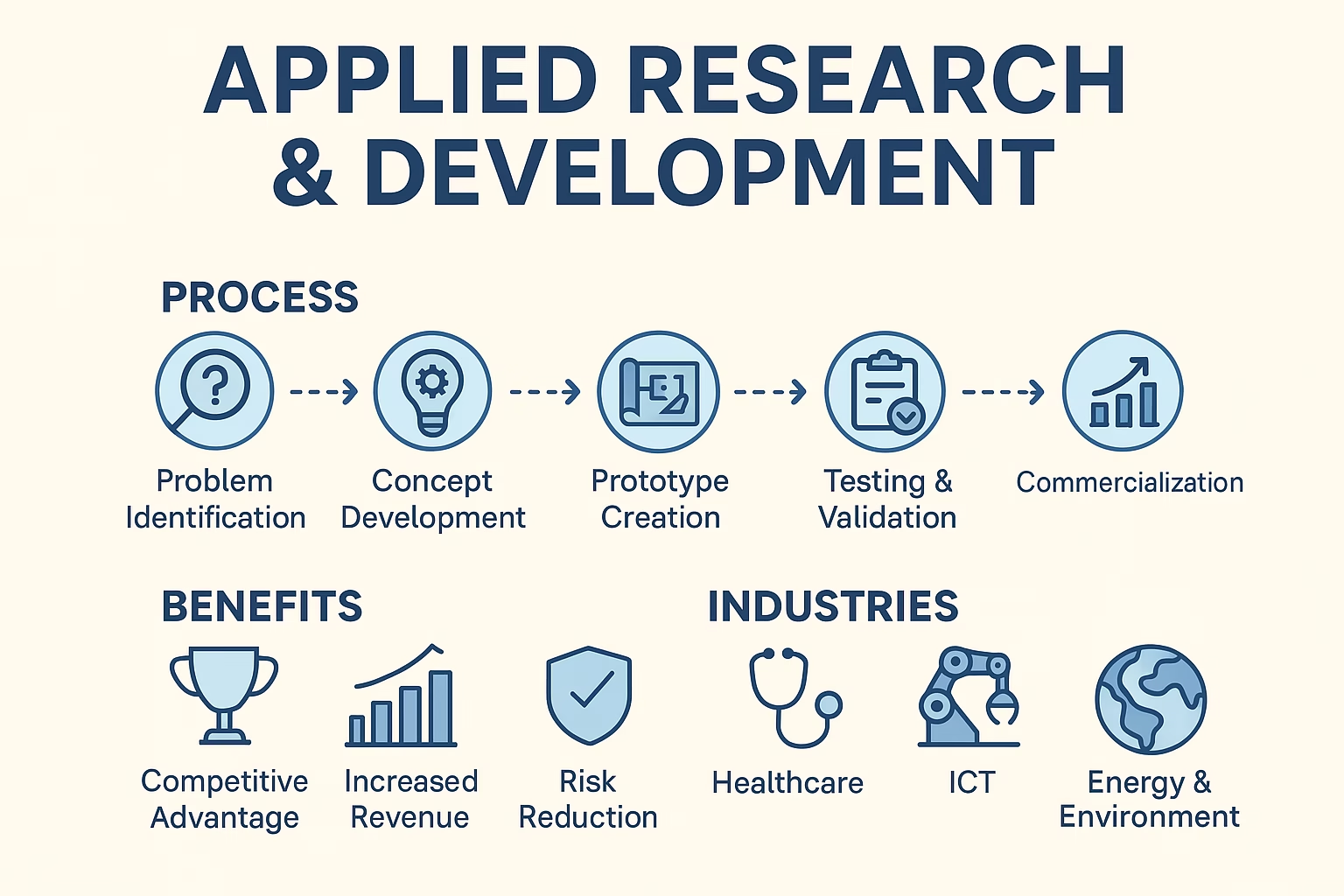
R&D refers to the systematic activities undertaken by businesses, governments, or institutions to innovate and introduce new products or services, or to improve existing ones. It typically involves two main components:
- Basic Research: Exploration to gain fundamental knowledge without a specific application in mind.
- Applied Research: Investigation with the goal of solving a specific problem or developing a new product or process.
Most industries also include experimental development, where research findings are transformed into prototypes or operational systems.
2. Importance of R&D in Different Industries
R&D plays a pivotal role in:
- Sustaining innovation
- Achieving competitive differentiation
- Responding to changing market demands
- Improving product quality and customer satisfaction
- Meeting regulatory standards and compliance
- Enhancing operational efficiency and sustainability
Industries investing in R&D are more likely to lead in innovation, profitability, and long-term growth.
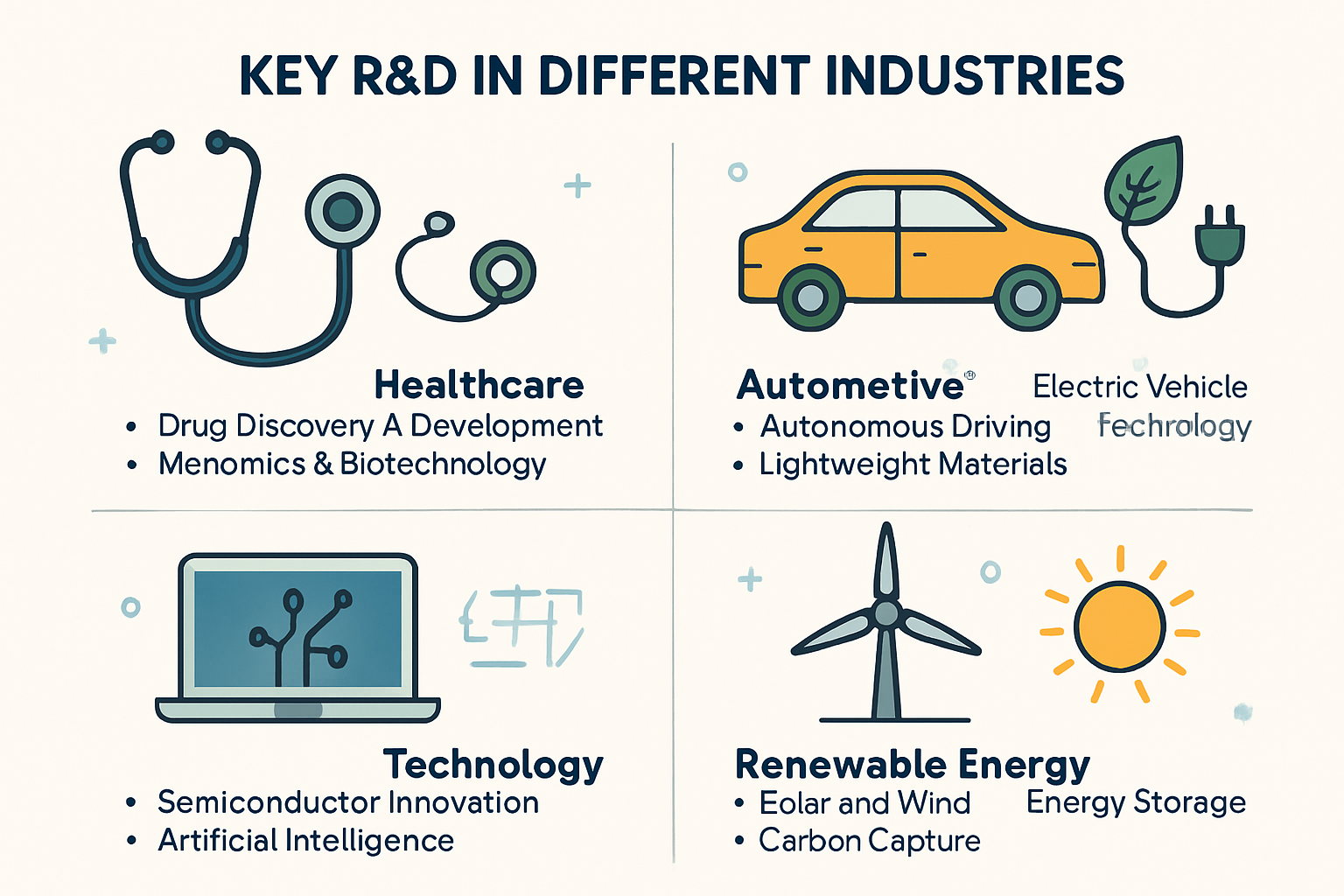
3. Key R&D in Different Industries
Let’s explore how R&D manifests in several prominent sectors:
a. Healthcare and Pharmaceuticals
Focus Areas:
- Drug discovery and development
- Vaccine research
- Medical device innovation
- AI-assisted diagnostics
R&D Challenges:
- High cost and long timelines (often 10+ years for new drugs)
- Strict regulatory requirements (e.g., FDA, EMA)
- Clinical trial risks
Trends:
- Personalized medicine
- mRNA technology (e.g., COVID-19 vaccines)
- Telemedicine tools and platforms
Impact:
Healthcare R&D saves lives, extends life expectancy, and responds rapidly to global health emergencies.
b. Information Technology and Software
Focus Areas:
- Software development
- Cloud infrastructure
- Artificial Intelligence and Machine Learning
- Cybersecurity solutions
R&D Characteristics:
- Agile development cycles
- High rate of innovation and iteration
- Heavy reliance on user feedback and data analytics
Trends:
- Generative AI (e.g., ChatGPT)
- Quantum computing
- Blockchain applications
Impact:
IT R&D has revolutionized communication, automation, and global productivity.
c. Automotive and Mobility
Focus Areas:
- Electric vehicle (EV) technologies
- Autonomous driving systems
- Lightweight materials
- Sustainable fuels and engines
Challenges:
- Safety compliance and real-world testing
- Public trust in autonomous systems
- Infrastructure for EVs (charging stations, etc.)
Trends:
- EV battery innovation
- Vehicle-to-everything (V2X) communication
- Integration of IoT and smart sensors
Impact:
R&D in the automotive industry is reshaping transportation, reducing emissions, and improving safety.
d. Agriculture and Food Technology
Focus Areas:
- Crop genetics and biotechnology
- Smart farming and IoT sensors
- Food safety and packaging innovation
Challenges:
- Climate change adaptation
- Land and water resource limitations
- Balancing cost with sustainability
Trends:
- Vertical farming
- Plant-based and lab-grown meats
- Precision agriculture using drones and AI
Impact:
Agri-tech R&D ensures food security, increases yield, and promotes sustainable farming.
e. Manufacturing and Industrial Engineering
Focus Areas:
- Automation and robotics
- 3D printing
- Lean manufacturing processes
- Energy efficiency
Challenges:
- Integration with legacy systems
- Workforce reskilling
- Capital investment in smart factories
Trends:
- Industry 4.0 and Industrial IoT (IIoT)
- Digital twins
- Predictive maintenance
Impact:
R&D in manufacturing enhances production speed, reduces waste, and boosts product quality.
4. Cross-Industry R&D Strategies
Many industries adopt similar R&D best practices:
- Open Innovation: Collaborating with external partners, universities, and startups
- User-Centered Design: Including end-user feedback early in the R&D process
- Sustainability-Focused Research: Developing green technologies and circular economy solutions
- Digital Transformation: Leveraging AI, big data, and simulation for smarter R&D cycles
5. Funding and Investment in R&D
R&D can be funded through:
- Internal corporate budgets
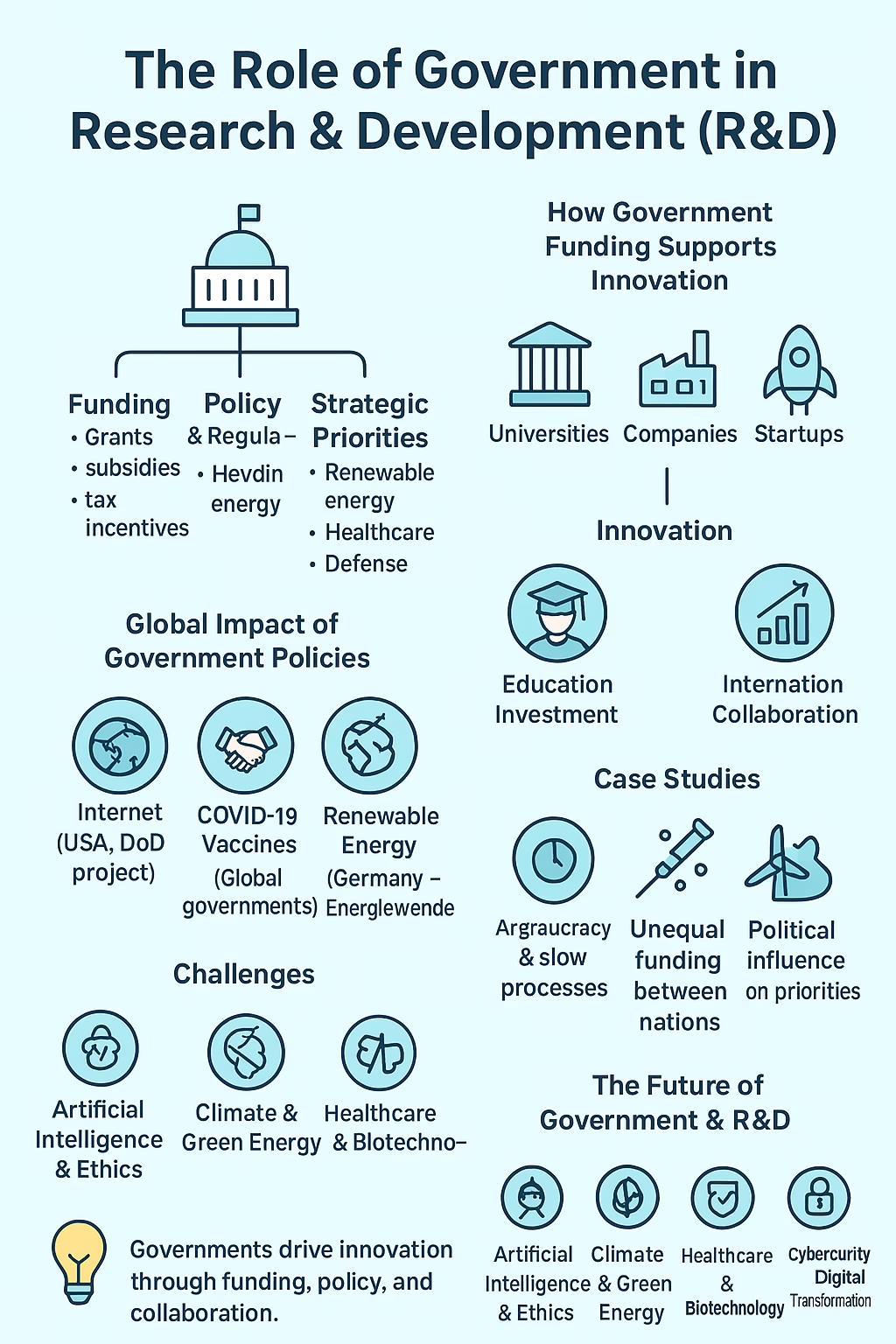
- Government grants and subsidies
- Venture capital and private equity (for startups)
- International funding programs (e.g., Horizon Europe)
Top R&D Spending Countries (2024 est.):
- United States
- China
- Japan
- Germany
- South Korea
Companies like Amazon, Alphabet (Google), and Samsung lead global R&D spending.
6. Measuring R&D Success
Key performance indicators (KPIs) include:
- Number of patents filed
- Time-to-market for new products
- ROI on R&D investment
- Product innovation index
- Customer satisfaction and adoption rates
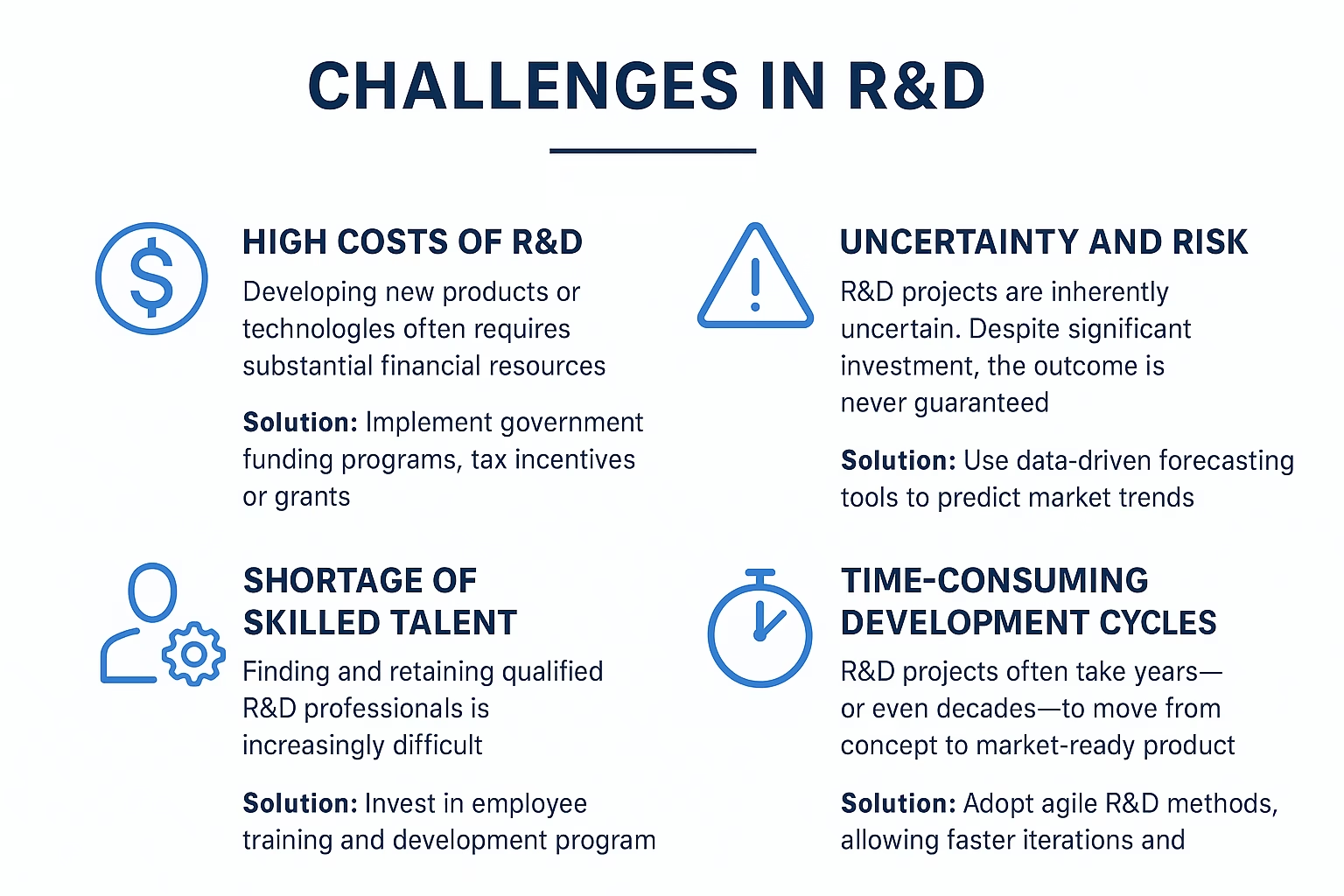
7. Challenges in R&D in Different Industries
- High Costs: Especially in pharmaceuticals and hardware-based sectors
- Time Pressure: Market trends evolve rapidly
- Regulatory Hurdles: Particularly in health and automotive industries
- Talent Shortage: Need for highly specialized researchers and engineers
8. The Future of R&D in Different Industries
Looking ahead, the future of R&D is expected to be:
- More Collaborative: Cross-industry and cross-border partnerships
- AI-Augmented: Using machine learning for simulations and predictions
- Decentralized: Innovation driven by smaller labs and global teams
- More Sustainable: Focused on climate-friendly, socially responsible outcomes
Conclusion of R&D in Different Industries
R&D is not a one-size-fits-all function—it varies greatly across industries in approach, tools, and impact. Yet, across every sector, it remains the engine of innovation. For businesses aiming to stay competitive, investing in strategic and sustainable R&D is not optional—it’s essential.
As technology advances and societal needs evolve, R&D will continue to shape the way we live, work, and connect. Embracing it across industries ensures a future that is smarter, healthier, and more resilient.