
Trends in Artificial Intelligence (AI) for 2025 is no longer a futuristic concept confined to science fiction. It is now a rapidly evolving technology that has permeated various sectors, from healthcare and finance to education and creative industries. As we step into the mid-2020s, the evolution of AI continues to accelerate, shaping how businesses operate and how society functions.
In this article, we will explore the most impactful trends in Artificial Intelligence that are set to define the future. Whether you’re a tech enthusiast, a business leader, or just curious about where AI is heading, understanding these trends will give you a competitive edge.
1. Trends in Artificial Intelligence (AI): Generative AI Becomes Mainstream
Generative AI, particularly large language models (LLMs) like ChatGPT, Gemini, and Claude, have made content creation more accessible and efficient. From text to images, music to code, generative AI is reshaping industries:
- Creative industries use AI to generate visual art, music compositions, and even full movie scripts.
- Business sectors utilize LLMs for customer service automation, marketing content, and internal documentation.
- Developers benefit from code generation tools that enhance productivity.
The democratization of these tools allows individuals and small businesses to compete with larger enterprises by reducing production costs and increasing creativity.
2. Trends in Artificial Intelligence (AI): Explainable and Ethical AI
As AI becomes more embedded in decision-making, the need for transparency, fairness, and ethics has never been more critical. AI systems must now comply with emerging regulations and societal expectations:
- Explainable AI (XAI): Allows users to understand how decisions are made, especially in sensitive areas like finance and healthcare.
- Bias mitigation: Companies are focusing on removing discriminatory outcomes in AI models.
- AI Governance: Governments are implementing policies to monitor AI deployment and prevent misuse.
Organizations embracing ethical AI practices will gain user trust and ensure long-term sustainability.
3. AI-Driven Automation and Autonomous Systems
From smart warehouses to autonomous vehicles, AI is powering machines that can operate with little or no human intervention:
- Autonomous delivery drones and vehicles are being deployed in logistics.
- Smart robotics in manufacturing lines are increasing production efficiency.
- AI in agriculture is helping automate planting, watering, and harvesting.
This trend boosts productivity but also requires upskilling the workforce to adapt to changing roles.
4. Trends in Artificial Intelligence (AI): AI in Edge Computing and IoT
Combining AI with Edge Computing brings processing power closer to where data is generated—on devices like cameras, sensors, and industrial machines. This has several benefits:
- Faster response times: Crucial for real-time applications like autonomous vehicles.
- Data privacy: Local processing reduces the need to send sensitive information to the cloud.
- Energy efficiency: Less data transmission means lower energy usage.
Industries like healthcare, smart cities, and manufacturing are seeing rapid adoption of AI at the edge.
5. Personalized AI Experiences
AI is becoming more context-aware and user-centric, offering hyper-personalized experiences:
- AI in education adapts learning paths to individual students.
- Retail and e-commerce use AI to predict customer preferences and optimize product recommendations.
- Healthcare AI tailors treatment plans based on patient history and behavior.
The convergence of AI with data analytics and behavioral science is creating smarter, more intuitive systems.
6. AI for Sustainability and Climate Action
One of the most promising applications of AI is its role in tackling climate change and promoting sustainability:
- Predictive analytics help forecast extreme weather patterns.
- AI in energy management optimizes usage in buildings and industrial systems.
- Smart agriculture systems reduce waste and increase crop yields.
AI is enabling a greener future by helping organizations reduce their environmental impact.
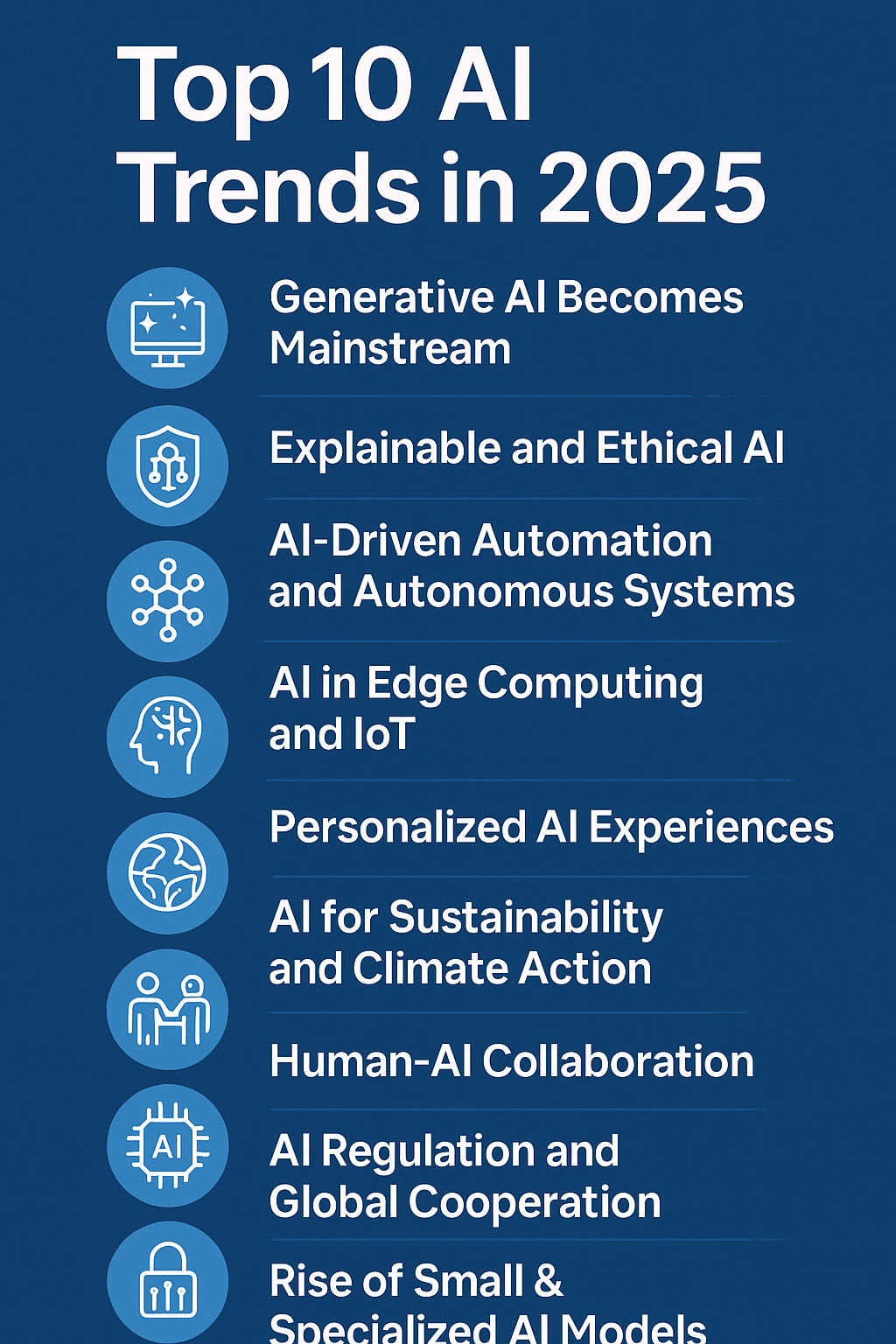
7. Human-AI Collaboration
The future is not just about AI replacing humans—but collaborating with them:
- Copilot models assist engineers, designers, and researchers in their work.
- AI assistants are embedded into daily workflows in tools like Microsoft 365, Google Workspace, and CRM systems.
- Human-Robot Interaction (HRI) is improving as robots become more socially aware and emotionally intelligent.
This synergy amplifies human capability, leading to better outcomes across disciplines.
8. AI Regulation and Global Cooperation
With great power comes great responsibility. The rise of AI necessitates international collaboration to ensure safety, ethics, and equitable access:
- AI safety initiatives aim to mitigate risks from powerful AI models.
- Cross-border regulation efforts are gaining momentum, such as the EU AI Act and global discussions through the UN and OECD.
- Standardization is crucial to ensure interoperability and accountability.
Businesses must stay updated on regulatory trends to remain compliant and competitive.
9. Rise of Small & Specialized AI Models
While large models dominate headlines, smaller and more efficient models are gaining ground:
- They require less computing power, making them ideal for mobile and embedded systems.
- Domain-specific models offer better performance in targeted applications like legal AI, medical diagnostics, and customer support.
This trend is making AI more accessible and sustainable across industries and geographies.
10. AI and Cybersecurity
AI is becoming both a tool and a target in cybersecurity:
- AI-powered defense systems detect threats in real-time and adapt to new attack methods.
- Conversely, hackers are using AI to craft smarter malware and phishing attacks.
Companies must invest in AI-driven threat intelligence and ensure their own AI systems are secure from manipulation.
Conclusion: Trends in Artificial Intelligence (AI) for 2025
Artificial Intelligence is no longer optional—it is a competitive necessity. From automation and personalization to climate action and ethics, AI is shaping every aspect of modern life. Organizations that understand and adapt to these trends will lead the next wave of innovation.
To keep up with AI’s rapid pace:
- Stay informed through trusted sources and publications.
- Invest in AI literacy across your organization.
- Collaborate ethically and transparently with stakeholders.
As the world continues to evolve, AI will remain a cornerstone of technological progress and human development.