Frequency is one of the most fundamental concepts in science and engineering. From the vibration of atoms to the broadcasting of radio waves, this plays a crucial role in how energy, signals, and systems behave. This article aims to give a comprehensive understanding of frequency, its measurement, applications, and significance in various fields.
📌 What is Frequency?
In simple terms, frequency refers to how often an event occurs in a specific period of time. In physics and engineering, it is usually defined as the number of cycles of a periodic signal or wave that occur in one second.
Mathematical Formula: f=Ntf = \frac{N}{t}f=tN
Where:
- fff = frequency (in Hertz)
- NNN = number of cycles
- ttt = time in seconds
For example, if a pendulum swings back and forth 60 times in one minute, it is 1 Hz (60 cycles / 60 seconds).
🧪 SI Unit of Frequency
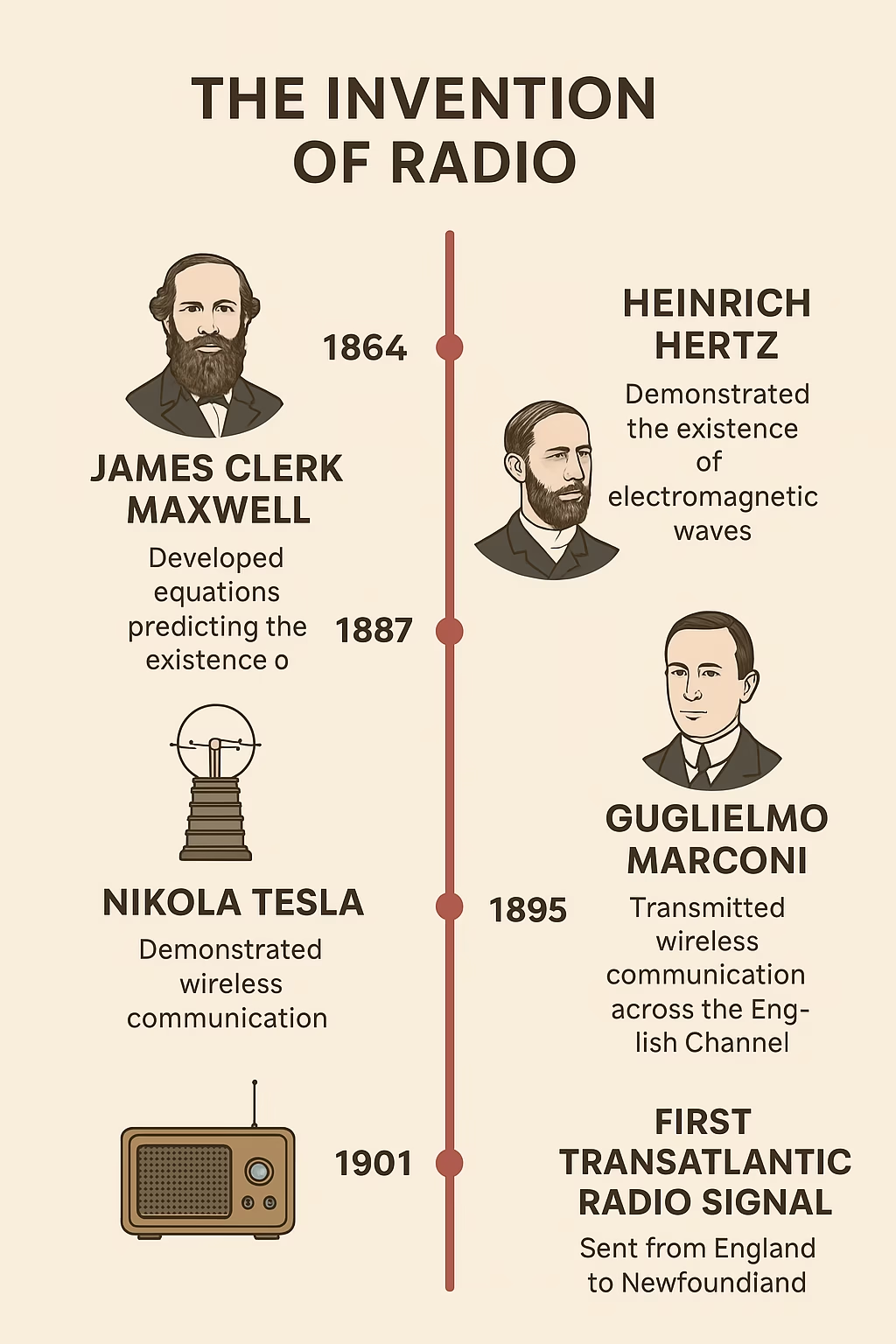
The SI (International System of Units) unit of is the Hertz (Hz), named after German physicist Heinrich Hertz.
- 1 Hz = 1 cycle per second
- Higher units:
- kHz (kilohertz) = 1,000 Hz
- MHz (megahertz) = 1,000,000 Hz
- GHz (gigahertz) = 1,000,000,000 Hz
- THz (terahertz) = 1,000,000,000,000 Hz
🌊 Frequency in Waves
One of the most common uses of frequency is in wave theory. A wave is a disturbance that travels through a medium, transferring energy. Whether it’s sound waves, light waves, or radio waves, their behavior is deeply defined by frequency.
- Sound Waves: The pitch of a sound is determined by its frequency. Higher = higher pitch.
- Light Waves: Color is related to frequency. Violet light has a higher is than red light.
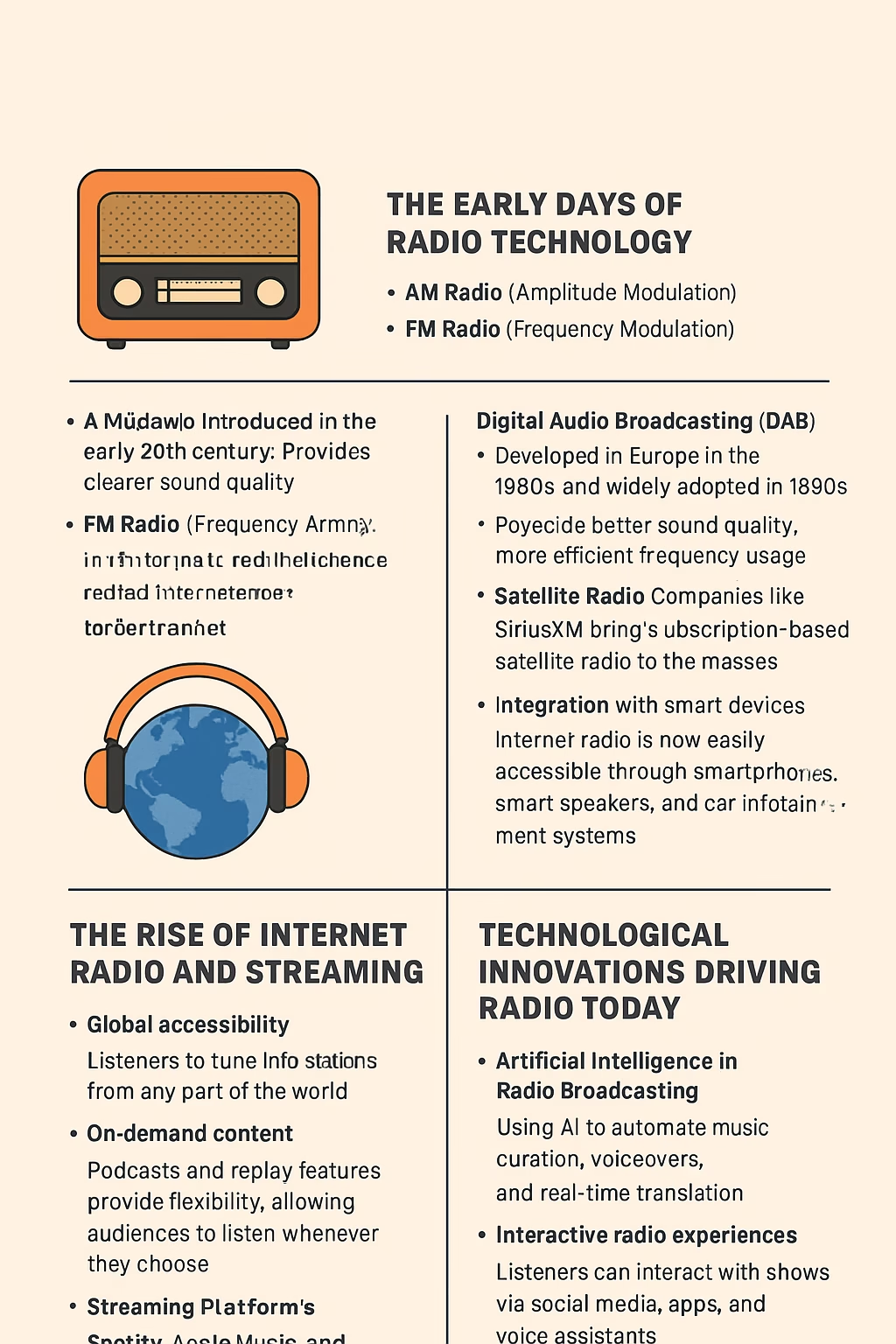
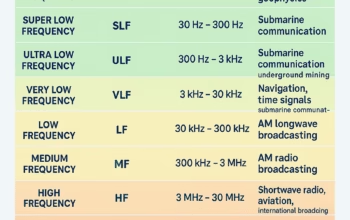
- Radio Waves: Different radio stations broadcast at different frequencies (e.g., 101.1 MHz).
🧭 Relation Between Frequency and Wavelength
Inversely proportional to wavelength (the distance between two successive wave peaks) in a given medium. v=f×λv = f \times \lambdav=f×λ
Where:
- vvv = wave velocity
- fff = frequency
- λ\lambdaλ = wavelength
In a vacuum, all electromagnetic waves travel at the speed of light (c=3×10⁸ m/s)(c = 3 \times 10^8 \text{ m/s})(c=3×108 m/s).
⚙️ Applications of Frequency in Daily Life
This not just a theoretical concept. It’s used practically in numerous areas of science, industry, and everyday technology.
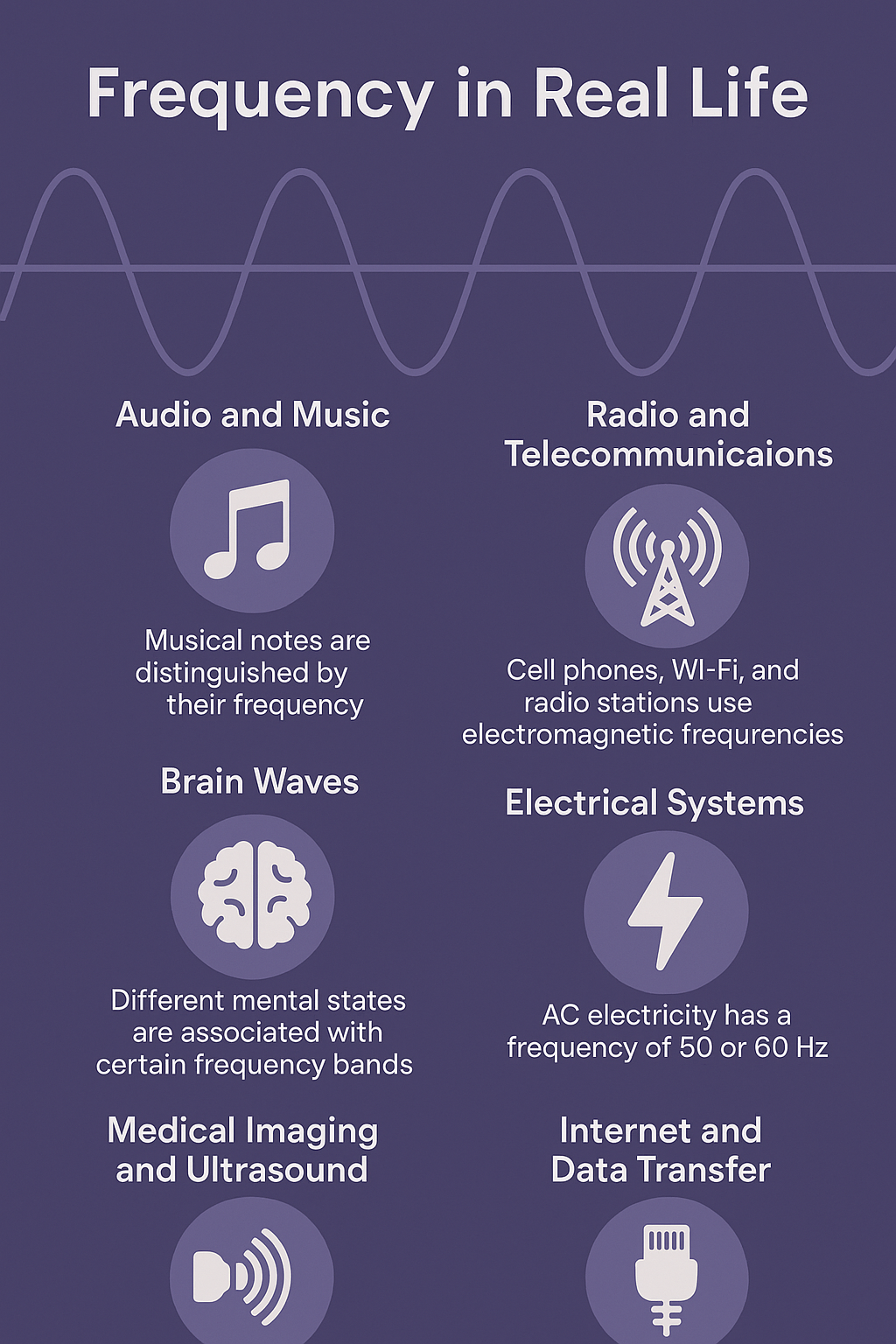
🔊 1. Audio and Music
Musical notes are distinguished by their frequency. A standard tuning pitch (A4) has a frequency of 440 Hz. Equal temperament tuning divides octaves into 12 frequencies.
📻 2. Radio and Telecommunications
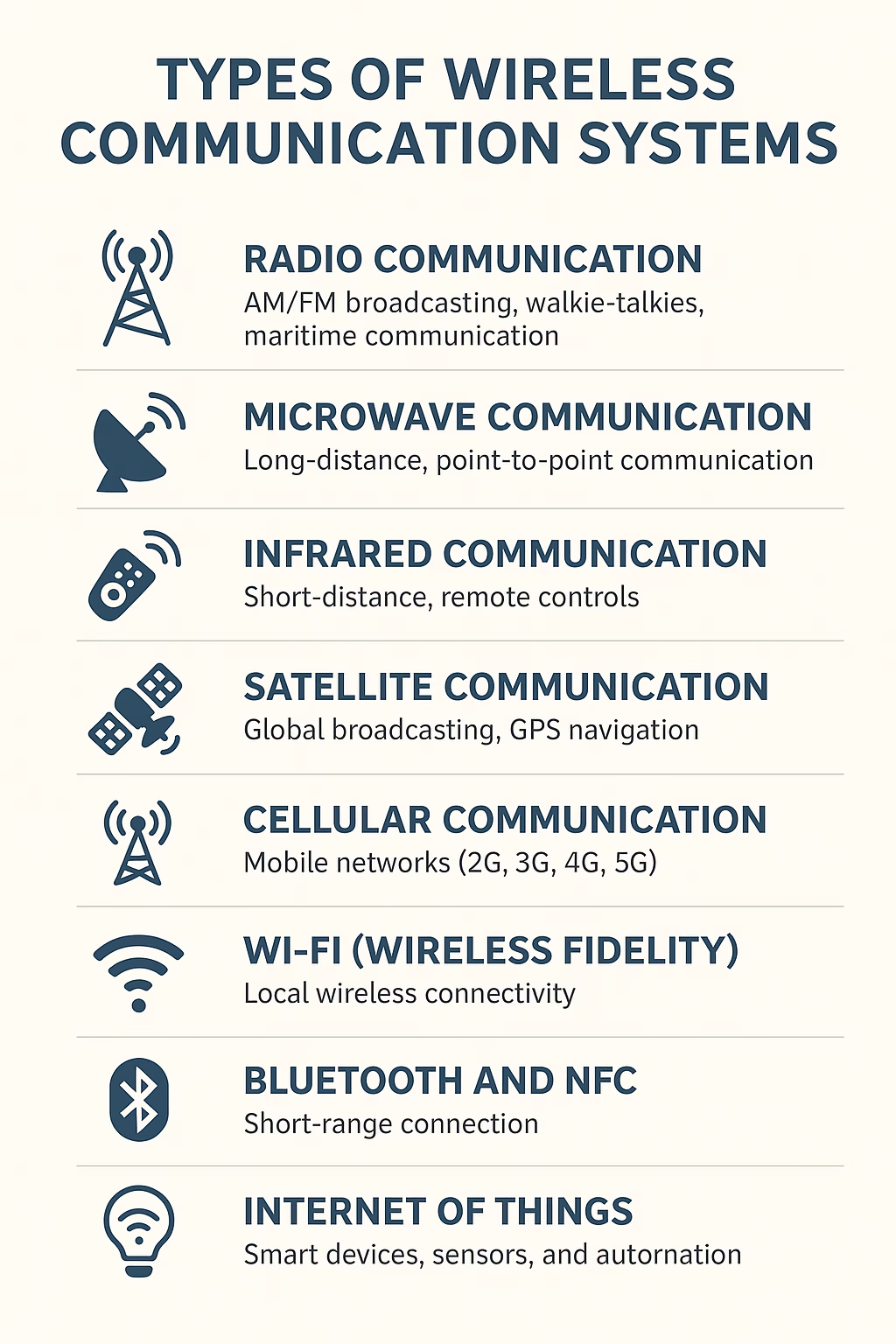
Radio stations, cell phones, Wi-Fi, and satellites all operate on specific electromagnetic frequencies. For example:
- FM Radio: ~88 to 108 MHz
- Wi-Fi: 2.4 GHz and 5 GHz
- Bluetooth: ~2.4 GHz
🧠 3. Brain Waves
Neuroscientists study brainwave frequencies to understand mental states:
- Delta (0.5–4 Hz): deep sleep
- Theta (4–8 Hz): relaxation, meditation
- Alpha (8–13 Hz): calm, resting
- Beta (13–30 Hz): active thinking
⚡ 4. Electrical Systems
Alternating current (AC) electricity has a:
- 50 Hz in most countries (e.g., Indonesia, Europe)
- 60 Hz in the U.S. and others
🔬 5. Medical Imaging and Ultrasound
Ultrasound uses high-frequency sound waves (typically 1–15 MHz) to image internal organs or monitor pregnancies.
🌐 6. Internet and Data Transfer
Data transmission rates (in bits per second) are related to bandwidth. Fiber optics, modems, and routers all depend on signal frequency.
🧮 How to Measure Frequency
There are various ways to measure depending on the signal type:
- Oscilloscope: Displays waveform, period, and calculates frequency.
- Frequency Counter: Electronic instrument that counts the number of cycles in a given time.
- Spectrum Analyzer: Used for complex signal frequencies, especially in communication systems.
⚖️ Frequency vs. Period
The period of a wave is the amount of time it takes to complete one cycle. It is the inverse of frequency. T=1fT = \frac{1}{f}T=f1
Where:
- TTT = period (in seconds)
- fff = frequency (in Hz)
For example, if a signal has of 10 Hz, its period is 0.1 seconds.
🌀 Types of Frequency
Depending on the context, frequency can be classified in various forms:
| Type | Description |
|---|---|
| Natural | Frequency at which a system naturally vibrates. |
| Resonant | The frequency at which an object responds with maximum amplitude. |
| Carrier | Frequency of a wave used to carry information (radio/TV). |
| Cutoff | Limit at which a filter blocks signals. |
| Sampling | In digital systems, the rate at which samples are taken from analog signals. |
📈 Importance of Frequency in Engineering and Science
Understanding frequency allows engineers and scientists to:
- Design efficient communication systems.
- Optimize signal processing in electronics.
- Improve acoustic systems in architecture.
- Analyze vibrations in mechanical structures.
- Ensure safety in electric and electronic equipment.
🧩 Conclusion
Frequency is everywhere — in sound, light, electricity, and more. Its simple definition hides a vast range of critical applications across many fields of science and technology. Whether you’re listening to music, using your smartphone, or analyzing circuits, you’re relying on the principles of frequency.
Understanding this concept opens the door to deeper insights into how the world around us works — especially in fields like electrical engineering, physics, audio technology, and communications.
If you want to dive deeper into related topics such as wavelength, signal processing, wave propagation, or electromagnetic spectrum, be sure to explore more articles on Abi Royen.