Signal amplification is one of the most crucial processes in the field of electronics and communication systems. Without amplification, weak signals generated by various sources such as microphones, sensors, or antennas would not be strong enough for further processing, transmission, or analysis.
In this article, we will explore what signal amplification is, its working principle, various types of amplifiers, and real-world applications. Whether you are an electronics student, an engineer, or a DIY enthusiast, this comprehensive guide will help you understand the essence and importance of signal amplification.
🔧 What is Signal Amplification?
Signal amplification refers to the process of increasing the strength or amplitude of an electrical signal without altering its original content. The device that performs this function is called an amplifier. Amplification is used in both analog and digital systems to enhance the usability and range of signals.
At its core, amplification makes it possible for low-power signals to drive loads or be transmitted over long distances, particularly in communication systems, audio devices, instrumentation, and more.
⚙️ How Does Signal Amplification Work?
Amplification typically involves an active electronic component—such as a transistor or an operational amplifier—that uses power from a power supply to boost the input signal.
Here’s how it works in simple terms:
- Input Signal: A weak electrical signal is fed into the amplifier.
- Amplification Stage: The amplifier uses external power (from a battery or power supply) to increase the signal’s amplitude.
- Output Signal: A stronger version of the input signal is produced at the output, preserving the original shape and frequency.
The gain of an amplifier (denoted in decibels, dB) indicates how much the amplifier boosts the signal. For example, a gain of 20 dB means the output signal is 10 times stronger than the input.
🔍 Types of Signal Amplification
There are various types of amplifiers used in signal amplification, each designed for specific purposes:
1. Voltage Amplifier
- Increases the voltage level of the input signal.
- Common in audio devices and instrumentation.
2. Current Amplifier
- Boosts the current level of the signal.
- Used in motor drivers and actuators.
3. Power Amplifier
- Increases both voltage and current to enhance power.
- Found in RF transmission, audio systems, and wireless communication.
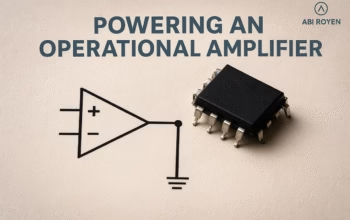
4. Operational Amplifier (Op-Amp)
- A versatile amplifier used in filters, integrators, and comparators.
- Features high gain and wide bandwidth.
5. RF (Radio Frequency) Amplifier
- Amplifies high-frequency signals in the MHz to GHz range.
- Used in wireless communication, radar, and satellite systems.
6. Audio Amplifier
- Specially designed to amplify sound signals.
- Used in headphones, speakers, and home theater systems.
7. Instrumentation Amplifier
- High-precision amplifier used for differential signal measurement.
- Widely used in medical and industrial sensors.
🧪 Signal Amplification in Analog vs. Digital Systems
- Analog Signal Amplification:
Analog signals are continuous waveforms that can vary in amplitude and frequency. Amplifiers in analog systems must maintain the waveform’s integrity without distortion. - Digital Signal Amplification:
Digital signals consist of discrete binary levels (0 and 1). In digital systems, amplifiers act as signal regenerators, ensuring signal integrity across long distances (as in repeaters or buffers).
📱 Real-World Applications of Signal Amplification
1. Audio Equipment
- Amplifiers boost weak signals from microphones or audio sources to drive loudspeakers with high fidelity.
2. Communication Systems
- In mobile phones, satellites, and radios, amplifiers enhance signals for clear transmission and reception.
3. Medical Devices
- ECG, EEG, and EMG machines use instrumentation amplifiers to detect and amplify biological signals.
4. Industrial Sensors
- Signal amplification helps process low-level signals from temperature, pressure, and motion sensors.
5. Television and Broadcasting
- Amplifiers are used in transmission towers to broadcast signals across vast areas.
6. Research and Measurement Equipment
- Oscilloscopes, signal analyzers, and other test equipment depend on clean signal amplification for accurate readings.

⚠️ Challenges in Signal Amplification
While amplification is beneficial, it comes with several technical challenges:
- Noise Introduction: Every amplifier introduces a certain amount of electrical noise, which can distort the signal.
- Distortion: Excessive gain can alter the waveform, especially in analog systems.
- Bandwidth Limitations: Amplifiers have a limited frequency range over which they can operate effectively.
- Power Consumption: High-gain amplifiers often require more power, which may not be ideal for battery-powered systems.
✅ Best Practices for Effective Signal Amplification
- Choose the right amplifier type for your application.
- Match the amplifier’s input/output impedance with the signal source and load.
- Use proper shielding and grounding to minimize noise.
- Avoid over-amplification to prevent signal clipping and distortion.
- Utilize feedback and gain control circuits to maintain signal integrity.
📚 Conclusion of Signal Amplification
Signal amplification is a foundational concept in electronics that enables reliable data transmission, sound processing, and accurate measurements. From your smartphone to high-end medical diagnostics, the ability to boost and preserve signals is vital across industries.
Understanding how amplification works, the types of amplifiers available, and their practical applications will empower engineers, students, and hobbyists to design and troubleshoot electronic systems effectively.
For more insightful articles about electronics and components, explore Abi Royen’s Electronics Hub.