
Capacitors Legal Industrial Standards ~ Capacitors are essential components in nearly every electronic circuit, from basic power supplies to advanced medical and aerospace systems. As their applications expand, so does the need for consistent quality, safety, and environmental compliance. To meet these demands, capacitors must adhere to a wide range of legal and industrial standards that ensure reliability, interoperability, and safety across different markets.
In this article, we explore the most significant legal and industrial standards related to capacitors, highlighting their purpose, scope, and impact on manufacturing, procurement, and global trade.
1. Why Standards Matter in Capacitor Manufacturing
Standardization in electronics is not just about consistency—it’s about safety, global compatibility, environmental impact, and consumer protection. Capacitor standards help:
- Define quality benchmarks
- Prevent equipment failure
- Facilitate international trade
- Ensure environmental and health safety
- Enable compatibility across systems and regions
Whether for consumer devices or industrial automation, every capacitor must be tested and certified according to standards established by regulatory bodies and industry consortiums.
2. Key Capacitors Legal Industrial Standards
a. RoHS (Restriction of Hazardous Substances Directive)
- Region: European Union
- Scope: Limits the use of hazardous substances like lead, cadmium, mercury, and hexavalent chromium.
- Impact on Capacitors: Capacitors must not contain restricted materials above specified limits. RoHS compliance is critical for entering the EU market.
b. REACH (Registration, Evaluation, Authorisation and Restriction of Chemicals)
- Region: European Union
- Focus: Ensures that chemicals used in manufacturing (including capacitor dielectrics and coatings) are registered and evaluated for safety.
- Compliance Need: Manufacturers must disclose material composition and verify that substances of very high concern (SVHCs) are not present.
c. UL (Underwriters Laboratories)
- Region: North America
- Purpose: Certifies product safety for fire, shock, and mechanical hazards.
- Relevant Certifications: UL 810 (for capacitors), UL 94 (flammability of plastics).
- Use Case: Particularly important for capacitors in consumer electronics, HVAC systems, and industrial machinery.
d. CE Marking
- Region: European Economic Area
- Significance: Indicates conformity with health, safety, and environmental protection standards.
- Requirement: Capacitor products must comply with EU Directives (like LVD and EMC) to receive the CE mark.
3. Important Capacitors Legal Industrial Standards
a. IEC Standards (International Electrotechnical Commission)
- Overview: Global organization that prepares and publishes international standards for electrical, electronic, and related technologies.
- Relevant Standards:
- IEC 60384: Fixed capacitors for use in electronic equipment
- IEC 61071: Capacitors for power electronics
- IEC 60252: Motor capacitors
b. Capacitors Legal Industrial Standards IEEE Standards
- Focus: US-based but globally recognized in industrial and utility applications.
- Key Documents:
- IEEE C37.99: Guide for the protection of shunt capacitor banks
- IEEE Std 18: Capacitor application guide
c. JIS Standards (Japanese Industrial Standards)
- Scope: Primarily used in Japan, JIS-C series covers capacitors used in telecommunications and general electronics.
- Significance: Many Japanese electronics manufacturers rely on JIS-compliant components for domestic and international products.
d. MIL-SPEC (Military Specifications)
- Application: Capacitors used in defense, aerospace, and critical communication systems.
- Attributes: High reliability, tolerance to extreme environments, and strict lifecycle testing.
4. Environmental and Sustainability Standards
As the electronics industry faces pressure to improve sustainability, capacitors must also meet environmental standards beyond RoHS and REACH.
a. WEEE (Waste Electrical and Electronic Equipment Directive)
- Region: European Union
- Role: Requires manufacturers to design capacitors and systems with end-of-life recyclability in mind.
- Importance: Promotes recovery and reuse, reducing e-waste.
b. ISO 14001 (Environmental Management Systems)
- Voluntary Compliance: Demonstrates a company’s commitment to reducing environmental impact during manufacturing, including materials used in capacitors.
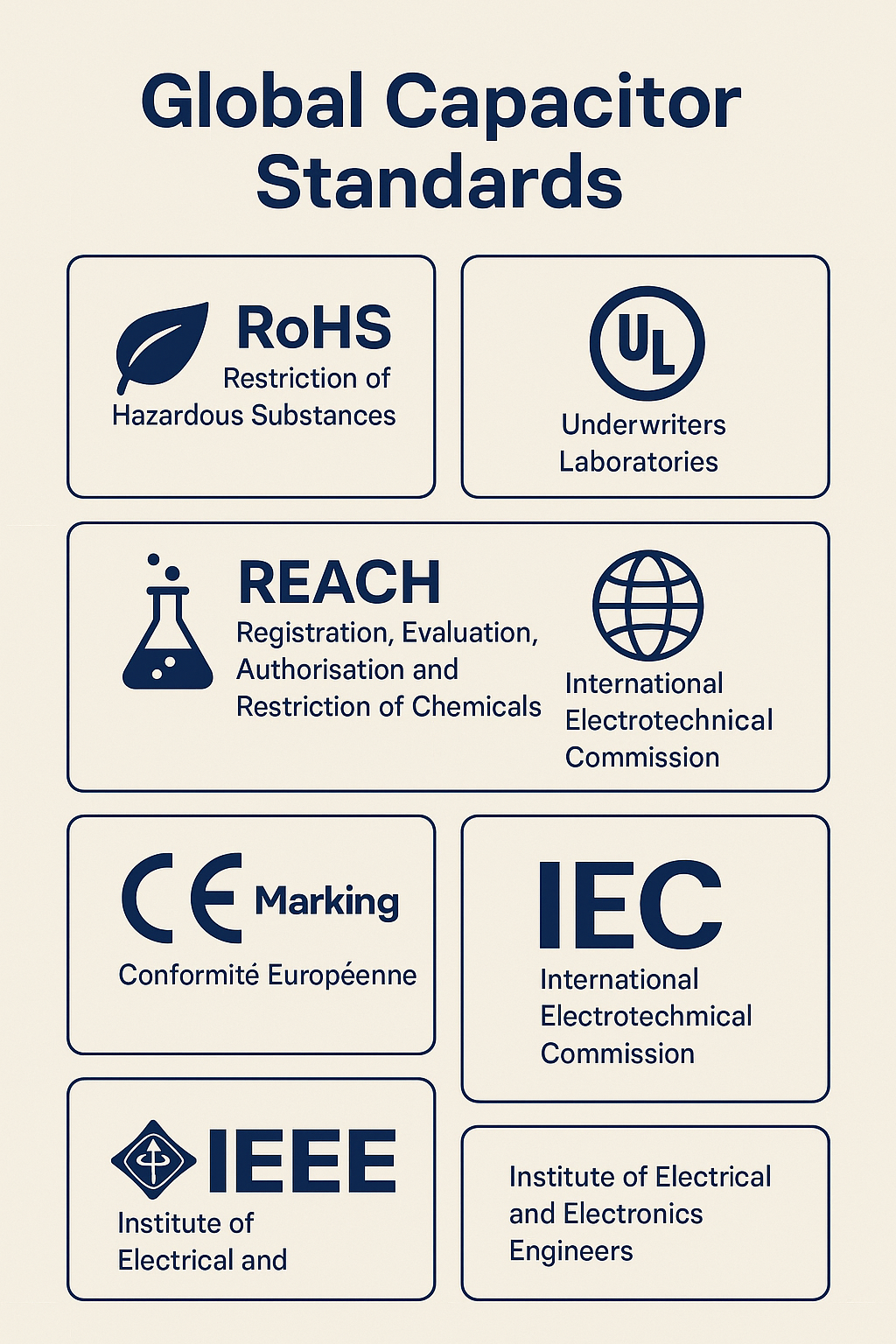
5. Capacitors Legal Industrial Standards, Labeling and Certification Marks
Capacitors typically bear various labels indicating compliance:
- RoHS Compliant
- UL Listed / Recognized Component
- CE Mark
- CSA (Canadian Standards Association)
- TÜV (Germany)
- VDE (Association for Electrical, Electronic & Information Technologies, Germany)
These marks are often accompanied by serial numbers or codes that trace the production batch, material source, and testing history.
6. Testing and Quality Assurance in Capacitor Manufacturing
To meet industrial and legal standards, capacitors undergo rigorous testing:
- Dielectric Strength Test
- Insulation Resistance Test
- Load Life Test
- Surge Voltage Test
- Thermal Shock and Humidity Test
Manufacturers often maintain ISO 9001 certification to standardize internal quality processes and document compliance for audits.
7. Challenges in Global Capacitors Legal Industrial Standards
With multiple regions having their own standards, global capacitor manufacturers face the challenge of overlapping or conflicting requirements. Some challenges include:
- Keeping up with revisions to standards (e.g., changing RoHS exemptions)
- Navigating documentation requirements for multiple markets
- Managing supply chains to ensure raw material compliance
- Balancing cost vs. certification needs in low-margin components
Therefore, many companies rely on automated compliance software and certification bodies to streamline processes.
8. Conclusion: The Strategic Value of Compliance Capacitors Legal Industrial Standards
Complying with legal and industrial standards is not just a formality—it is a strategic necessity in modern electronics. Capacitors that meet global certifications not only guarantee safety and performance but also open doors to international markets and build trust with consumers and OEMs.
For electronics manufacturers, sourcing capacitors from certified suppliers is essential to avoid recalls, penalties, or failure in mission-critical systems. Understanding capacitor standards helps designers, engineers, and procurement teams make informed, compliant decisions.
Ready to ensure your capacitor designs meet industry standards?
Stay updated with the latest insights at Abi Royen—your trusted source for electronics component knowledge and compliance guides.