Variable Resistor are essential components in electronics used to control current flow and adjust signal levels. Unlike fixed resistors, variable resistors can change their resistance dynamically, making them highly useful in a variety of applications such as volume controls, tuning circuits, and feedback systems.
In this article, we will dive deep into the components of a variable resistor, understand how each part functions, and explore the role they play in the overall operation of the device.
What Is a Variable Resistor?
A variable resistor, often referred to as a potentiometer or rheostat, is a type of resistor whose resistance value can be adjusted manually or electronically. It consists of several key components that work together to vary resistance across a circuit.
The two main types of variable resistors are:
- Potentiometers: Three-terminal devices used to vary voltage.
- Rheostats: Two-terminal devices used to vary current.
While their applications differ slightly, both share similar internal components and construction.
Key Components of a Variable Resistor
Here is a breakdown of the fundamental components that make up a typical variable resistor:
1. Resistive Track (Element)
- Function: The resistive track is the core element of a variable resistor. It is the pathway through which current flows and whose resistance changes depending on the position of the wiper.
- Material: Common materials include carbon, cermet, conductive plastic, or wire-wound metal.
- Shape: It can be linear (straight track) or rotary (circular track), depending on the design.
2. Wiper (Slider or Brush)
- Function: The wiper moves across the resistive track, making contact at different points to change the resistance value. It determines the output voltage or current by selecting a point on the resistive element.
- Construction: Typically made of metal or conductive material that maintains a stable connection with the resistive element.
- Movement: Can be moved manually via a knob or automatically via servomechanism in digital potentiometers.
3. Terminals (Pins)
- Function: Variable resistors typically have two or three terminals.
- In a potentiometer:
- Terminal 1: Connects to one end of the resistive element.
- Terminal 2: Connects to the wiper.
- Terminal 3: Connects to the other end of the resistive element.
- In a rheostat, only two terminals are used (one fixed end and the wiper).
- In a potentiometer:
- Material: Usually made from copper, brass, or nickel-plated metal for good conductivity.
4. Rotary Shaft or Sliding Mechanism
- Function: The user uses the shaft or slider to adjust the position of the wiper along the resistive track.
- Types:
- Rotary Type: Common in potentiometers (used in volume controls).
- Linear Slider Type: Used in sliders for audio mixers or faders.
- Material: Often plastic or metal, with a gripping surface for easy rotation or sliding.
5. Housing (Enclosure)
- Function: Protects internal components from dust, moisture, and mechanical damage.
- Material: Usually made of plastic, metal, or a combination of both.
- Design Considerations: May include sealing for high-precision or industrial applications.
6. Mounting Hardware
- Function: Secures the variable resistor to a panel or PCB (printed circuit board).
- Includes:
- Threaded bushings
- Lock washers
- Nuts
- These parts allow stable mechanical installation and easy alignment with control knobs.
7. Knob or Adjustment Tool (Optional)
- Function: Allows manual adjustment of the resistance via the wiper.
- Types:
- Knobs: Used in consumer devices for easy hand-turning.
- Screwdriver Slots: Found in trim pots (trimmer potentiometers) for internal adjustments.
- Material: Plastic, aluminum, or other durable materials.
Types of Variable Resistors Based on Construction
Depending on design and application, variable resistors are categorized as follows:
- Rotary Potentiometer: Uses a rotating knob to adjust the resistance.
- Slide Potentiometer: Uses a sliding mechanism.
- Trimmer Potentiometer: Small, adjustable by tools, used for calibration.
- Digital Potentiometer: Electronically controlled with digital inputs.
- Wire-wound Rheostat: High-power applications with large resistance range.
Each type may slightly differ in its component design, but the essential parts remain consistent.
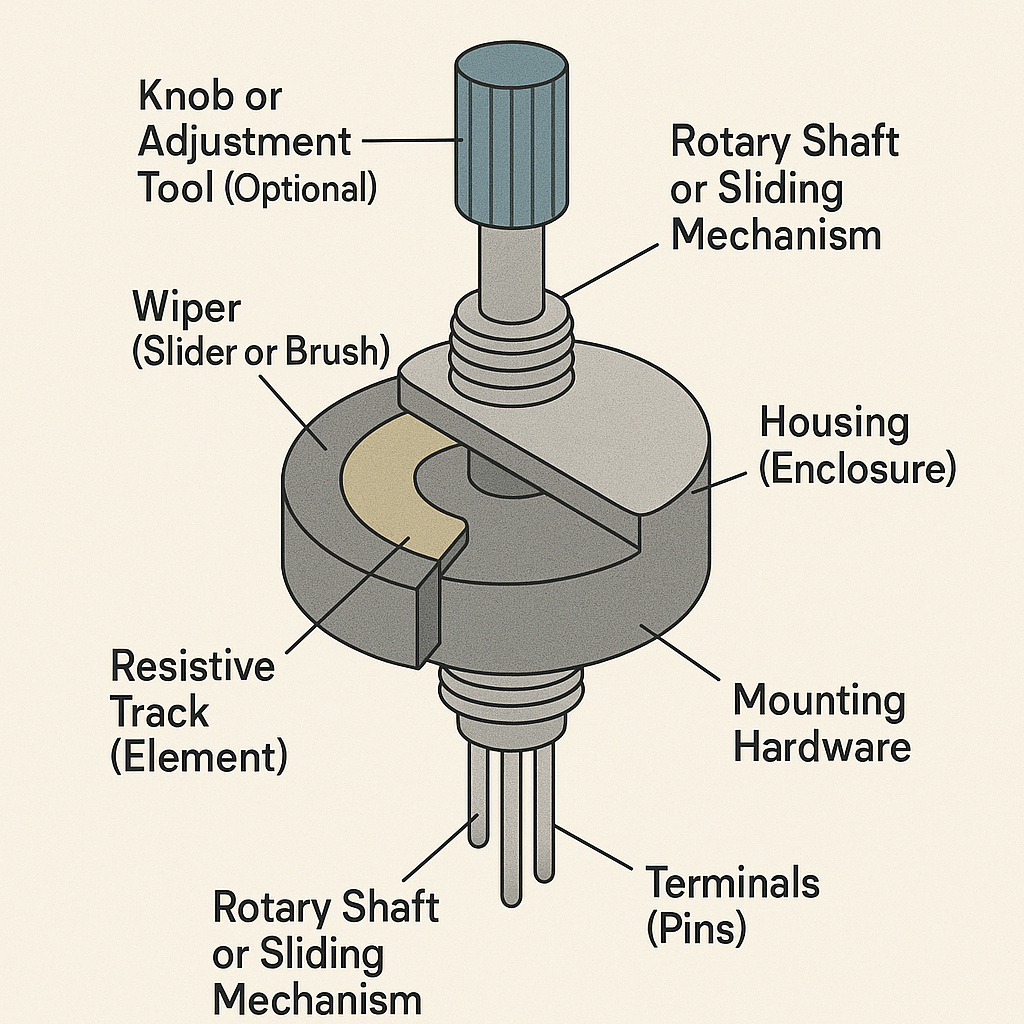
How Variable Resistor Components Work Together
Let’s explore how these parts interact:
- User rotates the shaft or slider, moving the wiper along the resistive track.
- The wiper makes contact at a different point, altering the resistance path between terminals.
- This changes the voltage or current that flows through the circuit, depending on configuration (voltage divider or current controller).
- The housing and mounting hardware ensure stable operation and protection.
Common Applications of Variable Resistor
Variable resistors are commonly used in:
- Volume and tone controls in audio devices.
- Brightness control in display systems.
- Calibration and tuning circuits.
- Sensor calibration and voltage division.
- Motor speed control in industrial systems.
Maintenance Tips for Variable Resistor
To maintain performance:
- Keep away from dust and moisture.
- Avoid over-rotation to prevent track damage.
- Clean contact points if intermittent operation is observed.
- For precision use, calibrate regularly using a multimeter.
Conclusion of Variable Resistor
Understanding the components of a variable resistor is fundamental for anyone involved in electronics. Whether you’re working on DIY projects, repairing equipment, or designing new systems, knowing how each part functions gives you better control and insight into your circuits.
From the resistive track to the wiper and terminals, each component has a vital role in ensuring the variable resistor operates efficiently and reliably. By appreciating this internal structure, you’ll be better equipped to troubleshoot, select, or utilize these versatile components.
📌 Featured on Abi Royen — Your Trusted Source for Electronics Knowledge