Capacitors are fundamental to modern electronics, serving in nearly every circuit design imaginable. Among various types of capacitors, tantalum capacitors are especially prized for their high volumetric efficiency, stability, and long life. These capacitors are essential in compact devices, where space and reliability are at a premium.
This article explores everything you need to know about tantalum capacitors—from their internal structure and working principles to their practical uses and benefits over other capacitor types.
What is a Tantalum Capacitor?
A tantalum capacitor is a type of electrolytic capacitor that uses tantalum metal for the anode. It is typically coated with a layer of tantalum pentoxide (Ta₂O₅), which acts as the dielectric. A conductive cathode layer, often made of manganese dioxide or polymer, completes the structure.
Tantalum capacitors are available in through-hole and surface-mount (SMD) formats, making them suitable for both legacy and modern PCB designs.
Construction and Working Principle
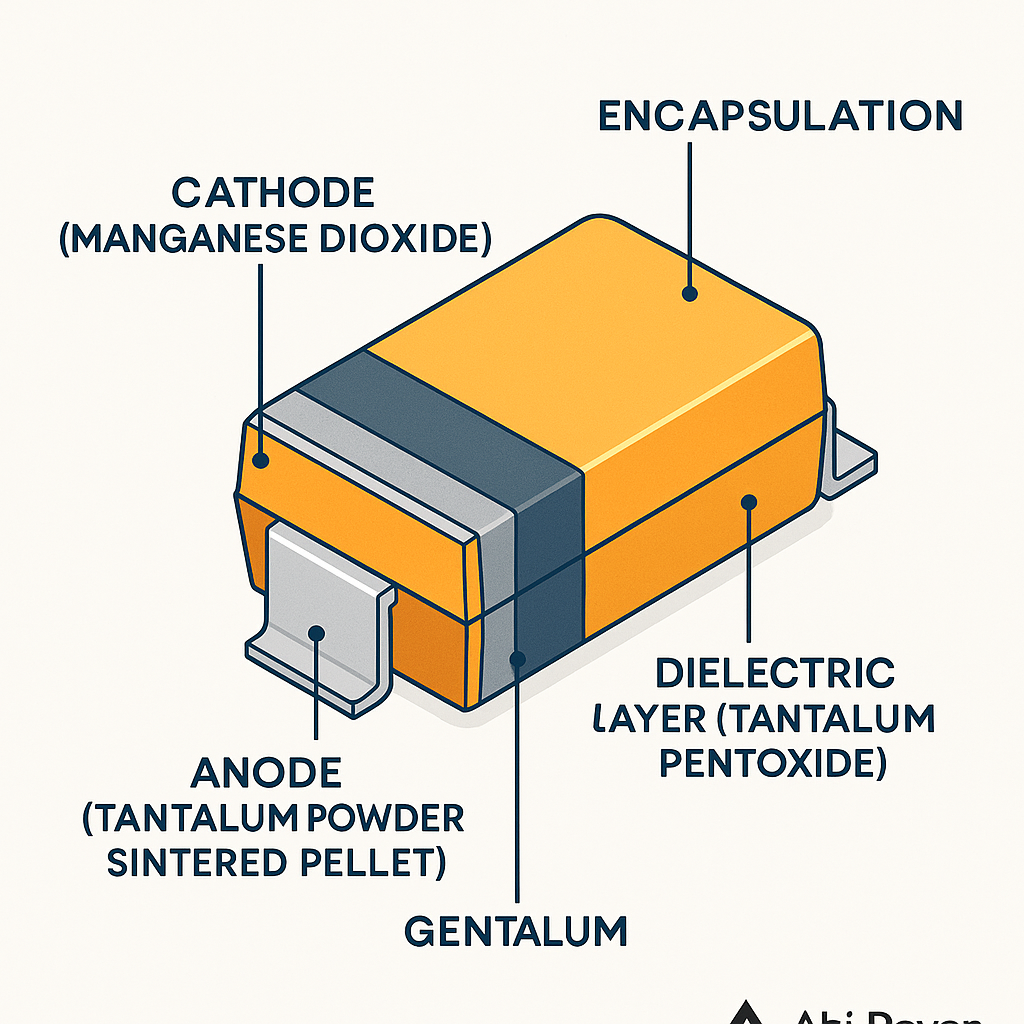
A typical tantalum capacitor consists of the following components:
- Anode (Tantalum Powder Sintered Pellet): This is the positive electrode. Tantalum powder is pressed and sintered to form a porous structure.
- Dielectric Layer (Tantalum Pentoxide): Formed by anodizing the tantalum pellet, this oxide layer is very thin and provides high capacitance in a small volume.
- Cathode (Manganese Dioxide or Conductive Polymer): This layer contacts the electrolyte and external terminal.
- Encapsulation: The entire unit is sealed in epoxy resin to protect it from environmental conditions.
Working Principle:
When a voltage is applied, electrons accumulate on one side of the dielectric (anode), while the cathode collects opposite charges. This separation of charges across the dielectric stores electrical energy.
Types of Tantalum Capacitors
Tantalum capacitors come in two main types:
1. Solid Tantalum Capacitors (MnO₂-Based):
- Use manganese dioxide as the cathode.
- Well-established in the industry.
- Suitable for applications with stable temperature and voltage.
2. Polymer Tantalum Capacitors:
- Use conductive polymer as the cathode.
- Offer lower ESR (Equivalent Series Resistance).
- Better performance in high-speed circuits and power applications.
Key Characteristics of Tantalum Capacitors
| Property | Tantalum Capacitors |
|---|---|
| Capacitance Range | 0.1 µF to 1000 µF |
| Voltage Range | 2.5V to 50V |
| Tolerance | ±10% to ±20% |
| Temperature Range | -55°C to +125°C |
| ESR | Low (especially in polymer types) |
| Polarity | Yes (electrolytic, polarized) |
| Size | Very compact for given capacitance |
Advantages of Tantalum Capacitors
- High Capacitance-to-Volume Ratio:
Ideal for compact designs where space is limited. - Stable Electrical Performance:
Excellent temperature and frequency stability compared to aluminum electrolytic capacitors. - Long Life and Reliability:
Tantalum capacitors have a low failure rate under normal operating conditions. - Low ESR:
Especially in polymer types, low ESR enhances power handling and reduces voltage ripple. - Tight Tolerance:
Allows precise filtering and timing in critical applications.
Disadvantages to Consider
- Polarity Sensitive:
Reversing polarity can permanently damage the capacitor. - Cost:
Generally more expensive than ceramic or aluminum electrolytic capacitors. - Limited Surge Capability:
Not suitable for circuits with high inrush current unless properly protected.
Applications of Tantalum Capacitors
Due to their unique advantages, tantalum capacitors are widely used in various industries:
1. Consumer Electronics
- Smartphones, tablets, and laptops
- Power regulation and decoupling applications
2. Automotive Systems
- Used in infotainment systems, ADAS modules, and ECUs (with AEC-Q200 qualified models)
3. Medical Devices
- Pacemakers, hearing aids, and other miniaturized electronics
4. Aerospace and Defense
- Communication systems and avionics due to their high reliability
5. Industrial Equipment
- Control units, sensors, and monitoring devices
6. Telecommunications
- Base stations, routers, and network interface cards
Tantalum Capacitors vs Other Capacitor Types
| Feature | Tantalum | Ceramic | Aluminum Electrolytic |
|---|---|---|---|
| Size Efficiency | High | Very High | Moderate |
| Cost | High | Low | Moderate |
| Voltage Rating | Low to Medium | High | High |
| Polarity | Yes | No | Yes |
| Stability | Very Good | Depends on Type | Fair |
| ESR | Low | Very Low | High |
| Failure Mode | Short Circuit | Open/Short | Open Circuit |
Tips for Using Tantalum Capacitors in Circuit Design
- Use in Low-Noise Designs: Their stability and low ESR are perfect for precision analog circuits.
- Mind the Polarity: Always mark and install correctly to avoid damage.
- Use Derating: Select a voltage rating that is at least 1.5x the working voltage for enhanced reliability.
- Combine with Ceramic Capacitors: For wideband decoupling, tantalum capacitors are often used alongside MLCCs.
Environmental Considerations
The use of tantalum in electronics has raised ethical and environmental concerns due to conflict minerals. Ensure sourcing from responsible supply chains that follow OECD guidelines and Conflict-Free Sourcing Initiatives (CFSI).
Conclusion
Tantalum capacitors are compact, reliable, and offer excellent performance characteristics in a variety of demanding applications. Whether you’re designing a smartphone, a medical device, or a satellite subsystem, understanding the features and constraints of tantalum capacitors can help you make informed choices in electronic circuit design.
As technology continues to shrink and reliability becomes even more critical, the role of tantalum capacitors will remain strong, especially in high-reliability and space-constrained environments.
For More Information:
Visit Abi Royen for technical resources, product catalogs, and expert insights into electronic components, including capacitors, resistors, diodes, and more.