How Do Transistors Work? ~ Transistors are among the most revolutionary inventions in the history of technology. They serve as the building blocks of modern electronic devices, from smartphones and computers to satellites and medical instruments. Without transistors, our digital world would not exist in the way we know it today.
But how do transistors work? To answer this, we need to explore their history, structure, working principle, functions, types, and applications. This article provides an in-depth explanation of transistors that will help students, hobbyists, and professionals understand why they are so essential.
1. What Is a Transistor?
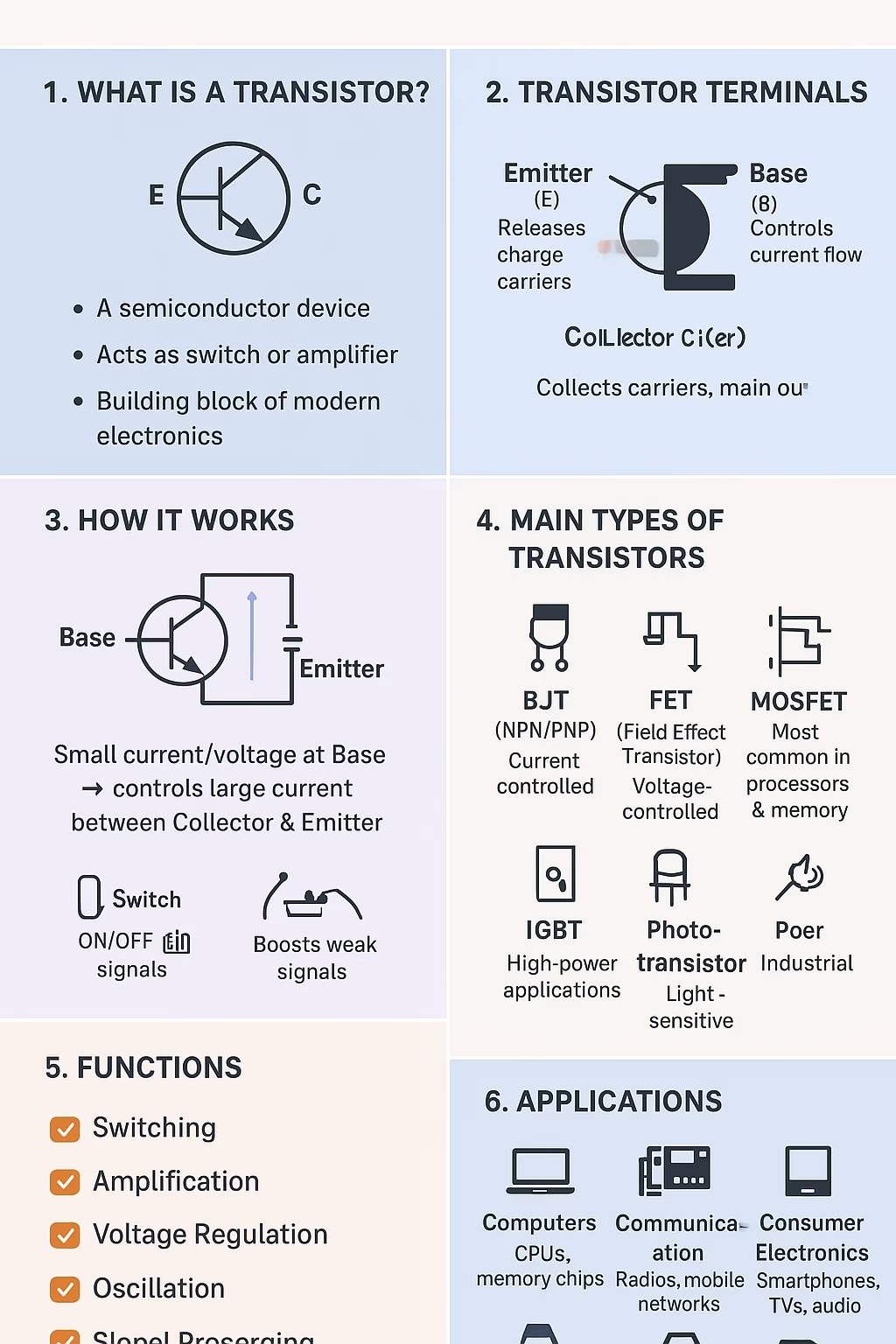
A transistor is a semiconductor device that can act as a switch or an amplifier for electrical signals. It controls the flow of current or voltage in a circuit. The transistor replaced bulky vacuum tubes in the 20th century, leading to smaller, faster, and more reliable electronic devices.
Invented in 1947 by John Bardeen, Walter Brattain, and William Shockley at Bell Labs, the transistor marked the beginning of the modern electronics era.
At its core, a transistor allows a small electrical signal to control a much larger signal, enabling amplification and digital logic operations.
2. Basic Structure of a Transistor
Transistors are made of semiconductor materials, typically silicon. A semiconductor has electrical properties between a conductor (like copper) and an insulator (like glass).
The basic structure of a transistor has three terminals:
- Emitter (E) – releases charge carriers (electrons or holes).
- Base (B) – a thin layer that controls how many carriers pass through.
- Collector (C) – collects the carriers and outputs the main current.
Depending on the type, a transistor can be either NPN or PNP, referring to how semiconductor layers are arranged.
3. How Do Transistors Work? (Working Principle)
The operation of a transistor relies on controlling the flow of charge carriers through semiconductor layers.
- In an NPN transistor, when a small current flows into the base, it allows a much larger current to flow from collector to emitter.
- In a PNP transistor, the current directions are reversed, but the principle remains the same: a small input signal controls a larger one.
In simple terms:
- As a Switch: When the base signal is strong enough, the transistor “turns on” and allows current to pass. When the base signal is absent, it stays “off.”
- As an Amplifier: A weak signal at the base gets amplified into a stronger signal at the output.
This property makes transistors fundamental in logic gates, digital circuits, and analog amplifiers.
4. Main Functions of a Transistor
Transistors are versatile devices with several key functions:
- Switching: Turning current on/off in digital circuits.
- Amplification: Boosting weak signals (used in audio amplifiers, radios).
- Regulation: Stabilizing voltages in power supplies.
- Oscillation: Creating signals for clocks and radios.
- Signal Processing: Used in communication and computing.
5. Types of Transistors
There are many types of transistors, each with unique properties and uses.
5.1 Bipolar Junction Transistor (BJT)
- Consists of NPN or PNP layers.
- Current-controlled device.
- Commonly used in amplifiers and switches.
5.2 Field Effect Transistor (FET)
- Voltage-controlled device.
- High input resistance, low power consumption.
- Common type: MOSFET (Metal-Oxide-Semiconductor FET).
5.3 MOSFET (Metal-Oxide-Semiconductor FET)
- Most widely used transistor in modern electronics.
- Forms the basis of CMOS technology found in microprocessors.
5.4 IGBT (Insulated Gate Bipolar Transistor)
- Combination of BJT and MOSFET.
- Used in high-power applications like inverters and motor drives.
5.5 Other Special Types
- Darlington Transistor – High current gain.
- Phototransistor – Activated by light.
- Tunnel Transistor – Used in advanced low-power devices.
6. Transistor Characteristics
To understand how transistors perform, engineers analyze these characteristics:
- Input Characteristics – Relationship between base current and base-emitter voltage.
- Output Characteristics – Relationship between collector current and collector-emitter voltage.
- Transfer Characteristics – Relationship between input and output signals.
These characteristics determine whether a transistor is suitable for switching, amplification, or power control.
7. Applications of Transistors
Transistors are everywhere in electronics. Their applications include:
7.1 Computing
- Billions of transistors are packed inside microprocessors and memory chips.
- Enable logic operations in digital systems.
7.2 Communication Systems
- Used in radios, TVs, and mobile networks.
- Amplify and process signals for transmission and reception.
7.3 Consumer Electronics
- Found in smartphones, laptops, audio devices, and cameras.
- Enable miniaturization of devices.
7.4 Power Electronics
- Used in inverters, converters, and power supply circuits.
- Control and regulate high-power signals.
7.5 Automotive Electronics
- Manage ignition, sensors, and infotainment systems.
- Support the shift to electric vehicles (EVs).
7.6 Industrial Applications
- Used in robotics, automation, and control systems.
- Drive motors, actuators, and signal systems.
8. Why Are Transistors Important?
Transistors are often called the “heart of electronics” because:
- They enabled the digital revolution.
- Made electronics smaller, faster, and more reliable.
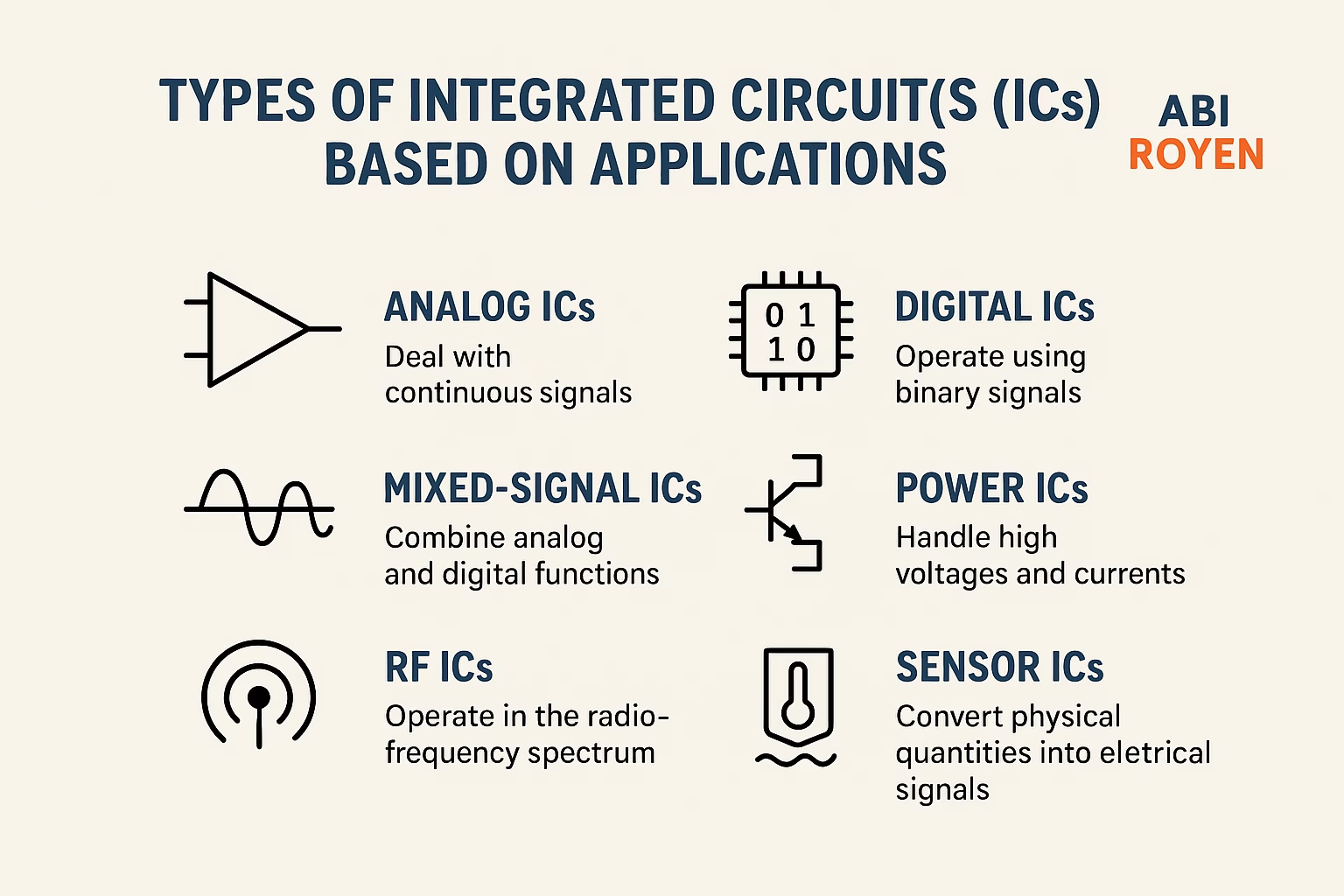
- Paved the way for integrated circuits (ICs) and microprocessors.
- Are the foundation of modern computing and communication.
Without transistors, we would not have smartphones, the internet, or advanced medical devices.
9. Future of Transistors
While traditional silicon transistors are approaching physical limits, researchers are developing new transistor technologies:
- Nano-transistors made of materials like graphene and carbon nanotubes.
- Quantum transistors for quantum computing.
- 3D transistors (FinFETs) used in modern CPUs and GPUs.
These innovations ensure that transistors will remain central to technology for decades to come.
Conclusion of How Do Transistors Work?
Transistors are the fundamental building blocks of modern electronics. They work by controlling the flow of current through semiconductor materials, enabling them to act as both switches and amplifiers. With countless applications in computing, communication, power systems, and consumer electronics, transistors have transformed the world.
From the first simple transistor at Bell Labs to today’s nanometer-scale devices in microchips, their journey reflects the incredible progress of human technology.
Understanding how transistors work not only helps us appreciate the devices we use daily but also inspires innovation in electronics, computing, and beyond.