
Introduction of Future Trends Transformer Technology
Future Trends Transformer Technology ~ Transformers have been the backbone of electrical power systems for more than a century. From stepping up voltages for long-distance transmission to stepping down voltages for safe distribution in homes and industries, transformers are indispensable to modern life. However, the demands of the 21st century—ranging from renewable energy integration to smart grids and sustainability—are pushing transformer technology into new directions.
This article explores the future trends in transformer technology that are set to reshape how we generate, distribute, and consume electricity. From smart digital solutions to eco-friendly materials and IoT-enabled monitoring systems, the transformer of the future will be more intelligent, efficient, and sustainable.
1. The Evolution of Transformer Technology
Traditionally, transformers were designed as static devices with minimal innovation over decades. However, rising global electricity demand, coupled with the rapid adoption of renewable energy and smart grid technologies, has accelerated transformer innovation. Key drivers include:
- Decarbonization: Reducing carbon footprints in power systems.
- Digitalization: Leveraging sensors, IoT, and AI for predictive maintenance.
- Decentralization: Adapting to distributed energy resources (DERs) such as solar and wind farms.
- Resilience: Ensuring stable power supply in the face of climate change and cyber threats.
2. Future Trends Transformer Technology: Smart Transformers and Digital Monitoring
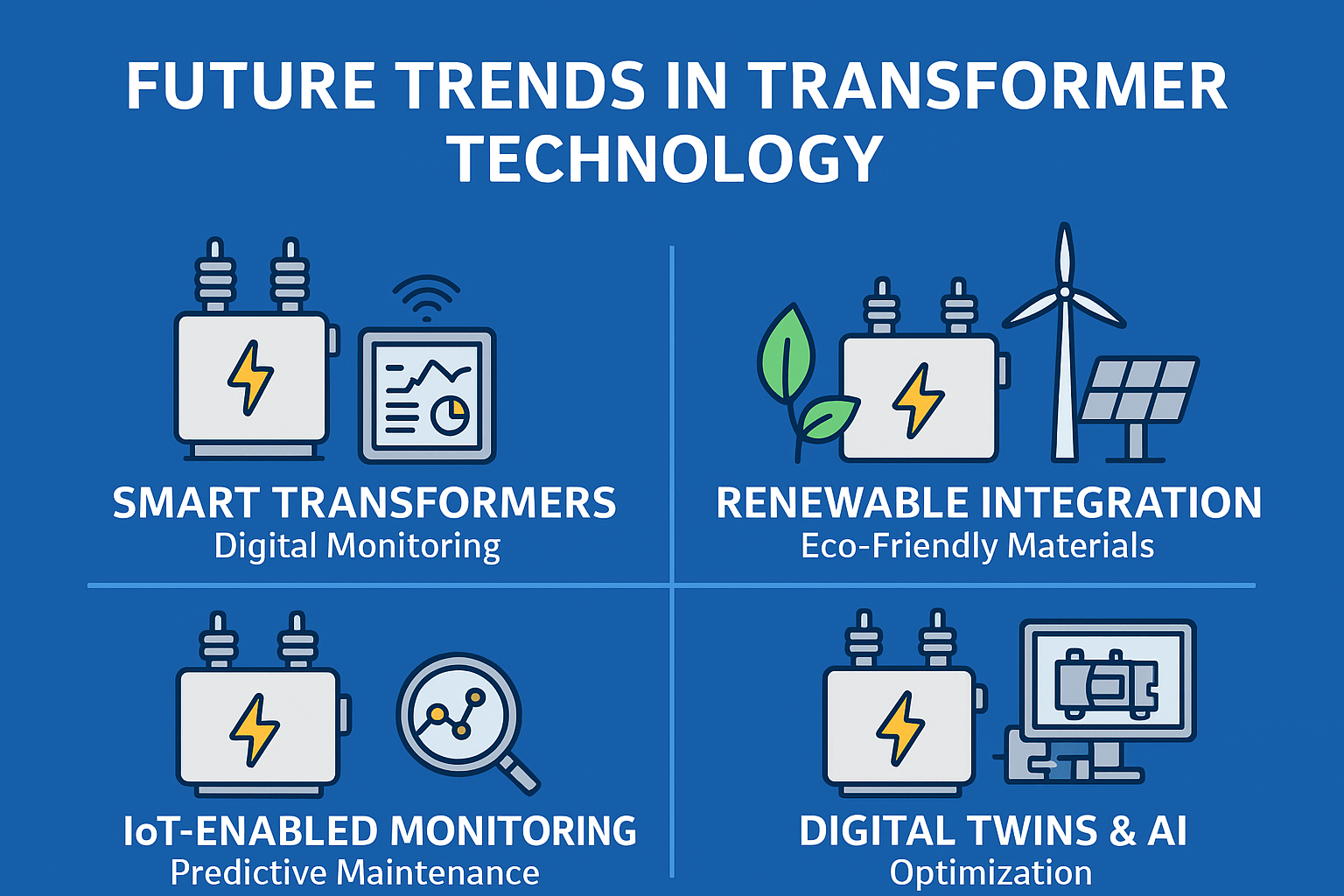
One of the most significant trends is the rise of smart transformers. Unlike conventional transformers, smart transformers are equipped with real-time monitoring and communication systems.
Features of Smart Transformers:
- IoT-Enabled Sensors: Track temperature, oil quality, load variations, and partial discharge.
- Remote Monitoring: Utilities can access transformer health data from anywhere.
- Self-Regulation: Smart transformers can adjust voltage dynamically, improving power quality.
- Predictive Maintenance: Using AI and big data to forecast potential failures before they occur.
These advancements reduce downtime, enhance grid reliability, and lower maintenance costs.
3. Integration with Renewable Energy Sources
As the world transitions to cleaner energy, transformers are evolving to accommodate renewable energy systems. Solar farms, wind turbines, and energy storage units require transformers that can handle:
- Fluctuating Loads: Renewable sources are variable, requiring adaptive transformers.
- Bidirectional Power Flow: Modern grids allow energy to flow both ways, from grid to consumer and vice versa.
- Microgrids and Decentralized Systems: Transformers are being designed for local, small-scale power distribution networks.
The future transformer must seamlessly integrate renewable power into national grids while ensuring stability.
4. Future Trends Transformer Technology: Eco-Friendly and Sustainable Transformers
Environmental sustainability is another driving force. Traditional transformers often use mineral oil for insulation and cooling, which poses fire and environmental risks. Future designs are embracing:
- Biodegradable Ester Oils: Safer, eco-friendly alternatives to mineral oils.
- Dry-Type Transformers: Eliminating liquid insulation, reducing risk of leaks and fires.
- Recyclable Materials: Using recyclable steel, copper, and insulation materials.
- Low-Loss Core Materials: Amorphous steel cores reduce energy losses.
These innovations not only improve efficiency but also align with global sustainability goals.
5. Digital Twins and AI in Transformers
The concept of digital twins—a virtual replica of a physical asset—is becoming popular in transformer technology.
- Simulation and Modeling: Digital twins allow utilities to simulate performance under different conditions.
- Fault Prediction: AI algorithms analyze historical data to predict failures.
- Optimization: Helps utilities optimize loading patterns and extend transformer lifespan.
This integration of AI and machine learning reduces downtime and operational costs significantly.
6. Future Trends Transformer Technology: Cybersecurity in Smart Transformers
With digitalization comes the risk of cyberattacks. Smart transformers connected to grids must be safeguarded against:
- Unauthorized Access
- Data Manipulation
- Remote Sabotage of Grid Stability
Future transformers will integrate cybersecurity protocols, including encryption, intrusion detection systems, and secure firmware updates.
7. Compact and Modular Transformers
Urbanization and space constraints are driving the development of compact transformer designs. Modular transformers can be easily installed in limited spaces, such as:
- Underground substations
- Urban distribution networks
- Offshore renewable platforms
Modular transformers also reduce installation and maintenance times, making them ideal for modern infrastructure.
8. The Role of Solid-State Transformers (SSTs)
A game-changing innovation is the solid-state transformer (SST). Unlike conventional transformers, SSTs use power electronics to manage voltage conversion.
Advantages of SSTs:
- Compact Size: Smaller and lighter than traditional transformers.
- Flexibility: Can manage both AC and DC power, essential for renewable and EV charging stations.
- Advanced Control: Allows grid operators to regulate power flow dynamically.
SSTs are expected to play a major role in electric vehicle charging infrastructure and smart grids.
9. Transformers for Electric Vehicle (EV) Infrastructure
The global rise of EVs demands a new class of transformers. EV charging stations require:
- High-Frequency Transformers: To support fast-charging technologies.
- Smart Load Balancing: To prevent grid overloads during peak charging.
- Bidirectional Power Flow: Vehicle-to-Grid (V2G) systems allow EVs to act as energy storage.
Future transformers will be central to supporting this electric mobility revolution.
10. Future Trends Transformer Technology: Global Market Outlook
According to recent industry reports, the global transformer market is expected to grow steadily, fueled by:
- Urbanization and industrialization in Asia-Pacific
- Modernization of aging infrastructure in Europe and North America
- Massive renewable energy projects worldwide
- Smart grid investments in developing countries
By 2030, smart and eco-friendly transformers are projected to dominate the market, replacing traditional designs.
Conclusion of Future Trends Transformer Technology
The future of transformer technology lies in the intersection of efficiency, intelligence, and sustainability. With the adoption of smart monitoring, eco-friendly materials, and solid-state innovations, transformers are no longer passive devices but active, adaptive, and resilient components of modern power systems.
As global energy systems transition toward renewable sources, electric mobility, and digital grids, transformers will play a pivotal role in ensuring a stable, secure, and sustainable power future.