

Introduction of Unijunction Transistor (UJT)
In the field of electronics and industrial automation, semiconductor devices are essential for controlling, switching, and regulating electrical signals. Among the many semiconductor components, the Unijunction Transistor (UJT) holds a unique position due to its distinct behavior and applications in triggering circuits, oscillators, and pulse generation.
Although it is not as commonly used today as MOSFETs or BJTs, the UJT is still an important concept in electronics, particularly for understanding the evolution of transistor technology and its applications in timing and triggering devices.
This article will provide a complete guide to the Unijunction Transistor (UJT), including its construction, working principle, characteristics, advantages, and applications in modern technology.
What is a Unijunction Transistor (UJT)?
A Unijunction Transistor (UJT) is a three-terminal semiconductor device that has only one PN junction. Unlike conventional transistors such as the Bipolar Junction Transistor (BJT) or Field Effect Transistor (FET), the UJT is not used primarily for amplification. Instead, it is mainly employed for switching and triggering purposes.
The device was first introduced in the 1960s and became widely used in relaxation oscillators, phase control circuits, and pulse generation circuits.
Terminals of a UJT
The UJT has three terminals:
- Emitter (E)
- Base1 (B1)
- Base2 (B2)
The unique structure and the single PN junction are what differentiate it from other transistors.
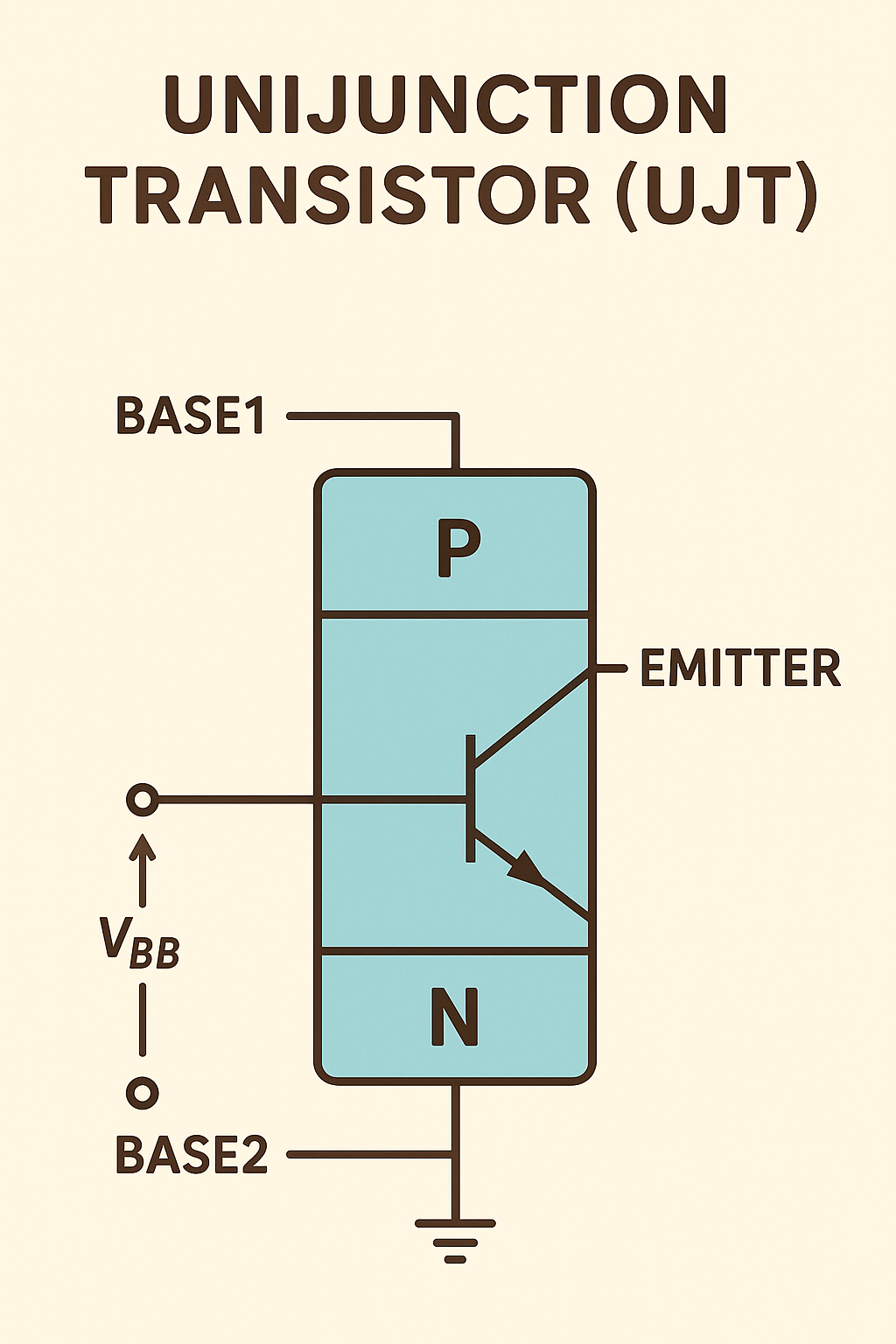
Construction of a Unijunction Transistor (UJT)
The construction of a UJT involves a lightly doped N-type silicon bar with two ohmic contacts at its ends, which form the terminals Base1 (B1) and Base2 (B2).
A small region of P-type material is diffused into the N-type silicon bar, forming the PN junction. This P-region is connected externally to the Emitter (E) terminal.
- The resistance between B1 and B2 without any applied voltage is known as interbase resistance (RBB).
- The emitter junction is usually placed closer to B2, making the resistance between Emitter and B1 lower than between Emitter and B2.
This asymmetric placement plays a crucial role in the functioning of the UJT.
Working Principle of Unijunction Transistor (UJT)
The working of a Unijunction Transistor is based on the control of current flow through its emitter and base terminals.
- When no voltage is applied to the emitter terminal, the resistance between B1 and B2 remains constant, known as the interbase resistance.
- When a positive voltage is applied to the emitter (with respect to B1), initially the emitter-base junction is reverse biased, and only a negligible current flows.
- As the emitter voltage reaches a certain value called the Peak Voltage (Vp), the PN junction becomes forward biased.
- At this point, the emitter injects charge carriers into the N-type bar, reducing the resistance between Emitter and B1.
- This causes a sudden increase in current, and the UJT enters a negative resistance region, which is a unique property of the device.
This characteristic makes UJT ideal for use in oscillators and triggering circuits.
Key Parameters of a UJT
Some important electrical parameters of a UJT are:
- Interbase Resistance (RBB): The resistance between B1 and B2 when emitter is open.
- Intrinsic Stand-off Ratio (η): The ratio of resistance between Emitter and B1 to the total interbase resistance.
- Peak Voltage (Vp): The emitter voltage at which the UJT switches from high resistance to low resistance.
- Valley Voltage (Vv): The voltage at which the UJT returns to its off state after conduction.
Characteristics of Unijunction Transistor (UJT)
The emitter characteristic curve of a UJT clearly shows three regions:
- Cut-off Region:
- When emitter voltage is below the peak voltage (Vp).
- Very little current flows.
- Negative Resistance Region:
- After Vp is reached, emitter current increases while emitter voltage decreases.
- This region is used in oscillators and pulse circuits.
- Saturation Region:
- Beyond the valley voltage, the UJT behaves like a conventional forward-biased diode.
Applications of Unijunction Transistor
The unique properties of UJT make it useful in various electronic and industrial applications. Some of the most common applications include:
1. Relaxation Oscillators
UJT is widely used in relaxation oscillators due to its ability to generate sawtooth waveforms. This makes it suitable for timing circuits.
2. Triggering Circuits for SCRs and Triacs
In power electronics, UJTs are used to trigger Silicon Controlled Rectifiers (SCRs) and Triacs in phase-controlled rectifiers, motor speed controllers, and light dimmers.
3. Pulse Generation
UJTs can be used to generate sharp pulses required in switching circuits.
4. Timing Circuits
Due to its predictable switching behavior, UJT is often used in timing applications, such as delay circuits.
5. Sawtooth Waveform Generation
The UJT can generate linear ramp signals, which are useful in television circuits, oscilloscopes, and sweep generators.
Advantages of UJT
- Simple construction with low cost.
- Reliable triggering device for SCRs.
- Requires very low triggering power.
- Exhibits stable operation with predictable switching.
Limitations of Unijunction Transistor (UJT)
- Cannot be used for amplification like BJTs or FETs.
- Limited frequency response compared to modern devices.
- Being an older technology, UJTs have largely been replaced by programmable unijunction transistors (PUTs) and other semiconductor devices.
Modern Relevance of UJT
Although the UJT is not as common in modern consumer electronics, it still holds relevance in industrial training, educational demonstrations, and certain triggering circuits. Engineers and students continue to study UJTs to understand the fundamentals of semiconductor switching and oscillator design.
Conclusion
The Unijunction Transistor (UJT) is a unique three-terminal semiconductor device with one PN junction. Its ability to exhibit negative resistance makes it highly useful in oscillators, triggering circuits, and timing applications.
Even though modern alternatives such as PUTs, microcontrollers, and integrated circuits have largely replaced UJTs, understanding their construction, working principle, and applications is still valuable in the study of electronics and industrial automation.
For industries, students, and electronics enthusiasts, mastering the UJT not only helps in understanding older circuit designs but also provides a strong foundation for learning more advanced semiconductor devices.