Introduction of Wireless Communication Systems
Wireless communication systems have become the backbone of modern society, enabling seamless connectivity across personal, commercial, and industrial applications. From mobile phones and Wi-Fi networks to satellite communication and IoT devices, wireless systems have transformed the way we live, work, and interact. Unlike wired communication, wireless systems transmit data using electromagnetic waves such as radio, microwave, or infrared signals, eliminating the need for physical cables.
This article provides a comprehensive exploration of wireless communication systems, including their basic principles, key technologies, applications, advantages, challenges, and future innovations that continue to shape the digital era.
1. Understanding Wireless Communication Systems
Wireless communication is the transfer of information between two or more points without using physical connections. Instead, the system relies on wireless channels like radio frequency (RF) spectrum, microwave bands, or infrared light.
Core Components of Wireless Communication
- Transmitter – Converts information into a signal suitable for transmission.
- Channel/Medium – The wireless path (air, vacuum, or space) used to carry the signal.
- Receiver – Captures the transmitted signal and reconstructs the original information.
- Antenna – Facilitates the transmission and reception of electromagnetic waves.
Principle of Operation
Wireless communication works through modulation and demodulation. The transmitter modulates the carrier wave with information, while the receiver demodulates it to retrieve the data.
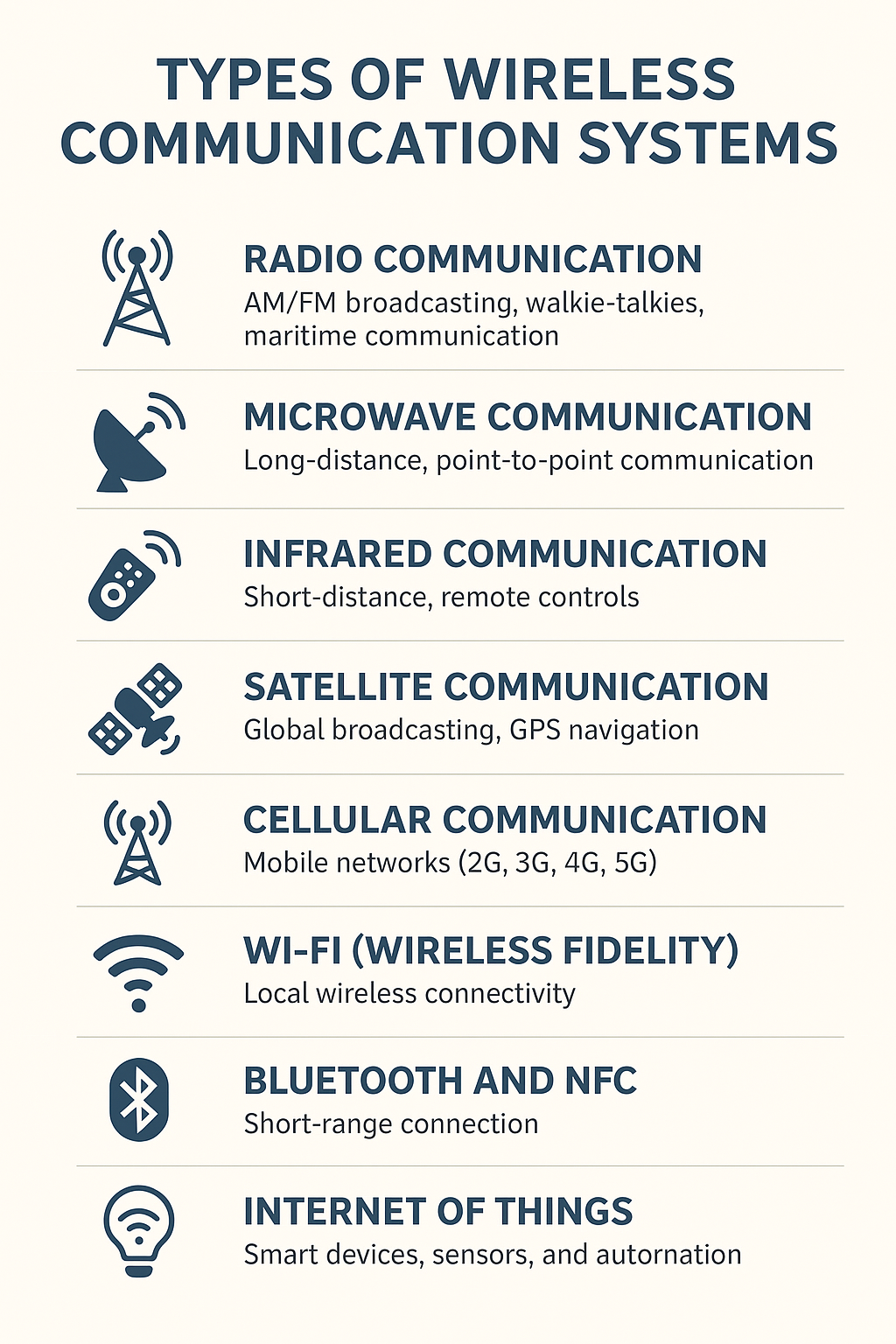
2. Types of Wireless Communication Systems
Wireless communication comes in different forms, each serving specific needs:
2.1 Radio Communication
- Used for AM/FM broadcasting, walkie-talkies, and maritime communication.
- Operates in the kHz to GHz range.
2.2 Microwave Communication
- Provides long-distance and point-to-point communication.
- Widely used in television transmission, satellite links, and military communication.
2.3 Infrared Communication
- Works over short distances.
- Common in remote controls and short-range wireless devices.
2.4 Satellite Communication
- Enables global broadcasting, GPS navigation, and military surveillance.
- Covers long distances, including remote areas.
2.5 Cellular Communication
- Forms the backbone of mobile networks (2G, 3G, 4G, and 5G).
- Supports voice, SMS, and high-speed internet.
2.6 Wi-Fi (Wireless Fidelity)
- Provides local wireless connectivity.
- Essential for homes, offices, and public hotspots.
2.7 Bluetooth and NFC (Near Field Communication)
- Supports short-range device-to-device communication.
- Used in headsets, wireless speakers, smartwatches, and contactless payments.
2.8 Internet of Things (IoT) Communication
- Uses protocols like Zigbee, LoRa, and NB-IoT.
- Powers smart homes, wearable devices, and industrial automation.
3. Advantages of Wireless Communication Systems
Wireless systems offer several benefits that make them indispensable in modern society:
- Mobility and Flexibility – Users can stay connected anywhere.
- Cost-Effective Deployment – Eliminates expensive wiring.
- Scalability – Easy to expand without physical infrastructure.
- Global Connectivity – Enables instant communication worldwide.
- Support for IoT and Smart Devices – Drives digital transformation.
4. Challenges in Wireless Communication Systems
Despite its advantages, wireless communication faces limitations:
- Interference – Signals may be disrupted by obstacles, weather, or other devices.
- Bandwidth Limitations – Spectrum availability is finite.
- Security Risks – Vulnerable to hacking and data breaches.
- Power Consumption – Mobile and IoT devices require efficient energy use.
- Latency Issues – Critical applications like autonomous driving demand ultra-low latency.
5. Applications of Wireless Communication Systems
Wireless communication is deeply embedded in every sector of modern life:
5.1 Personal Communication
- Mobile phones, messaging apps, and video calls.
5.2 Business and Enterprise
- Wireless LANs, video conferencing, and remote collaboration.
5.3 Healthcare
- Remote patient monitoring, telemedicine, and smart wearables.
5.4 Transportation
- GPS navigation, vehicle-to-vehicle (V2V) communication, and autonomous driving.
5.5 Industrial Applications
- Smart factories, wireless sensors, and automation.
5.6 Defense and Security
- Military satellites, radar systems, and encrypted communication.
5.7 Entertainment and Media
- Online streaming, wireless gaming, and broadcasting.
6. The Role of Wireless Communication Systems in the Internet of Things (IoT)
IoT heavily relies on wireless systems to connect billions of devices. Technologies like Bluetooth Low Energy (BLE), Zigbee, and LoRaWAN enable communication between sensors, appliances, and cloud servers. This connectivity drives smart cities, connected cars, and intelligent healthcare systems.
7. Evolution of Wireless Communication: From 1G to 5G and Beyond
Wireless technology has evolved through several generations:
- 1G (1980s) – Analog voice calls.
- 2G (1990s) – Digital communication, SMS, and limited internet.
- 3G (2000s) – Mobile internet and multimedia services.
- 4G (2010s) – High-speed data, video streaming, and VoIP.
- 5G (2020s) – Ultra-fast speeds, low latency, and IoT integration.
The future points toward 6G networks, which aim to provide holographic communication, AI-driven networks, and ultra-reliable low-latency communication (URLLC).
8. Future Trends in Wireless Communication Systems
The future of wireless communication promises groundbreaking innovations:
- 6G and Beyond – Offering speeds up to 100 times faster than 5G.
- Artificial Intelligence Integration – AI-driven network optimization.
- Quantum Communication – Unbreakable security with quantum encryption.
- Satellite Internet (e.g., Starlink) – Global internet coverage.
- Green Communication Systems – Energy-efficient and eco-friendly designs.
- Augmented Reality (AR) & Virtual Reality (VR) – Enhanced by ultra-fast networks.
Conclusion of Wireless Communication Systems
Wireless communication systems are the foundation of global connectivity, bridging distances and enabling modern innovations. From mobile networks and IoT devices to satellite links and future 6G technologies, wireless systems continue to revolutionize industries and daily life. As advancements in AI, quantum technology, and energy-efficient systems reshape the landscape, wireless communication will remain at the heart of the digital future.
For businesses, governments, and individuals, staying ahead in wireless technology is not just a necessity but a gateway to unlocking unprecedented opportunities in the connected world.