Introduction of Characteristics of Thyristors
Thyristors are essential semiconductor devices widely used in power electronics due to their ability to handle high voltages and currents efficiently. They play a crucial role in controlling and converting electrical energy in applications such as motor drives, rectifiers, and power control systems. Understanding the characteristics of thyristors is fundamental for engineers, students, and anyone involved in electronics design and power management.
In this article, we will explore the main features, electrical behavior, and applications of thyristors, giving you a complete overview of their importance in modern electronics.
What is a Thyristor?
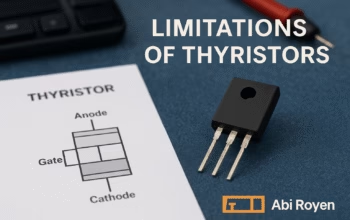
A thyristor is a four-layer semiconductor device made of alternating p-type and n-type materials, forming a PNPN structure. It has three terminals:
- Anode (A) – connected to the p-type layer.
- Cathode (K) – connected to the n-type layer.
- Gate (G) – used to trigger the device into conduction.
When a thyristor is triggered, it allows current to flow from the anode to the cathode. Once it starts conducting, it remains in the conducting state even if the gate signal is removed, as long as the current remains above a certain threshold.
Basic Characteristics of Thyristors
The performance of a thyristor is defined by several important characteristics. Let’s break them down into categories:
1. Static Characteristics
These are characteristics observed when the thyristor is not switching rapidly.
- Forward Blocking State (Off State):
When the anode is positive with respect to the cathode and no gate signal is applied, the thyristor blocks the current. Only a very small leakage current flows. - Forward Conduction State (On State):
When the gate receives a triggering pulse, the thyristor switches on and conducts a large current with minimal voltage drop. - Reverse Blocking State:
When the cathode is made positive with respect to the anode, the device blocks current, similar to a reverse-biased diode.
2. Dynamic Characteristics
These describe the behavior of the thyristor during switching operations.
- Turn-On Time (ton):
The time taken by the device to switch from blocking to conduction after receiving the gate signal. - Turn-Off Time (toff):
The time required for the device to regain its blocking ability after the current falls below the holding current. - Rise Time (tr):
The time during which the current rises from 10% to 90% of its final value. - Fall Time (tf):
The time during which the current decreases when the thyristor turns off.
3. Important Electrical Parameters
- Breakover Voltage (VBO):
The minimum forward voltage at which the thyristor switches on without a gate signal. - Holding Current (IH):
The minimum current required to keep the thyristor conducting. - Latching Current (IL):
The minimum current required to latch the device into conduction immediately after being triggered. - Gate Triggering Current (IGT):
The minimum current needed at the gate terminal to turn the thyristor on. - Forward Voltage Drop (Vf):
The voltage drop across the thyristor when conducting, usually between 1–2 volts.
V-I Characteristics of Thyristors
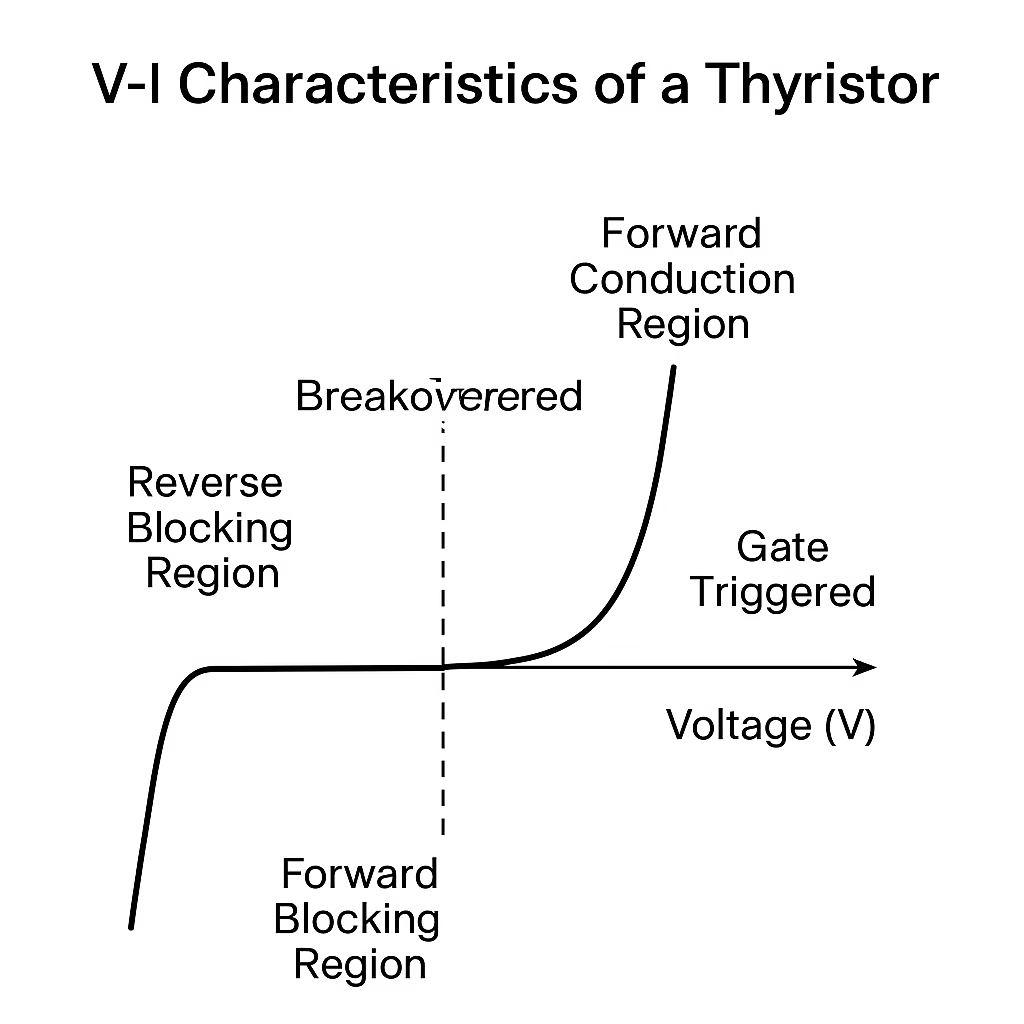
The Voltage-Current (V-I) characteristics of a thyristor are crucial for understanding its operation. The curve is divided into three main regions:
- Reverse Blocking Region – The thyristor blocks reverse voltage like a diode.
- Forward Blocking Region – A small leakage current flows until the gate is triggered.
- Forward Conduction Region – Once triggered, the thyristor conducts fully with minimal voltage drop.
This behavior makes thyristors highly efficient for switching applications.
Key Features of Thyristors
Thyristors are widely used because of the following features:
- Ability to handle high voltage and current.
- Low conduction losses, making them energy-efficient.
- Compact size compared to mechanical switches.
- Unidirectional conduction – current flows only in one direction.
- High reliability and durability in industrial applications.
- Can be controlled using a small gate signal.
Advantages of Thyristors
- High efficiency due to low power loss.
- Capability to operate at very high voltages (up to several kV).
- Suitable for AC and DC applications.
- Simple triggering method using a small gate current.
- Low cost compared to other semiconductor switches.
Limitations of Thyristors
Despite their advantages, thyristors also have some limitations:
- Cannot be turned off using the gate terminal (requires external commutation).
- Relatively slow switching speed compared to modern transistors.
- Only conduct in one direction.
- Sensitive to overvoltage and overcurrent conditions.
Applications of Thyristors
Thyristors are widely used in:
- Controlled Rectifiers – converting AC to DC with control.
- AC Voltage Regulators – controlling power in lighting and heating systems.
- Motor Speed Control – adjusting the speed of DC and AC motors.
- Inverters – converting DC to AC for renewable energy systems.
- Power Switching – in high-voltage and high-current environments.
- Crowbar Circuits – protecting sensitive electronics from overvoltage.
Future of Thyristors in Power Electronics
With advancements in semiconductor technology, newer devices like IGBTs and MOSFETs are often preferred for high-frequency switching. However, thyristors still dominate in high-power, high-voltage applications where efficiency and robustness are essential.
Industries such as HVDC transmission, railway electrification, and large motor drives continue to rely on thyristors due to their proven reliability.
Conclusion of Characteristics of Thyristors
The characteristics of thyristors make them indispensable in many power electronic systems. From their static and dynamic properties to their wide applications in power control, thyristors remain one of the most important semiconductor devices in electrical engineering.
By understanding their V-I characteristics, triggering requirements, and operational limitations, engineers can effectively design and optimize circuits for efficiency and reliability.
As technology advances, thyristors will continue to play a vital role in heavy-duty applications where high power and robustness are crucial.