Capacitors are among the most important passive components in electronic circuits. They are widely used in energy storage, filtering, coupling, and signal tuning applications. While fixed capacitors have a constant capacitance value, variable capacitors are specifically designed to allow users to adjust their capacitance to suit different requirements. This unique feature makes them invaluable in applications such as radios, oscillators, antennas, and many other electronic devices.
In this article, we will explore the fundamentals of variable capacitors, their working principles, different types, advantages, and real-world applications in modern electronics.
What is a Variable Capacitor?
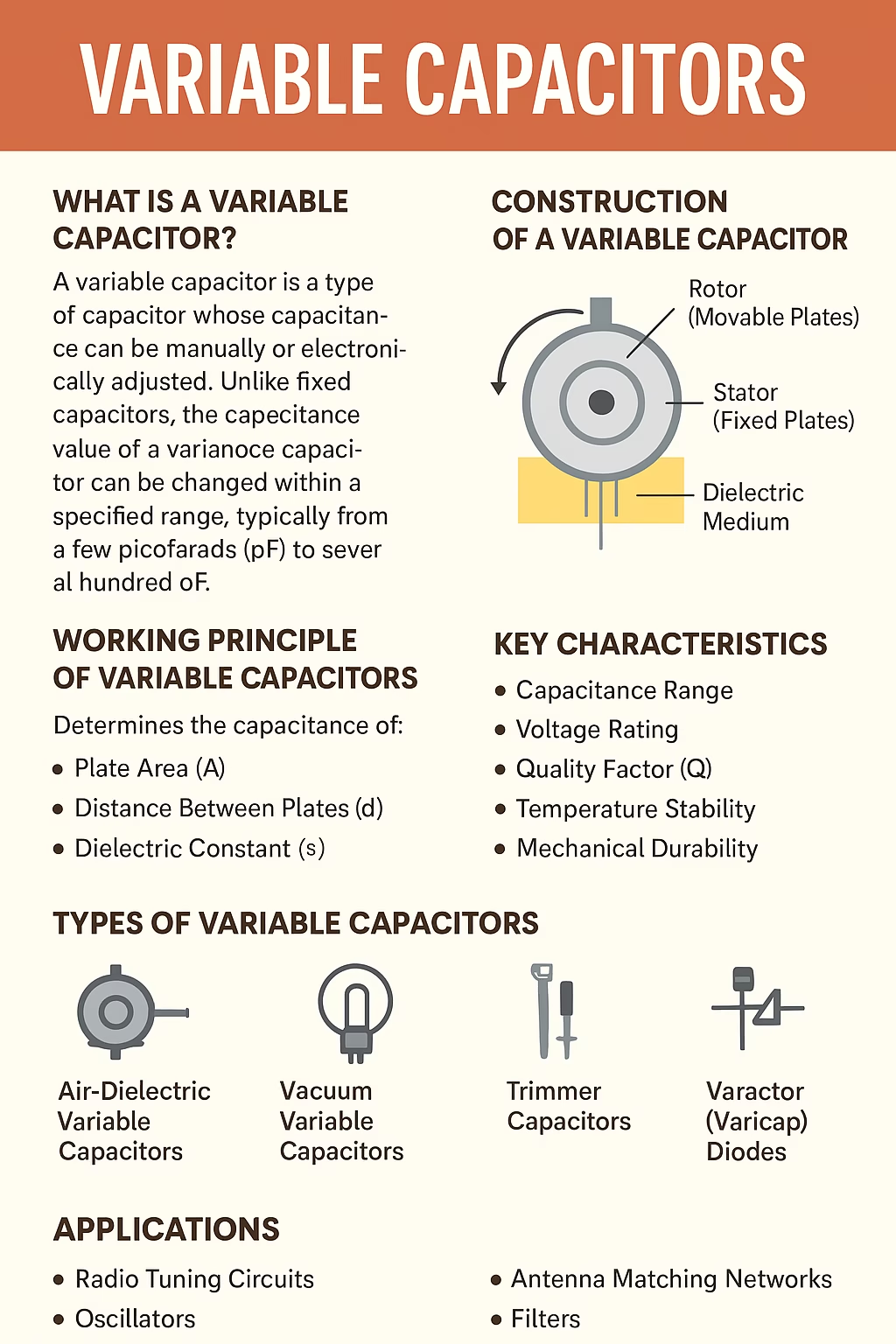
A variable capacitor is a type of capacitor whose capacitance can be manually or electronically adjusted. Unlike fixed capacitors, their capacitance value can be changed within a specified range, typically from a few picofarads (pF) to several hundred pF.
The main purpose of variable capacitors is to allow fine-tuning of electrical circuits, especially those that require frequency adjustment, such as radio receivers, transmitters, and oscillators.
Construction of a Variable Capacitor
Variable capacitors generally consist of two sets of plates:
- Rotor (Movable Plates): These plates can be rotated or shifted to change the overlap with the stator plates.
- Stator (Fixed Plates): These remain stationary and act as one side of the capacitor.
- Dielectric Medium: Air, mica, or plastic is often used as the dielectric material.
When the rotor plates move closer or overlap more with the stator plates, the capacitance increases. Conversely, when the overlap decreases, the capacitance is reduced.
Working Principle of Variable Capacitors
The capacitance of a capacitor is determined by three main factors:
- Plate Area (A): The larger the overlapping area between plates, the higher the capacitance.
- Distance Between Plates (d): The smaller the gap, the higher the capacitance.
- Dielectric Constant (ε): The type of material between the plates affects the capacitance.
In variable capacitors, capacitance is typically adjusted by changing the effective overlapping plate area or by altering the dielectric material’s insertion. This allows electronic circuits to be tuned for specific frequencies or impedance levels.
Types of Variable Capacitors
Variable capacitors can be classified into several types based on their construction and tuning mechanisms. The main types include:
1. Air-Dielectric
- Uses air as the dielectric medium.
- Commonly found in older radio tuning systems.
- Offers smooth capacitance adjustment with low dielectric losses.
- Capacitance range: 10 pF to 500 pF.
2. Vacuum
- Use a vacuum as the dielectric.
- Provide very high voltage handling capacity and stability.
- Widely used in high-frequency and high-power RF transmitters.
3. Trimmer Capacitors
- Small, adjustable capacitors designed for fine-tuning circuits.
- Typically adjusted with a screwdriver.
- Common in printed circuit boards (PCBs) for calibration purposes.
4. Varactor (Varicap) Diodes
- Semiconductor devices that act as voltage-controlled variable capacitors.
- Used in modern tuning circuits where electronic adjustment is required.
- Found in applications like automatic frequency control (AFC) and voltage-controlled oscillators (VCOs).
Key Characteristics of Variable Capacitors
When selecting or using variable capacitors, engineers consider the following parameters:
- Capacitance Range: The minimum and maximum capacitance values.
- Voltage Rating: The maximum voltage the capacitor can handle.
- Quality Factor (Q): A measure of efficiency and loss at a given frequency.
- Temperature Stability: The capacitor’s performance under varying temperatures.
- Mechanical Durability: Particularly important in mechanical tuning systems.
Advantages of Variable Capacitors
Variable capacitors provide several advantages that make them useful in many circuits:
- Tuning Capability: Ideal for adjusting resonance frequency in radios and antennas.
- Versatility: Can be used in both low-power and high-power circuits.
- Compactness: Trimmer capacitors are small and easy to integrate into PCBs.
- Precision: Allows fine control of capacitance in critical electronic systems.
Applications of Variable Capacitors
Variable capacitors play a significant role in different sectors of electronics and communications. Some of the major applications include:
1. Radio Tuning Circuits
Perhaps the most well-known use of variable capacitors is in radio receivers and transmitters. By adjusting the capacitance, the resonance frequency of the tuning circuit can be changed, allowing users to select different radio stations.
2. Oscillators
Variable capacitors are used to adjust the frequency of oscillators in communication systems, enabling precise frequency generation.
3. Antenna Matching Networks
In wireless systems, variable capacitors help match the antenna impedance with the transmitter or receiver, improving signal strength and reducing power loss.
4. Filters
Variable capacitors are employed in LC (Inductor-Capacitor) filters, allowing dynamic control over cutoff frequencies.
5. Test and Measurement Equipment
Laboratories use variable capacitors for calibration and testing circuits where different capacitance values are required.
Variable Capacitors vs Fixed Capacitors
| Feature | Variable Capacitors | Fixed Capacitors |
|---|---|---|
| Capacitance Value | Adjustable | Constant |
| Applications | Tuning, matching, oscillators, calibration | Filtering, decoupling, energy storage |
| Complexity | More complex, mechanical or electronic | Simple design |
| Cost | Generally higher | Relatively lower |
This comparison highlights the specialized role of variable capacitors in tuning and frequency-sensitive applications, while fixed capacitors dominate in energy storage and filtering.
Future in Electronics
With the advancement of wireless communication, IoT devices, and 5G networks, electronically tunable capacitors like varactors are becoming increasingly important. Their integration with digital systems enables automatic tuning, adaptive filtering, and real-time frequency control.
The demand for miniaturized and high-frequency variable capacitors is expected to grow, especially in consumer electronics, aerospace, and advanced telecommunication systems.
Conclusion
Variable capacitors are essential components in the field of electronics, offering flexibility, precision, and adaptability in circuits that require frequency adjustment. From classic radio tuning systems to modern RF communication and IoT devices, their importance remains significant.
Understanding their types, characteristics, and applications helps engineers and enthusiasts design efficient and optimized electronic systems. As technology continues to advance, variable capacitors will remain key enablers in ensuring accurate signal control and tuning across industries.