
What is Fixed Resistor? ~ Resistors are among the most fundamental components in electronics. They are used in almost every electrical circuit, from small gadgets to large industrial systems. One of the most common types of resistors is the fixed resistor. As the name suggests, a fixed resistor has a resistance value that does not change under normal operating conditions.
In this article, we will explore what a fixed resistor is, how it works, its different types, characteristics, and where it is used in electronics.
Definition of a What is Fixed Resistor?
A fixed resistor is a passive electronic component that provides a specific, unchanging resistance to the flow of electric current. Unlike variable resistors such as potentiometers or rheostats, fixed resistors have a constant resistance value set during manufacturing.
The main function of a fixed resistor is to control or limit the flow of current in a circuit, divide voltage, or set biasing conditions for active devices like transistors and operational amplifiers.
Mathematically, resistors follow Ohm’s Law: R=VIR = \frac{V}{I}R=IV
Where:
- R is resistance (ohms, Ω)
- V is voltage (volts, V)
- I is current (amperes, A)
Characteristics of Fixed Resistors
Fixed resistors come with specific characteristics that make them suitable for different applications. These include:
- Resistance Value
- Defined in ohms (Ω). Ranges from a few milliohms to several megaohms.
- Tolerance
- The percentage by which the actual resistance may vary from the stated value. Common tolerances are ±1%, ±5%, and ±10%.
- Power Rating
- Indicates how much power (in watts) the resistor can safely dissipate without damage. Typical values: 1/8W, 1/4W, 1/2W, 1W, etc.
- Temperature Coefficient
- Describes how resistance changes with temperature.
- Material
- Different materials affect performance, stability, and cost.
Types of Fixed Resistors
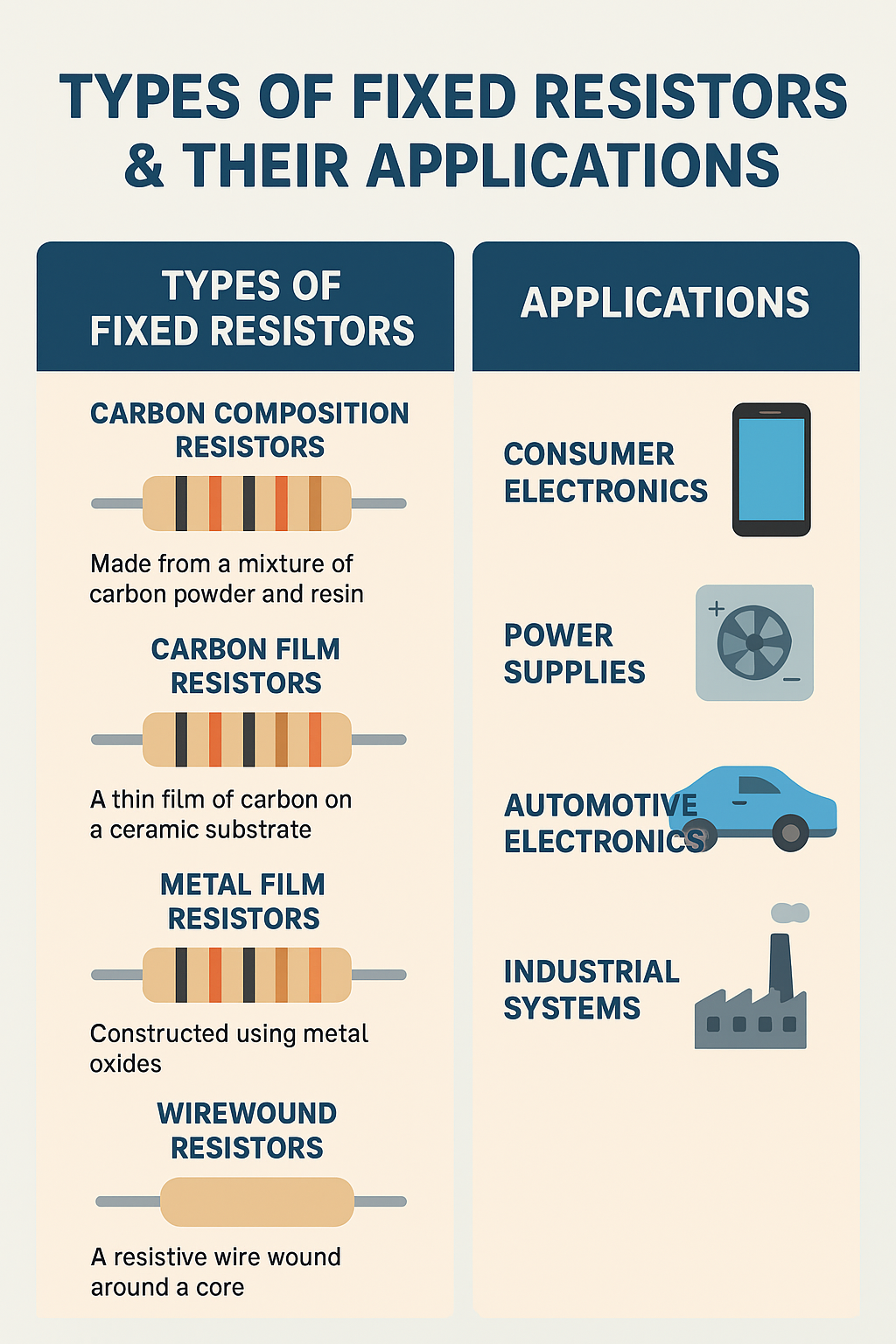
Fixed resistors are classified based on the material and construction method used. Below are the main types:
1. Carbon Composition Resistors
- Made from a mixture of carbon powder and a binding resin.
- Provide high resistance values.
- Less stable and more prone to noise.
- Common in older equipment.
2. Carbon Film Resistors
- A thin film of carbon is deposited on a ceramic substrate.
- More stable and reliable than carbon composition resistors.
- Widely used in general-purpose electronics.
3. Metal Film Resistors
- Made by depositing a thin metal film on a ceramic rod.
- Offer high accuracy, low tolerance, and good stability.
- Commonly used in precision circuits.
4. Metal Oxide Film Resistors
- Constructed using metal oxides.
- Provide better heat resistance and higher stability compared to carbon types.
- Used in high-power circuits.
5. Wire Wound Resistors
- Made by winding a resistive wire around a ceramic or fiberglass core.
- Can handle high power and high current.
- Used in power supplies, motor control, and high-power applications.
6. Thick Film and Thin Film Resistors
- Used in integrated circuits and surface-mount devices (SMD).
- Provide high accuracy and compact size.
- Suitable for modern electronic devices like smartphones and laptops.
Functions of Fixed Resistors
Fixed resistors play several crucial roles in electronic circuits:
- Current Limiting
- Protects components like LEDs or transistors by limiting current.
- Voltage Division
- Used in voltage divider circuits to provide reference voltages.
- Biasing Active Components
- Essential for setting the operating conditions of transistors and amplifiers.
- Heat Dissipation
- Some resistors convert excess electrical energy into heat to stabilize circuits.
- Signal Conditioning
- Helps in shaping signals in audio, sensor, and communication circuits.
Applications of Fixed Resistors
Fixed resistors are used in almost every electronic and electrical system. Some common applications include:
- Consumer Electronics
- Televisions, radios, smartphones, computers, and home appliances.
- Power Supplies
- Voltage regulation and current limiting in AC/DC converters.
- Automotive Electronics
- Used in dashboard displays, sensors, and lighting systems.
- Industrial Systems
- Motor control, automation, robotics, and instrumentation.
- Communication Devices
- Radios, transmitters, and receivers.
- Medical Equipment
- Monitoring devices, imaging equipment, and diagnostic systems.
Advantages of Fixed Resistors
- Simple and reliable.
- Cost-effective.
- Available in a wide range of resistance values.
- Stable performance in most environments.
Limitations of Fixed Resistors
- Cannot adjust resistance value once manufactured.
- May suffer from tolerance variation.
- High-power resistors can generate heat and require cooling solutions.
How to Identify Fixed Resistors
Most fixed resistors use a color code system to indicate resistance value and tolerance. This consists of colored bands painted on the resistor body. For example:
- Brown, Black, Red → 1kΩ (±1%).
Alternatively, in surface-mount resistors (SMD), resistance is indicated by a numerical code.
Conclusion of What is Fixed Resistor?
Fixed resistors are the backbone of electronic circuits. They provide stability, control current, divide voltage, and ensure that devices operate correctly and safely. With different types available—carbon film, metal film, wire wound, and more—engineers and hobbyists can select the right resistor for their needs.
Understanding fixed resistors is essential for anyone working in electronics, whether you are a beginner learning circuit basics or a professional engineer designing complex systems.
By mastering the knowledge of fixed resistors, you build a solid foundation for exploring more advanced electronic components and applications.