Introduction
In the world of wireless communication, the radio antenna plays a critical role as the gateway between electrical signals and electromagnetic waves. Whether it is for broadcasting, satellite communication, radar, or everyday Wi-Fi connections, antennas make wireless technology possible. Without antennas, the world of radio, television, GPS, and mobile networks would not exist.
This article explores in detail what radio antennas are, their working principles, types, and how they continue to shape modern communication systems.
What is a Radio Antenna?
A radio antenna is a device that transmits or receives electromagnetic waves. It works as a transducer, converting electrical currents into radio waves (for transmission) or capturing radio waves and converting them back into electrical signals (for reception).
Antennas are designed to operate at specific frequencies depending on the intended application. For instance, a television antenna operates at different frequencies compared to a Wi-Fi or mobile antenna.
How Does a Radio Antenna Work?
The basic working principle of an antenna revolves around electromagnetic radiation. When an alternating current flows through a conductor, it generates oscillating electric and magnetic fields, which propagate outward as radio waves.
- Transmission Mode: Electrical signals from a transmitter are fed into the antenna. The antenna radiates them as electromagnetic waves into space.
- Reception Mode: The antenna intercepts electromagnetic waves, inducing a small voltage that is then passed to the receiver for processing.
The efficiency of an antenna depends on parameters such as its size, shape, orientation, and operating frequency.
Types of Radio Antenna
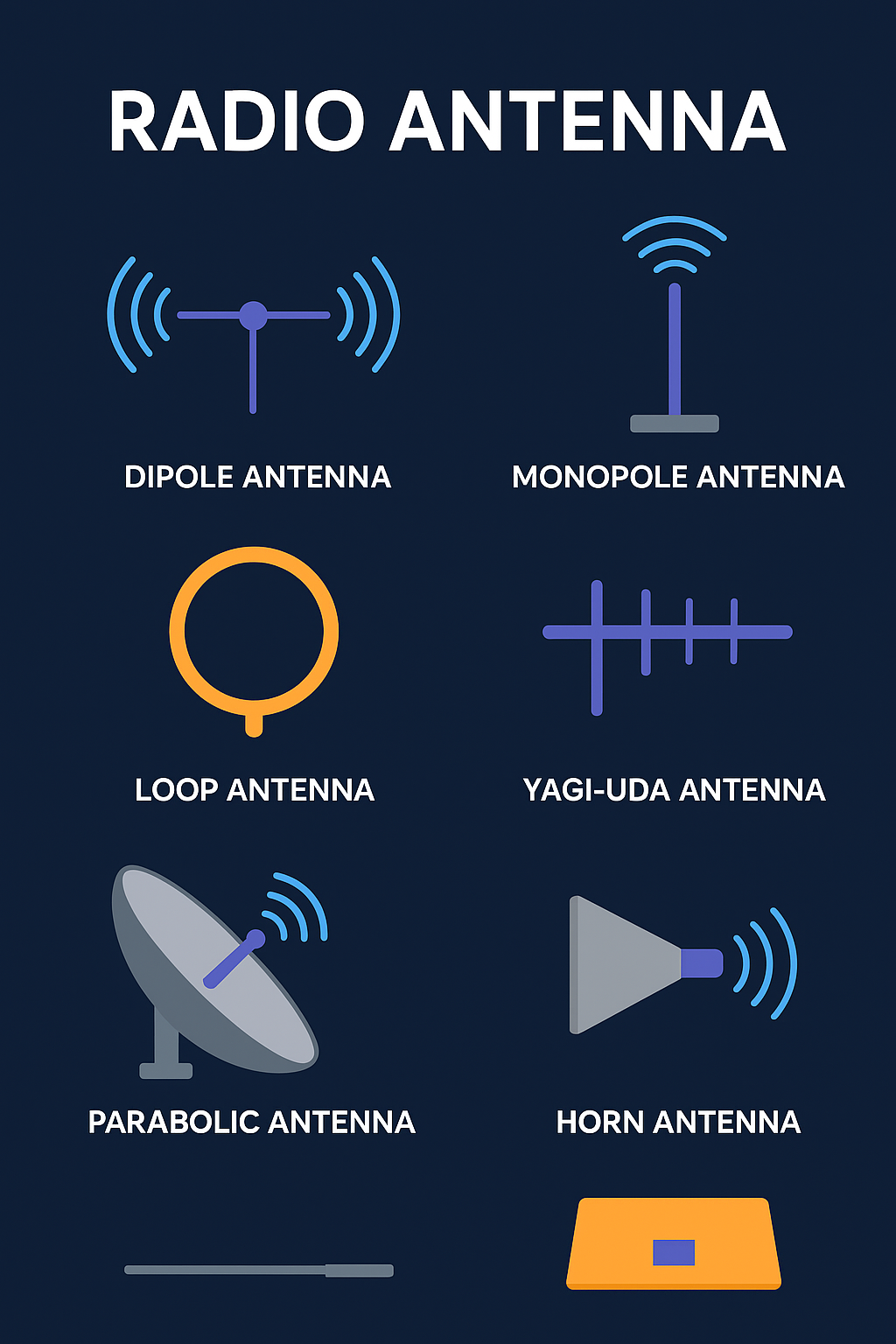
There are many different kinds of antennas, each designed for specific uses. Below are the most common types:
1. Dipole Antenna
- One of the simplest and most widely used antennas.
- Consists of two conductive elements placed end-to-end.
- Commonly used in FM radios and television broadcasting.
2. Monopole Antenna
- A single rod-shaped conductor placed over a ground plane.
- Frequently used in car radios and mobile phones.
3. Loop Antenna
- Consists of a coil or loop of wire.
- Compact and widely used in RFID systems and direction-finding equipment.
4. Yagi-Uda Antenna
- Features multiple elements including a reflector, driven element, and directors.
- Known for its high gain and directionality, often used for TV reception and amateur radio.
5. Parabolic Antenna
- Shaped like a dish to focus radio waves.
- Extremely directional and used in satellite communication and radar systems.
6. Horn Antenna
- Shaped like a horn to direct radio waves efficiently.
- Commonly used in microwave communication and radar.
7. Patch (Microstrip) Antenna
- Flat, lightweight antennas used in mobile phones, Wi-Fi routers, and GPS receivers.
- Compact size makes them ideal for portable devices.
Key Parameters of Radio Antenna
When evaluating an antenna, engineers consider several key performance factors:
- Frequency Range – The range of frequencies where the antenna can operate effectively.
- Gain – Indicates how much power is directed in a specific direction compared to an isotropic antenna.
- Bandwidth – The range of frequencies where performance is maintained.
- Polarization – The orientation of the electric field of the wave (horizontal, vertical, or circular).
- Radiation Pattern – The distribution of power radiated in different directions.
Applications of Radio Antenna
Radio antennas are vital to many industries and technologies, including:
- Broadcasting – Used in AM/FM radio, digital radio, and television transmission.
- Telecommunications – Mobile phones, Wi-Fi, Bluetooth, and satellite communication rely heavily on antennas.
- Navigation Systems – GPS devices use antennas to receive signals from satellites.
- Military and Defense – Radar and communication systems rely on specialized antennas.
- Space Exploration – Spacecraft use high-gain antennas to communicate with Earth.
- IoT (Internet of Things) – Smart devices, RFID tags, and wireless sensors all use compact antennas.
The Future of Antenna Technology
With the rapid growth of 5G networks, IoT, and satellite-based internet, antenna technology is evolving. Modern trends include:
- Smart Antennas – Using adaptive beamforming to optimize signal quality.
- MIMO (Multiple Input Multiple Output) – Multiple antennas working together to boost data rates in 4G and 5G.
- Miniaturized Antennas – Essential for compact devices such as smartphones and wearable gadgets.
- Metamaterial Antennas – Utilizing engineered materials to achieve superior performance.
These innovations will make wireless communication faster, more reliable, and more efficient.
Conclusion
The radio antenna remains the backbone of wireless communication. From the earliest days of radio broadcasting to the latest 5G and satellite networks, antennas have continuously evolved to meet the growing demands of connectivity.
Understanding antenna types, applications, and advancements is essential not only for engineers but also for businesses and individuals who rely on wireless technology every day.
As the world becomes increasingly interconnected, the importance of radio antennas will only grow, powering the communication systems of the future.