Introduction
In the world of electronics and optoelectronics, Phototransistor play a crucial role in detecting and responding to light. These devices convert light energy into electrical signals, making them fundamental components in applications ranging from remote controls and smoke detectors to industrial automation and fiber optic communication.
A photo-transistor can be considered an advanced version of a photodiode, as it not only senses light but also amplifies the resulting current, making it more sensitive and reliable in various systems. Understanding how photo-transistors work and where they are used is essential for anyone involved in electronics, engineering, or automation.
This article explores the definition, working principle, types, advantages, and practical applications of phototransistors in modern technology.
What is a Phototransistor?
A phototransistor is a type of transistor that uses light as its input signal instead of electrical voltage at the base. It is a light-sensitive semiconductor device that generates and amplifies current when exposed to photons.
While a regular transistor requires an electrical signal at the base to control current flow between the collector and emitter, a photo-transistor replaces this base signal with light intensity. The brighter the light falling on the device, the higher the current generated.
In simple terms:
- Photodiode → detects light, produces a small current.
- Phototransistor → detects light, amplifies the current for stronger output.
Working Principle of Phototransistor
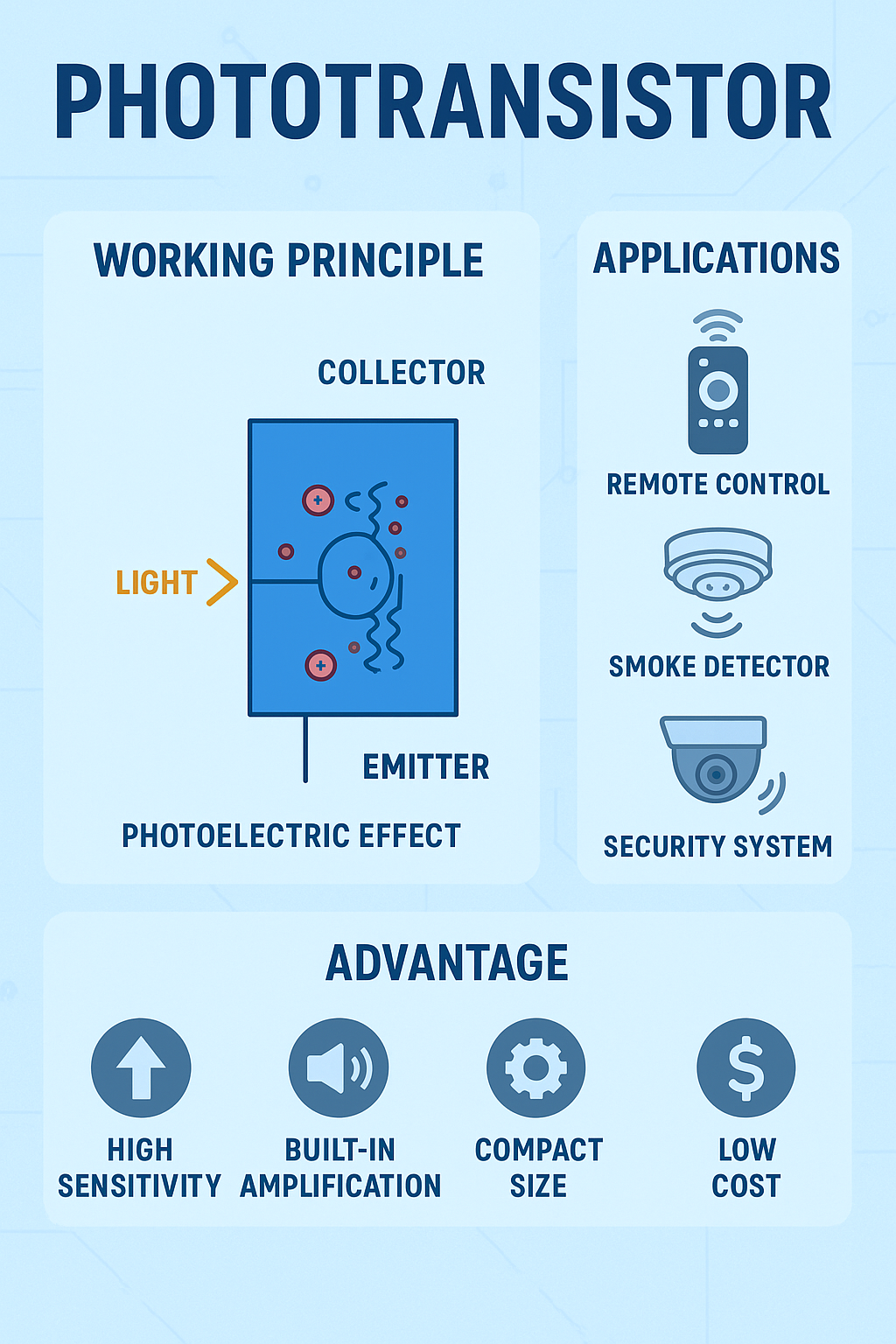
The working principle of a phototransistor is based on the photoelectric effect. When light photons hit the semiconductor material (usually silicon), they release electron-hole pairs. These charge carriers are then accelerated by the electric field inside the transistor, resulting in a flow of current.
Steps of Operation:
- Light Absorption – Photons strike the base region of the photo-transistor.
- Generation of Carriers – Electron-hole pairs are generated.
- Amplification – Unlike photodiodes, the transistor action amplifies the photocurrent.
- Output Signal – The amplified current flows between collector and emitter, producing a measurable output.
The sensitivity of a phototransistor depends on:
- The wavelength of light.
- The surface area of the base region.
- The gain (β) of the transistor.
Types of Phototransistor
There are different types of photo-transistors designed for specific applications:
- Bipolar Phototransistor (BJT-based)
- Uses a PN junction.
- Provides higher gain.
- Commonly used in general-purpose light detection.
- Field Effect Phototransistor (FET-based)
- Works on field-effect principle.
- Provides faster response times.
- Used in high-speed optical communication.
- Photodarlington Transistor
- A combination of two transistors.
- Offers extremely high sensitivity.
- Slower response but ideal for low-light detection.
Advantages of Phototransistor
Photo-transistors have several advantages over other light sensors:
- High Sensitivity: Can detect even low levels of light.
- Built-in Amplification: Provides stronger output without external amplifiers.
- Compact Size: Easily integrated into electronic circuits.
- Low Cost: Affordable compared to complex optical detectors.
- Wide Applications: Suitable for industrial, commercial, and consumer electronics.
Applications of Phototransistor
Photo-transistors are used in a wide range of fields where light detection and conversion into electrical signals are required.
1. Consumer Electronics
- Remote controls for televisions and home appliances.
- Automatic lighting systems.
- Infrared sensors in smartphones.
2. Safety and Security Systems
- Smoke detectors and fire alarms.
- Intruder detection in security alarms.
- Motion detectors and surveillance systems.
3. Industrial Applications
- Object counting in conveyor belts.
- Industrial automation sensors.
- Optical encoders for position sensing.
4. Medical Technology
- Biomedical sensors for patient monitoring.
- Light-based pulse oximeters.
- Medical imaging systems.
5. Communication Systems
- Fiber optic receivers.
- Infrared data transmission.
- Wireless communication using light.
Phototransistor vs. Photodiode
While both devices are light-sensitive, they serve slightly different purposes.
| Feature | Photodiode | Phototransistor |
|---|---|---|
| Sensitivity | Low | High |
| Amplification | No | Yes |
| Response Speed | Very fast | Moderate |
| Complexity | Simple | Slightly more complex |
| Typical Applications | High-speed optical communication | General light detection and automation |
Limitations of Phototransistor
Despite their advantages, photo-transistors also have some limitations:
- Slower response time compared to photodiodes.
- Sensitive to noise in high-frequency applications.
- Limited to certain wavelengths depending on the semiconductor material.
These drawbacks make photodiodes preferable in high-speed communication systems, while photo-transistors remain ideal for general light-sensing tasks.
Future of Phototransistor Technology
With advancements in nanotechnology and optoelectronics, photo-transistors are becoming faster, smaller, and more efficient. Researchers are developing graphene-based and quantum photo-transistors that can detect even single photons, opening doors to new applications in quantum computing, ultra-fast communication, and advanced imaging systems.
As industries continue to demand smarter sensors and automation, photo-transistors will remain a vital component in bridging the gap between light signals and electronic control.
Conclusion
A phototransistor is a powerful light-sensitive device that amplifies electrical signals in response to light. Its simple design, low cost, and high sensitivity make it an essential component in countless modern technologies, from consumer electronics to medical devices and industrial automation.
By understanding its working principle, advantages, and applications, engineers and enthusiasts can effectively incorporate photo-transistors into innovative projects and future technologies.