Introduction
In modern power electronics, the need for efficient and reliable switching devices is greater than ever. Among the various semiconductor devices, the Gate Turn-Off Thyristor (GTO) stands out for its ability to be turned off via a gate signal, unlike traditional thyristors that require natural or forced commutation. GTOs are widely used in high-power applications, such as motor drives, inverters, and power control systems.
This article will explore the construction, working principle, advantages, disadvantages, and practical applications of GTOs in detail.
What is a Gate Turn-Off Thyristor (GTO)?
A Gate Turn-Off Thyristor (GTO) is a four-layer, three-junction semiconductor device that operates as a switch in power electronic circuits. Unlike a conventional silicon-controlled rectifier (SCR), which can only be turned on through a gate signal and turned off by removing the current, the GTO can be turned on and off using gate control.
Key Characteristics of GTO:
- It is a bidirectional gate-controlled switch.
- It can handle high voltages (up to several kilovolts) and high currents (up to thousands of amperes).
- It offers faster switching than conventional SCRs.
Construction of Gate Turn-Off Thyristor (GTO)
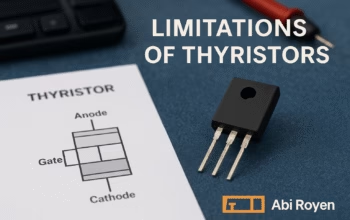
The GTO is made up of alternating P-type and N-type semiconductor layers (PNPN structure). The key components include:
- Anode – Connected to the outer P-layer.
- Cathode – Connected to the outer N-layer.
- Gate – Connected near the cathode for controlling turn-on and turn-off.
To improve turn-off capability, GTOs are designed with a highly interdigitated gate-cathode structure, ensuring uniform current distribution and faster removal of carriers during turn-off.
Working Principle of Gate Turn-Off Thyristor (GTO)
The operation of a GTO is divided into turn-on and turn-off modes.
1. Turn-On Mode
- A positive gate current pulse is applied between the gate and cathode.
- This injects charge carriers into the device, triggering it into conduction.
- Once turned on, the GTO remains conducting even if the gate signal is removed (latching).
2. Turn-Off Mode
- A negative gate current pulse is applied.
- This draws charge carriers out of the device, stopping the current flow.
- The device then returns to a high-impedance state, blocking current until triggered again.
Advantages of Gate Turn-Off Thyristor (GTO)
GTOs offer several advantages over conventional SCRs and other switching devices:
- Gate-Controlled Turn-Off – No need for external commutation circuits.
- High Voltage and Current Capability – Suitable for large power systems.
- Reduced Power Loss – Lower conduction losses compared to transistors in high-power applications.
- Fast Switching Speeds – Better performance in high-frequency operations.
- Compact Size – Reduces system size and complexity.
Disadvantages of Gate Turn-Off Thyristor (GTO)
Despite its benefits, GTOs also have limitations:
- High Gate Drive Requirement – Needs large gate current for turn-off.
- Limited Switching Frequency – Not as fast as some modern IGBTs or MOSFETs.
- Snubber Circuit Requirement – Often requires additional circuitry to control voltage spikes.
- Complex Gate Drive Design – More complicated than for SCRs.
Types of Gate Turn-Off Thyristor (GTO)
GTOs can be classified based on their turn-off characteristics:
- Asymmetric GTO (A-GTO) – Blocks high voltage in one direction and low in the reverse direction.
- Symmetric GTO (S-GTO) – Can block high voltage in both directions, useful in AC applications.
- Reverse Conducting GTO (RC-GTO) – Includes a built-in diode for reverse conduction.
Applications of Gate Turn-Off Thyristor (GTO)
GTOs are widely used in industries that require high-power control and reliability. Common applications include:
- AC and DC Motor Drives – For controlling speed and torque in industrial motors.
- Traction Systems – Used in electric trains and locomotives for power control.
- Power Inverters – Converting DC to AC in renewable energy systems.
- Static VAR Compensators – For reactive power control in electrical grids.
- HVDC Transmission Systems – Used in high-voltage direct current transmission lines.
- UPS Systems – Ensuring stable power supply in critical systems.

Comparison: GTO vs SCR vs IGBT
| Feature | GTO | SCR | IGBT |
|---|---|---|---|
| Turn-Off Control | Gate-controlled | External commutation | Gate-controlled |
| Switching Frequency | Medium | Low | High |
| Power Handling | Very High | Very High | Medium to High |
| Efficiency | High | High | Medium to High |
| Complexity | Moderate | Low | Moderate |
Future of GTO Technology
While GTOs are still widely used in certain high-power applications, newer semiconductor devices such as Integrated Gate-Commutated Thyristors (IGCTs) and Insulated Gate Bipolar Transistors (IGBTs) are increasingly preferred in some applications due to their higher switching frequencies and reduced gate drive requirements. However, GTOs remain a viable and cost-effective choice for many heavy-duty industrial systems.
Conclusion
The Gate Turn-Off Thyristor (GTO) remains an important semiconductor device in power electronics due to its unique ability to be turned off via gate control, high power handling capacity, and reliable performance. While it faces competition from newer devices, its role in applications like motor drives, traction systems, and HVDC transmission ensures it will remain relevant in the foreseeable future.
For engineers and designers working on high-power systems, understanding the characteristics and operation of GTOs is essential for selecting the right switching device for the job.