Advantages of Thermocouples ~ Thermocouples are among the most widely used temperature measurement devices in industries, laboratories, and engineering applications. Known for their robustness, simplicity, and adaptability, thermocouples play a crucial role in monitoring and controlling processes that depend on precise temperature readings.
From heavy-duty manufacturing to delicate laboratory experiments, thermocouples offer a unique set of advantages that make them an essential component in modern instrumentation. This article explores the main benefits of thermocouples, why they remain a top choice for temperature sensing, and how they compare with other sensor technologies.
1. Advantages of Thermocouples: Wide Temperature Measurement Range
One of the biggest advantages of thermocouples is their ability to measure extremely wide temperature ranges — from as low as −200°C to as high as 2,300°C, depending on the thermocouple type.
- Low temperatures: Cryogenic applications use Type T and Type E thermocouples for precision below −100°C.
- High temperatures: Type B, R, and S thermocouples can measure extreme heat in furnaces and metallurgical processes.
This broad range makes thermocouples suitable for a variety of industries, including aerospace, energy, food processing, and petrochemicals.
2. Fast Response Time
Thermocouples react quickly to temperature changes because of their small thermal mass and direct metal-to-metal contact with the heat source.
- Thin-wire thermocouples can respond in milliseconds.
- Sheathed thermocouples still provide rapid detection while adding protection against mechanical damage.
This fast response ensures real-time temperature monitoring, which is crucial in processes like chemical reactions, combustion control, and safety systems.
3. Advantages of Thermocouples: Durability and Ruggedness
Thermocouples are well-known for their ability to withstand harsh environments, including high vibration, mechanical stress, and chemical exposure.
- Stainless steel or Inconel sheathing protects against corrosion.
- High-pressure and abrasive process environments can still be measured effectively.
This makes thermocouples ideal for heavy industrial environments like oil refineries, gas turbines, steel manufacturing, and marine applications.
4. Cost-Effectiveness
Compared to other temperature measurement devices, thermocouples are relatively inexpensive to produce and replace.
- Simple construction: just two dissimilar metal wires joined at one end.
- Low maintenance requirements mean lower long-term costs.
This affordability allows widespread use across large-scale operations without compromising performance.
5. Advantages of Thermocouples: Self-Powered Operation
Thermocouples do not require an external power source to function. They generate a voltage based on the Seebeck effect — a principle where temperature differences between two dissimilar metals produce an electrical potential.
This self-powered nature means thermocouples can be deployed in remote or power-limited locations without needing batteries or wired power connections.
6. Versatility in Design and Application
Thermocouples are available in a variety of configurations:
- Exposed junction for maximum sensitivity and speed.
- Grounded junction for better durability and noise reduction.
- Ungrounded junction for electrical isolation.
This flexibility allows engineers to select a thermocouple design that perfectly matches the operational requirements, whether for precision laboratory measurements or rugged industrial processes.
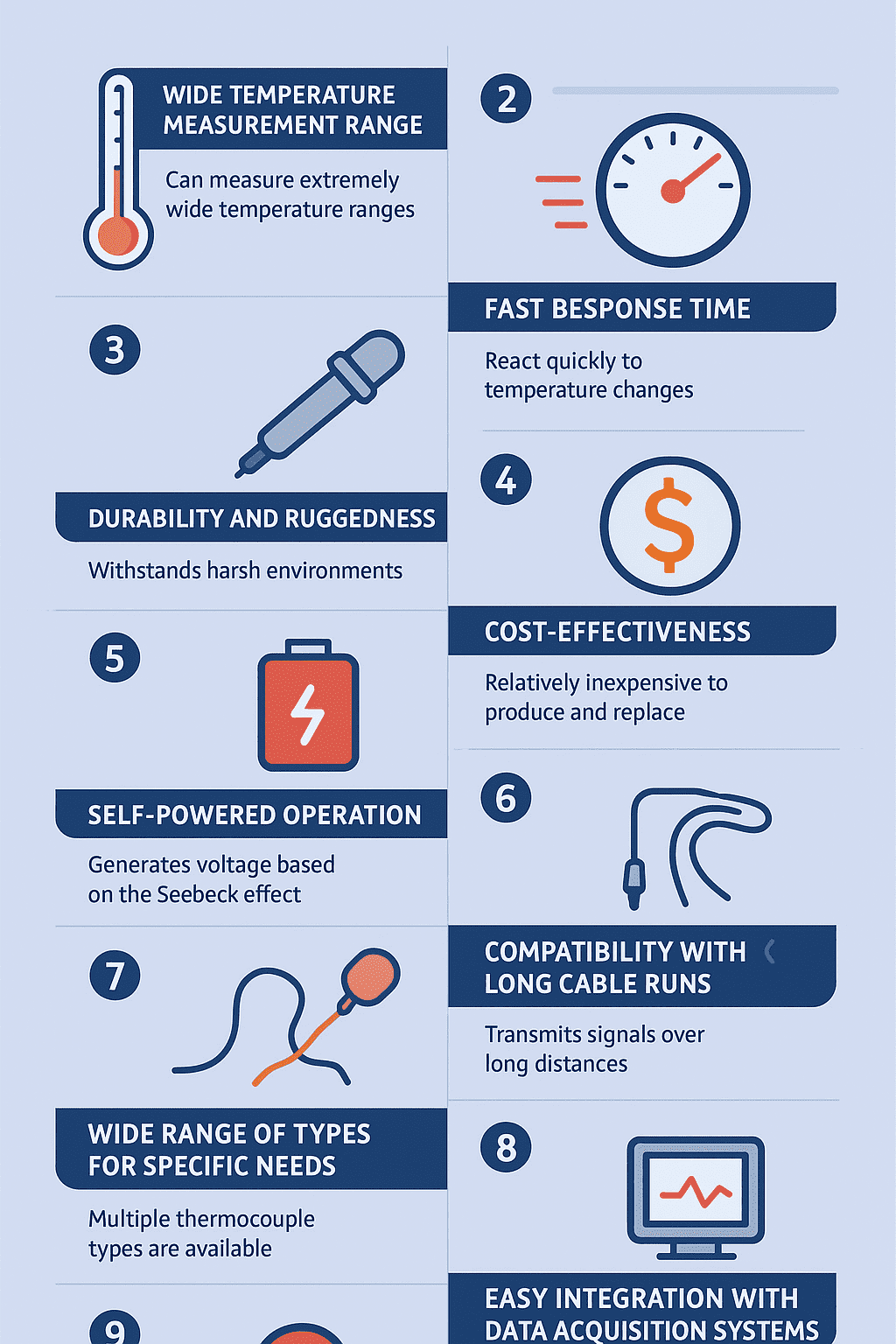
7. Advantages of Thermocouples: Compatibility with Long Cable Runs
Thermocouples can transmit signals over long distances without significant signal loss, making them suitable for large industrial plants. Using thermocouple extension cables or compensating cables ensures accurate readings even when the sensor is located far from the monitoring equipment.
8. Wide Range of Types for Specific Needs
There are multiple thermocouple types, each with unique performance characteristics:
- Type K: General-purpose, wide temperature range, affordable.
- Type T: Excellent for low-temperature measurements.
- Type J: Suitable for older equipment and moderate temperatures.
- Type R/S/B: Platinum-based, extremely high temperature applications.
This variety means thermocouples can be adapted to almost any temperature-sensing challenge.
9. Easy Integration with Data Acquisition Systems
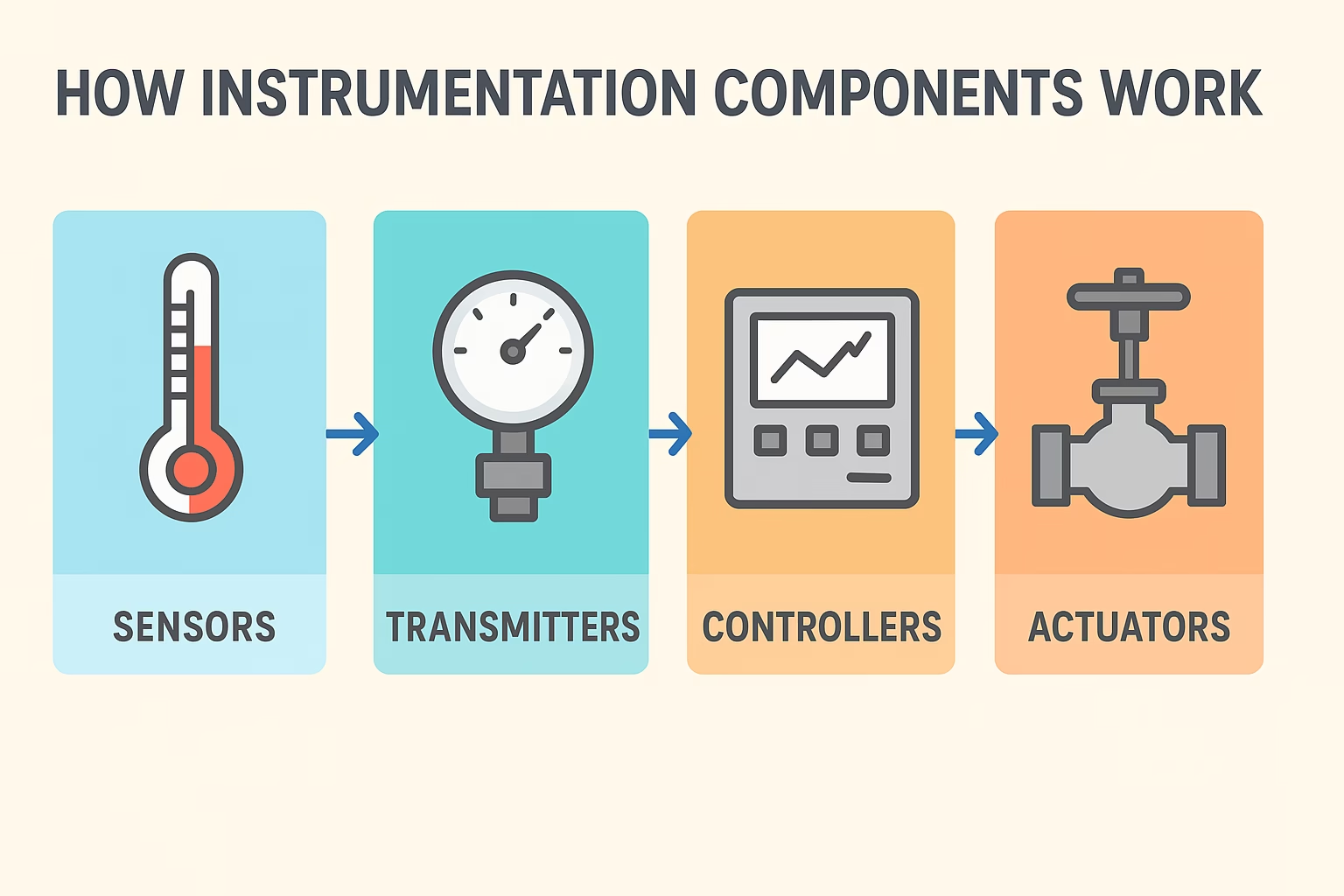
Modern thermocouples can easily interface with PLC systems, data loggers, and digital displays. With the help of signal conditioners or temperature transmitters, thermocouples can send real-time data for process automation, predictive maintenance, and quality control.
10. Advantages of Thermocouples: Proven Reliability Over Time
Thermocouples have been in use for more than a century and remain a trusted technology for temperature measurement. Their long track record in diverse applications is a testament to their reliability and consistent performance.
Conclusion
Thermocouples combine wide temperature capability, fast response, ruggedness, and cost-effectiveness into a single temperature measurement solution. Whether used in a research laboratory, a food processing plant, or a high-temperature furnace, their adaptability and proven performance make them an indispensable tool in industrial and scientific applications.
When selecting a thermocouple, consider the specific temperature range, environment, and required response time to ensure optimal performance. As industries continue to evolve toward greater automation and precision, thermocouples will remain a cornerstone of accurate temperature monitoring.