Light Emitting Diode (LED), have become one of the most important components in modern electronics and lighting technology. From small indicator lights on devices to large LED billboards, this compact and efficient light source has transformed how we illuminate spaces, display information, and even transmit data.
In this article, we will explore what LEDs are, how they work, their types, applications, advantages, and key considerations when using them.
1. What is a Light Emitting Diode (LED)?
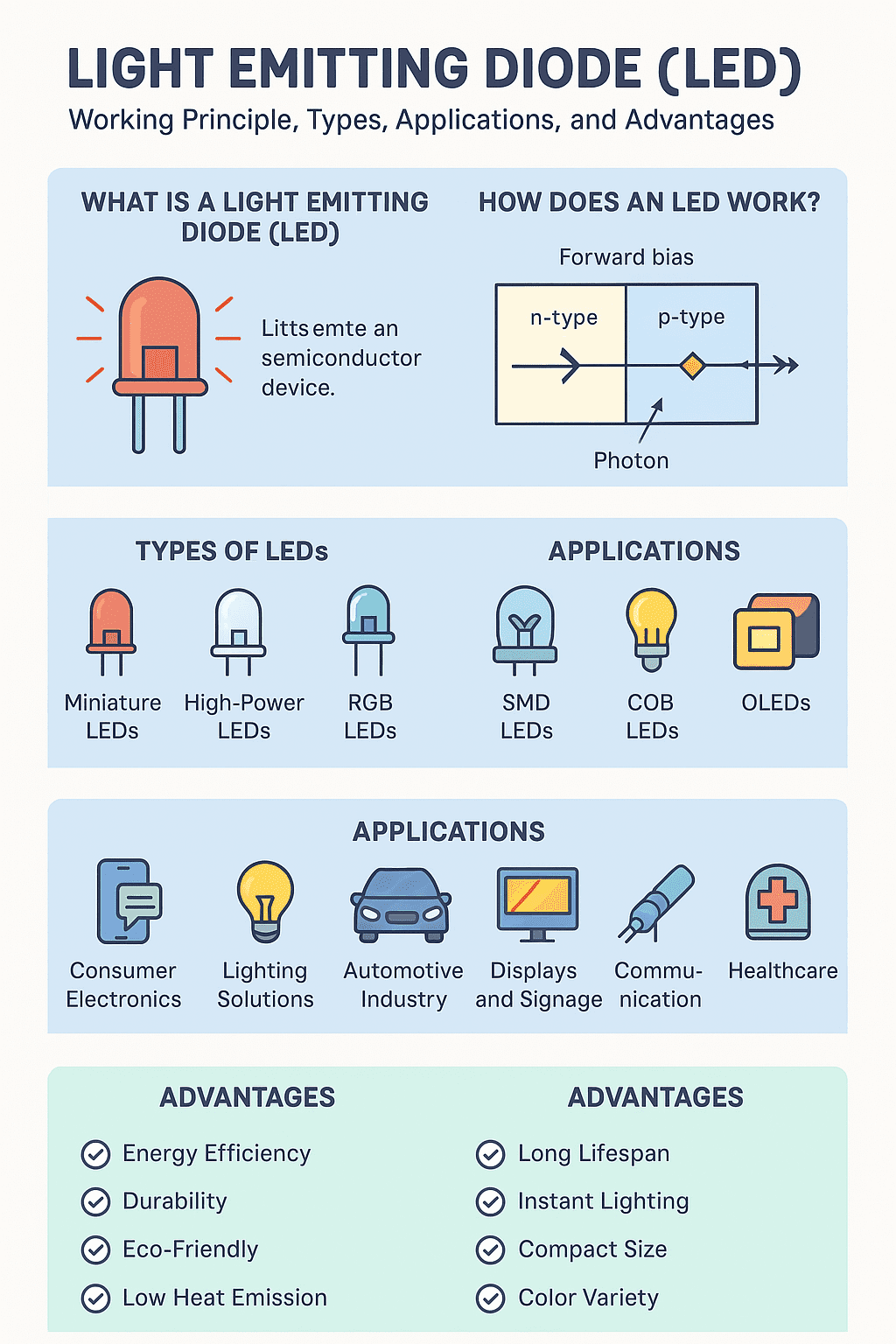
A Light Emitting Diode is a semiconductor device that emits light when an electric current passes through it. Unlike traditional incandescent bulbs that generate light by heating a filament, LEDs produce light through electroluminescence — a process where electrons recombine with holes in a semiconductor material, releasing energy in the form of photons.
LEDs are widely known for their energy efficiency, durability, and compact size. They can produce various colors without using filters, simply by changing the semiconductor material.
2. How Does an Light Emitting Diode (LED) Work?
The operation of an LED is based on p-n junction semiconductor technology.
Step-by-step working principle:
- Construction
- An LED consists of a p-type semiconductor (positive) and an n-type semiconductor (negative) joined together.
- The junction is designed with a specific material that determines the wavelength (color) of light emitted.
- Forward Bias
- When voltage is applied in the forward direction, electrons from the n-type region move toward the p-type region, while holes from the p-type move toward the n-type.
- Electron-Hole Recombination
- At the junction, electrons recombine with holes.
- This recombination releases energy in the form of photons (light).
- Color of Light
- The color depends on the bandgap energy of the semiconductor material.
- Common materials include Gallium Arsenide (GaAs), Gallium Phosphide (GaP), and Gallium Nitride (GaN).
3. Types of Light Emitting Diode (LED)
LEDs come in many forms, each designed for specific applications.
a. Miniature LEDs
- Used as indicator lights in devices.
- Sizes range from 2mm to 8mm.
- Available in various colors.
b. High-Power LEDs
- Produce intense light output.
- Used in headlights, street lights, and industrial lighting.
c. RGB LEDs
- Combine Red, Green, and Blue diodes in one package.
- Capable of producing millions of colors by adjusting brightness of each diode.
d. SMD LEDs (Surface-Mount Device)
- Small and compact for surface-mounted circuits.
- Common in LED strips and display panels.
e. COB LEDs (Chip on Board)
- Multiple LED chips mounted directly on a substrate.
- High brightness and uniform light distribution.
f. OLEDs (Organic LEDs)
- Made from organic semiconductor materials.
- Used in modern TV and smartphone displays.
g. Infrared LEDs
- Emit light in the infrared spectrum.
- Used in remote controls, night vision devices, and sensors.
4. Applications of Light Emitting Diode (LED)
LED technology has penetrated almost every industry.
a. Consumer Electronics
- Indicator lights on devices.
- Backlighting for LCD screens.
- Camera flashes.
b. Lighting Solutions
- Residential and commercial lighting.
- Street and roadway illumination.
- Decorative and architectural lighting.
c. Automotive Industry
- Headlights, brake lights, turn indicators.
- Dashboard illumination.
d. Displays and Signage
- LED billboards and advertising screens.
- Scoreboards and public information displays.
e. Communication
- Optical fiber data transmission using LED light sources.
f. Industrial Applications
- Machine vision systems.
- Status indicators on industrial equipment.
g. Healthcare
- Phototherapy devices.
- Surgical lighting.
5. Advantages of Light Emitting Diode (LED)
LEDs offer several benefits over traditional lighting technologies:
- Energy Efficiency – Consume up to 80% less energy than incandescent bulbs.
- Long Lifespan – Operate for 25,000 to 100,000 hours.
- Durability – Resistant to shock, vibration, and external impacts.
- Instant Lighting – No warm-up time; they reach full brightness immediately.
- Eco-Friendly – Contain no toxic materials like mercury.
- Compact Size – Suitable for miniaturized devices.
- Low Heat Emission – Most energy is converted into light, not heat.
- Color Variety – Produce multiple colors without filters.
6. Limitations of Light Emitting Diode (LED)
Despite their advantages, LEDs have some limitations:
- Higher Initial Cost – More expensive than traditional bulbs (though prices are dropping).
- Temperature Sensitivity – Excessive heat can reduce lifespan.
- Directional Light – May require diffusers for wider light spread.
7. How to Choose the Right Light Emitting Diode (LED)
When selecting an LED for a specific application, consider:
- Luminous Intensity (brightness).
- Color Temperature (warm or cool light).
- Beam Angle.
- Power Consumption.
- Durability and IP Rating for outdoor use.
8. Future of Light Emitting Diode (LED) Technology
LED technology is continuously evolving, with trends such as:
- Smart LEDs – Integrated with IoT for automated control.
- MicroLED Displays – Ultra-high resolution and brightness.
- Human-Centric Lighting – Adjusting color temperature to improve health and productivity.
The future points toward even greater efficiency, miniaturization, and integration into every aspect of our lives.
Conclusion
The Light Emitting Diode (LED) is more than just a light source—it’s a versatile, efficient, and eco-friendly technology shaping the future of illumination, display, and communication. As advancements continue, LEDs will likely become even more efficient, cost-effective, and widely adopted in applications we can’t yet imagine.