Thermocouples Type J ~ Thermocouples are widely used temperature measurement devices in industrial, laboratory, and engineering applications due to their robustness, wide temperature range, and cost-effectiveness. Among the various thermocouple types, Type J, made from Iron (Fe) and Constantan (Cu-Ni alloy), is one of the most reliable and cost-efficient options for low-to-medium temperature measurements.
This article will explore what a Type J thermocouple is, its operating principles, technical specifications, advantages, limitations, and common applications.
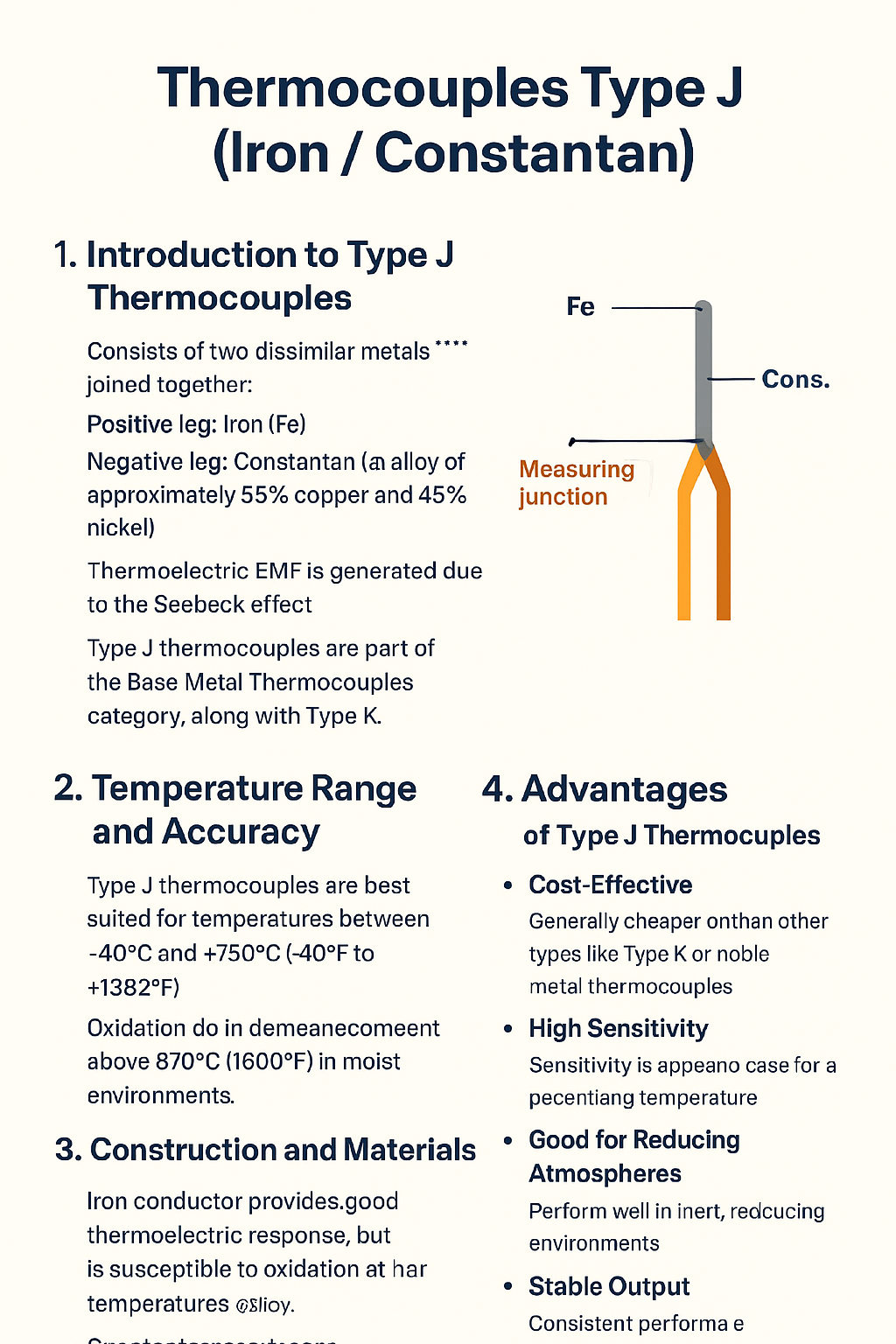
1. Introduction to Thermocouples Type J
A Type J thermocouple consists of two dissimilar metals joined together:
- Positive leg: Iron (Fe)
- Negative leg: Constantan (an alloy of approximately 55% copper and 45% nickel)
When these two metals are joined at one end (the measuring junction) and exposed to heat, a small voltage (thermoelectric EMF) is generated due to the Seebeck effect. This voltage can be measured and correlated to temperature.
Type J thermocouples are part of the Base Metal Thermocouples category, along with Type K, T, and E, but they have specific properties that make them better suited for certain environments.
2. Temperature Range and Accuracy
Type J thermocouples are best suited for temperatures between -40°C and +750°C (-40°F to +1382°F). While they can technically measure up to 870°C (1600°F), oxidation of the iron conductor becomes a significant concern at higher temperatures, especially in moist environments.
Typical accuracy:
- Standard limits of error: ±2.2°C or ±0.75% (whichever is greater)
- Special limits of error: ±1.1°C or ±0.4% (whichever is greater)
3. Construction and Materials
The composition of Type J thermocouples gives them a unique performance profile:
- Iron conductor – provides a good thermoelectric response but is susceptible to oxidation at high temperatures.
- Constantan conductor – stable alloy with low thermal conductivity, enhancing measurement precision.
Type J thermocouples are often constructed with protective sheaths made from stainless steel, Inconel, or other corrosion-resistant materials to improve lifespan.
4. Advantages of Thermocouples Type J
Type J thermocouples are popular for several reasons:
- Cost-Effective – They are generally cheaper than other thermocouple types like Type K or noble metal thermocouples.
- High Sensitivity – Type J has a sensitivity of approximately 55 µV/°C, making it very responsive to temperature changes.
- Good for Reducing Atmospheres – They perform well in inert or reducing environments where oxidation is minimal.
- Stable Output – Provides consistent performance for many applications.
- Simple to Integrate – Compatible with most industrial controllers and temperature measurement instruments.
5. Limitations of Type J Thermocouples
Despite their benefits, there are certain drawbacks:
- Oxidation Risk – The iron leg oxidizes rapidly in humid or high-temperature oxidizing environments.
- Limited Temperature Range – Not suitable for temperatures above 750°C in long-term use.
- Shorter Lifespan in Harsh Environments – Requires protective sheaths for prolonged operation.
6. Common Applications
Type J thermocouples are widely used in industries that require reliable and affordable temperature monitoring in the low-to-medium range:
- Plastics Processing – Extrusion and injection molding machines.
- Food Industry – Cooking, baking, and sterilization processes.
- HVAC Systems – Monitoring and controlling heating equipment.
- Scientific Laboratories – Temperature monitoring for experiments.
- Industrial Ovens and Furnaces – For operations below 750°C.
- Automotive Industry – Engine and exhaust temperature testing (within the specified range).
7. Thermocouples Type J vs. Other Thermocouples
| Feature | Type J (Fe/Constantan) | Type K (NiCr/NiAl) | Type T (Cu/Constantan) |
|---|---|---|---|
| Temperature Range | -40°C to 750°C | -200°C to 1260°C | -200°C to 370°C |
| Sensitivity | ~55 µV/°C | ~41 µV/°C | ~43 µV/°C |
| Cost | Low | Moderate | Low |
| Oxidation Resistance | Poor at high temp (iron oxidation) | Good | Good |
| Best For | Low-mid range industrial applications | General-purpose, high temp | Low temp, cryogenic applications |
8. Installation and Best Practices
To maximize the lifespan and performance of Type J thermocouples:
- Use Protective Sheaths – Especially in oxidizing or corrosive atmospheres.
- Avoid High-Humidity Environments – This prevents rapid oxidation of the iron conductor.
- Calibrate Regularly – To maintain accuracy.
- Match with Correct Instruments – Use thermocouple-compatible controllers with proper cold junction compensation.
9. Calibration and Maintenance
Like all thermocouples, Type J sensors drift over time, meaning periodic calibration is necessary. Factors such as mechanical stress, temperature cycling, and environmental conditions can affect accuracy.
Recommended calibration intervals:
- Industrial applications: every 3–6 months
- Critical laboratory use: every 1–3 months
10. Summary
Type J thermocouples remain one of the most cost-effective and reliable temperature measurement solutions for low-to-medium temperature industrial and laboratory applications. Their high sensitivity, stable output, and low cost make them an excellent choice—provided they are used in environments that minimize oxidation.
By understanding their strengths and limitations, engineers and technicians can ensure optimal performance and extended service life from their Type J thermocouples.
✅ Key Takeaways
- Metals Used: Iron (Fe) and Constantan (Cu-Ni)
- Best Range: -40°C to 750°C
- Advantages: Cost-effective, high sensitivity, stable performance
- Limitations: Susceptible to oxidation, limited high-temp use
- Applications: Plastics processing, ovens, HVAC, food processing, automotive